


WRITTEN OUT OF HISTORY, Part II: Here’s how Wikipedia aids sloppy journalism promoting Murray Warmath at expense of Duffy Daugherty and true 1960s pioneers
PHOTO: Big Ten coaches Duffy Daugherty (left) and Murray Warmath share this photo, but when it comes to the media explaining college football integration leadership. Daugherty (1954-72) is a paragon. Warmath (1954-71) led from behind.
Buy me a coffee to support my research to tell untold college football integration untold stories.
Thomas Shanahan | @Thomas-Shanahan-23
Watch our documentary development trailer: Game Changers
***
“Who controls the past controls the future. Who controls the present controls the past.”
— George Orwell, “Nineteen Eight-Four,” Chapter 3.
By TOM SHANAHAN
Prophecies taken from George Orwell classic book “Nineteen Eighty-Four” can be applied to many genres — yes, even rewriting college football lore.
Revisionist history, Orwell could have forewarned, can take Alabama coach Bear Bryant’s segregationist past and reshape him in the present and future as Rosa Parks.
Bryant coached segregated teams at four schools for 25 years, 1945 to 1969, but a fawning myth of Bryant made up two decades after the 1970 USC-Alabama game was played somehow captured the narrative in the 1990s. Lost to history is the reality Bryant was the seventh of 10 Southeastern Conference coaches to recruit his first Black player in 1970. By then, 33 of 37 major southern programs were integrated.
With few exceptions, the media accepts the unvetted myths. One departure is Pulitzer Prize winner David Halberstam, who wrote in a 2002 ESPN article that Bryant was a late arrival joining his peers on desegregation: “But the Bear was very late to the dance, especially because people are always talking about football coaches as leader. In this case, he did not lead very well.”
But as Orwell could have predicted if he was a college football fan, Halberstam was ignored and Bryant myths regurgitated.
If the deep state’s revisionist history has you rooted in hailing Bryant’s legend, stop reading here. You’re a lost cause — like the “The Lost Cause” southern historians in the 1920s successfully pushed a rewrite of the Civil War. They claimed the Civil War was about States Rights, not slavery. They said Confederate Gen. Robert E. Lee, a traitor, was a gallant hero and Union Gen. Ulysses S. Grant a butcher and a drunk. People still believe their rewrites a century later.
Similarly, Minnesota coach Murray Warmath’s status-quo record of following college football’s unwritten quota of limiting Black players to a half-dozen or so was rewritten to make him appear as if he was a true leader like, well, Michigan State coach Duffy Daughetery. Continue reading if you want to learn Daugherty’s story was written out of history.
The remainder of this piece, focused on Warmath, is Part II of my recent post: “WRITTEN OUT OF HISTORY: Here’s how Wikipedia aids sloppy journalism promoting 1970 Bear Bryant fairytales at the expense of Duffy and true 1960s pioneers.”
Although it’s true the 1960s Gophers featured Sandy Stephens as the first Black quarterback to win a national title and Bobby Bell was a sophomore recruited from the segregated South, they were two of only five Black players on the roster.
Warmath was no different than USC coach John McKay, whose 1962 national team numbered only five Black players and the Trojans’ 1967 national championship roster with seven despite leading a program located in populous and diverse Los Angeles. Yet McKay rides the coattails of the 1970 Bryant fairytales to undeserved credit.
Now, let me make this clear: I use Wikipedia as a source of information. Its consistent format makes it easy to find biographical information on a player’s paths from their early days to college or the pros. The same is true about players turned coaches. You don’t have to sift through the bio of a team page that may not contain such earlier information.
Having said that, though, you need to be careful with facts found in Wikipedia stories. I’m still waiting for ESPN to correct a 2013 story claiming Bryant and Clemson coach Frank Howard sent Daugherty his southern Black stars to escape segregation. Adam Rittenberg, who wrote that ESPN story and still writes for ESPN, has never responded to me. Same with NBC producers when I noted they told Duffy Daugherty’s superficial story on its broadcast the Michigan State-Notre Dame’s 60th anniversary of the 1966 Game of the Century.
Here’s what can go wrong when website editors and TV producers rely on archived stories about college football integration in the 1960s:
NBC Sports dropped the ball with its coverage of Michigan State playing Notre Dame on September 19 to honor the 60th anniversary of the 1966 Game of the Century. The NBC producers provided announcers Noah Eagle and Todd Blackledge with erroneous information.
— Tom Shanahan
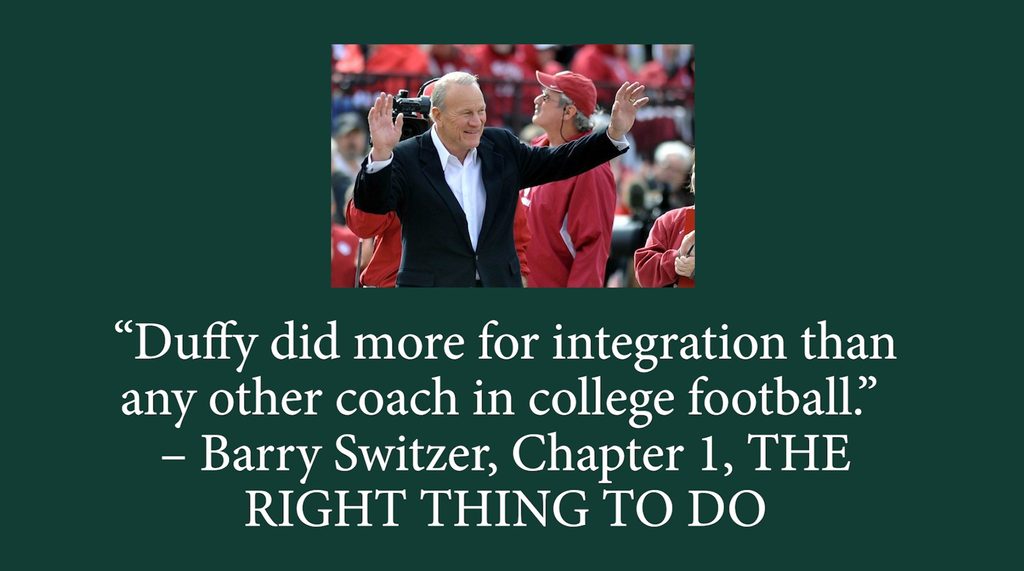
Another national champion roster example was Notre Dame in 1966 with only one Black player, Alan Page. That same season, though, Notre Dame faced an extreme contrast in the Game of the Century that was overlooked by the media. Daugherty, who was the first coach to ignore quota limits, lined up 20 Black players. The teams played to a 10-10 with identical 9-0-1 records and the National Football Foundation named them national co-champions.
But with the media avoiding race — until it was no longer unavoidable following Black athlete protests surrounding the 1968 Mexico City Olympics — ABC announcer Chris Schenkel and Sports Illustrated magazine’s Dan Jenkins didn’t mentioned Daugherty and the Spartans stood alone. Schenkel said MSU All-American Bubba Smith was from Beaumont, Texas, without mentioning Smith and other Spartans escaped segregation. Jenkins identified Jimmy Raye, the South’s first Black quarterback who won a national title on the Spartans’ 1965 and 1966 teams, simply as having a mustache.
A PARAGON WITHOUT CREDIT
Who to blame for Daugherty shoved into the shadows of Bryant and Warmath?
Start with the 1960s sports media failing to report milestones Daugherty’s 1960s rosters established. Add media negligence to credit denied individual Black players facing down Jim Crow and the Ku Klux Klan desegregating southern programs throughout the decade.
They include Maryland’s Darryl Hill (1963), Wake Forest’s Bob Grant and Butch Henry (1964), Houston’s Warren McVea (1964), Southern Methodist’s Jerry LeVias (1965), Kentucky’s Nate Northington and Greg Page (1966), Tennessee’s Lester McClain (1967) and Auburn, Alabama’s in-state rival, among others in 1969 with James Owens. Stories about the ground-breaking pioneers might appear in a local newspaper, but their courage wasn’t part of the national narrative.
Continue with sloppy modern sports journalism’s complicity backfilling lost history with canards. Media irresponsibility accepted unvetted myths in the Internet age that helped propel such false narratives deeper into college football lore. Stories from ESPN, The Athletic, Sports Illustrated, The Atlantic and other outlets hover in the Internet ether and end up on Wikipedia pages.
Unsuspecting media members – many of them prominent – regurgitate the errors until they’re entrenched and overlooked. Producers at HBO, Showtime and ESPN turn the Bryant fairytales into films to provide additional roots.
Warmath’s Wikipedia page misleadingly states, “Warmath became known as a catalyst for social change, as he was one of the first major college coaches to take multiple black athletes in a single recruiting class.”
This conclusion is inaccurate or misleading at best.
In 1962, The Associated Press reported MSU’s 17 Black players were the most in major college football history. However, the rare intrepid 1960s reporting on race failed to note the Spartans broke their own records each year.
In 1964, Michigan State was the first fully integrated team to play in the South in a game against North Carolina at segregated Chapel Hill. But the media didn’t report the milestone, even though the journey included the Holiday Inn West in Durham defying Jim Crow by housing and feeding the Spartans.
In the 1966 Game of the Century, Michigan State’s 20 Black players featured 11 Black starters, two Black team captains, College Football Hall of Famers George Webster and Clinton Jones, and the South’s first Black quarterback to win a national title, Jimmy Raye of segregated Fayetteville, N.C.
This is prime information to be told on Daugherty’s Wikipedia page to be picked up by print, radio and TV, but Duffy’s Wikipedia page fails to credit his game-changing leadership.
Coincidentally, Daugherty and Warmath recruited their first Black player from the segregated South in 1959. That’s a good starting point to explain Warmath’s Underground Railroad was minor and by accident, while Daugherty’s Underground Railroad was major and organic.
MURRAY WARMATH AND BOBBY BELL
Warmath’s southern Black players amounted to a handful after he learned about Bobby Bell through a friend, North Carolina coach Jim Tatum. Bell was an unknown from playing eight-man football in Shelby, N.C., but Tatum saw Bell play in the 1958 Negro Shrine All-Star Game. When he recommended Warmath take him, Warmath initially resisted. He didn’t relent until Tatum told him he would pay for Bell’s scholarship if he didn’t pan out.
I learned this from Bell in an interview recapped on Page 206 of THE RIGHT THING TO DO, The True Pioneers of College Football Integration in the 1960s.” You can’t find a better source than the horse’s mouth.
After Bell played on Minnesota’s 1959 freshman team (prior to the NCAA permitting varsity eligibility in 1972), Warmath asked Bell if he had any friends who could play Big Ten football. Bell told him about Carl Eller in Winston-Salem, N.C. Eller agreed to come to Minnesota but only if Warmath also took his high school teammate, halfback Jay Sharpe.
Bell played for the Gophers’ varsity in 1960-62 and Eller 1961-63. They both emerged as a College Football Hall Famer and a Pro Football Hall of Famer.
Later, Warmath recruited Aaron Brown (1964-65) out of Port Arthur, Texas. His recruitment isn’t detailed in archived stories, but in those days, it wasn’t unusual for an alumnus living in the South to contact his school about a prospect.
That’s how Garland Boyette, who played nine NFL seasons, explained he began his career at Northwestern, in 1958. Boyette worked a part-time job for a Northwestern alum who owned a hotel in Orange, Texas. Boyette explained to me in “THE RIGHT THING TO DO” southern Black high school kids knew there were only about five spots available on a northern roster and hoped they could get one.
Boyette was thrilled with his opportunity to escape segregation to Big Ten school near Chicago, but he admitted he soon felt isolated on the campus. He returned to the South to play for HBCU’s Grambling and its legendary coach, Eddie Robinson.
Other isolated examples of an alumni connection include Illinois recruiting Bobby Mitchell (1954-57) out of Hot Springs, Arkansas, and Missouri finding Johnny Roland (1962, 1964-65) in Corpus Christi, Texas.
Missouri’s program, led by Duffy Daugherty Disciple Dan Devine, desegregated in 1958. That was 12 years ahead of Bryant, but you won’t find a reference on Devine’s leadership posted on a Wikipedia page.
DUFFY DAUGHERTY AND CLIFTON ROAF
Daugherty didn’t recruit the South. The South recruited Daugherty. Southern Black high school coaches during segregation steered their players to Michigan State. They trusted Daugherty after watching the Spartans win the 1954 and 1956 Rose Bowls behind the play of Black stars.
Daugherty’s first Underground Railroad passenger in 1959 was Clifton Roaf of Pine Bluff, Arkansas. Roaf was a star and the valedictorian for the city’s Black high school, Merrill. At the time, MSU School of Education professor Raymond Hatch studied the segregated Pine Bluff schools. Roaf’s principal, M.D Jordan, and football coach, Ervin Phillips, knew Hatch and asked him to reach out to Daugherty.
Roaf tells the story in Chapter 11 of “RAYE OF LIGHT, Jimmy Raye, Duffy Daugherty, the Integration of College Football and the 1965-66 Michigan State Spartans.” You can’t get a better source than the horse’s mouth.
Although Roaf suffered a knee injury during 1960 spring football and never played on the varsity, he said he remained indebted to Michigan State. Daugherty kept him on scholarship. Roaf graduated and returned to Pine Bluff for a career as a dentist.
His Michigan State bride, Andree Layton Roaf, was the first Black woman named to the Arkansas State Supreme Court. Two of their daughters earned Ph.D degrees. Their son Willie Roaf is a College and Pro Football Hall of Famer. Daugherty’s commitment to Roaf through the injury and graduation speaks to the coach’s character beyond the football field.
The contact trend continued in 1960 with Sherman Lewis, who played at Dupont Manuel High in Louisville. A Louisville coach was friends with athletic director Biggie Munn. The floodgates opened in 1963 when Bubba Smith’s father, a legendary coach in Texas during segregation, called Daugherty about his son Bubba and Gene Washington, who played at a rival school. In Anderson, S.C., George Webster’s coach contacted the Daugherty.
PRE-COACHING INFLUENCE
Another timeline to measure is comparing the pre-coaching backgrounds shaping Warmath and Daugherty.
Warmath was born in 1912 in segregated Tennessee and played at the University of Tennessee, 1932-34. The Volunteers remained segregated another 33 years.
Warmath worked his way up the coaching ladder as an assistant at Tennessee (1935-38), Mississippi State (1939-42) and returned to Tennessee (1945-48). Jim Crow America was all Warmath knew until he experienced life above the Mason-Dixon Line as an assistant at Army West Point (1949-52), But West Point’s first Black football letterman wasn’t until Gary Steele in 1966.
Daugherty’s open mind and meritocracy can be traced to his Syracuse playing days, 1937-39.
One of Daugherty’s teammates was Wilmeth Sidat-Singh, an African American quarterback. In 1937, when Syracuse played at Maryland, Daugherty witnessed Syracuse cave to the Gentleman’s Agreement that required northern schools to bench their Black players in the Jim Crow South.
Another 1937 teammate was halfback Marty Glickman, a world-class sprinter who was scheduled to run for the U.S. 400-meter relay team in the 1936 Olympics, the Berlin Games shrouded by German dictator Adolf Hitler’s antisemitism. At the last minute, U.S. officials pulled Glickman from the race.
In a book about Sidat-Singh’s life, “INVISIBLE NO MORE,” authors Scott Pitoniak and Rick Burton contend Daugherty was influenced by discrimination inflicted upon two teammates.
As a coach, Daugherty was a 1946 assistant on the staff of Syracuse head coach Biggie Munn. When Munn took the Michigan State job in 1947 and brought Daugherty with him, the Spartans numbered only two Black players. Those numbers grew as Munn and Daugherty tapped into Midwest-based talent. The Underground Railroad players were added in the 1960s.
What a trio of American legends: Sidat-Singh went on to serve as a Tuskegee Airman until his 1943 death in a World War II training accident; Glickman was a famed national sports broadcasting career based in New York; and Daugherty changed the face of the game as a College Football Hall of Fame coach.
But Daugherty’s leadership is buried an avalanche of unvetted Bryant and Warmath tales.
STAIGHTENING OUT HISTORY
Although Michigan State opened the Duffy Daugherty Football Building in 1981, its walls don’t tell his deeper story. For a half-century, Michigan State squandered Daugherty’s legacy. MSU players and students cycled through the Banks on the Red Cedar without understanding Daugherty stands alone.
Now, there are plans to honor Duffy with a sculpture in the 2027 football season. Unlike past MSU administrators and coaches who are gone, Michigan State President Kevin Guskiewicz (hired in 2024), athletic director Dan Bartholomae (hired in 2026) and football coach Pat Fitzgerald (coaching his first season in 2026) are committed to learning Duffy’s deeper story.
But if Michigan State continues to describe Daugherty as “one of the coaches” leading the way, the visiting media and TV announcers on gameday will describe him that way. They won’t know where to start to tell Duffy’s deeper story.
Americans, as historian and honored documentarian Ken Burns says, prefer their stories tied up in a nice little bow. Duffy’s story needs a longer ribbon and a couple of knots to finish the bow.
That explains how simple Bryant/Warmath canards control the past, present and future and Daugherty was written out of history.
-30-
I invite you to follow me on Twitter @shanny4055
NOTE: All facts cited in this story were researched by me as part of writing “RAYE OF LIGHT, Jimmy Raye, Duffy Daugherty, the Integration of College Football and the 1965-66 Michigan State Spartans” and “The RIGHT THING TO DO, The True Pioneers of College Football Integration in the 1960s.”
I’ll put my facts on the true pioneers of college football integration versus Bear Bryant fairytales against anybody, anytime, anywhere. Watch here.
Click here for my first-place FWAA story on the 1962 Rose Bowl, Segregation and Alabama.
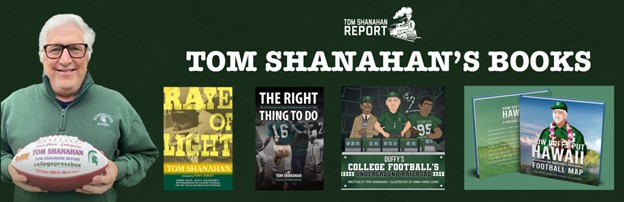
— Tom Shanahan is an award-winning sportswriter with two books on college football integration, “RAYE OF LIGHT, Jimmy Raye, Duffy Daugherty, the Integration of College Football and the 1965-66 Michigan State Spartans,” and “THE RIGHT THING TO DO, The True Pioneers of College Football Integration in the 1960s.” They are the most accurate accounts of college football integration in the 1950s and 1960s. They also debunk myths about the 1970 USC-Alabama game. The false narrative co-opted the stories of the true pioneers who stood up to Jim Crow and the KKK.
— Two children’s books also explain Michigan State College Football Hall of Fame coach Duffy Daugherty’s impact on integration through the Underground Railroad and the Hawaiian Pipeline: “DUFFY’S COLLEGE FOOTBALL UNDERGROUND RAILROAD” and “HOW DUFFY PUT HAWAII ON AMERICA’S FOOTBALL MAP.”
***
PURCHASE LINKS, non-fiction books
— RAYE OF LIGHT, August Publications or on Amazon.
— THE RIGHT THING TO DO, August Publications or on Amazon.
PURCHASE LINKS, children’s books
— DUFFY’S COLLEGE FOOTBALL UNDERGROUND RAILROAD, Order from Barnes and Noble here and Amazon here.
— HOW DUFFY PUT HAWAII ON AMERICA’S FOOTBALL MAP, coming soon on Barnes and Noble and Amazon.

