


Surprise! Sports Illustrated writes Duffy back into history (well, somewhat)
PHOTO: Duffy Daugherty acknowledges to crowd at Spartan Stadium upon announcing his retirement at the end of the 1972 season.
***
Buy me a coffee to support my research to tell untold college football integration untold stories.
Thomas Shanahan | @Thomas-Shanahan-23
Watch our documentary development trailer: Game Changers
***
By TOM SHANAHAN
Thank you, Tim Capurso.
I never thought I’d see a story from a Sports Illustrated writer who understood Michigan State coach Duffy Daugherty led college football integration. Capurso is that writer.
He was one of three writers contributing to an SI article naming college football’s 25 all-time ranked teams. MSU’s 1966 team was No. 20 with the segment credited to “—TC” as the author among writers who compiled the overall list.
The key here is Capurso didn’t say “Duffy was one of the coaches …” That’s where national outlets get it wrong. Duffy stands alone as the first coach to assemble fully integrated rosters in the 1960s. I can now drop Sports Illustrated from misguided national outlets ESPN, The Athletic, The Atlantic, the Sporting News et al failing to understand Daughety’s deeper story.
Sports Illustrated posted the story August 28, but I didn’t see it until the Detroit News wrote about the No. 20 ranking in its October 20 edition. One Michigan team makes SI’s all-time top 25. It’s not the Wolverines. The Detroit News also got Duffy’s story correct in this September 17 article: Story of Duffy Daugherty’s MSU teams can’t be lost, historian says
Here’s what was written in SI:
The 1960s Michigan State teams were not only dominant on the field, they were far ahead of their time off it during a contentious period of racial injustice and civil unrest, in which college football was broadly complicit. Rosters were segregated for much of the 20th century—the SEC didn’t integrate until 1966—until certain programs began to break down those barriers.
The ’66 Spartans, and MSU’s national title-winning team the year before, were trailblazers in this regard. Coach Duffy Daugherty opened doors that were shut for Black high school athletes, and coaches, in the South. Michigan State featured 17 African-American players, 10 of them from the South, in ’66, making it one of the most integrated teams of the era. It’s not only one of the most impactful recruiting runs in the sport’s history, but also one of the best.
Michigan State was a force to be reckoned with in 1966, as the program rolled to a 9-0-1 record, outscoring teams by nearly 20 points per game. The Spartans thumped No. 9 Purdue 41–20 and swept their Big Ten conference schedule. The Michigan State defense, led by future College Football Hall of Famers Bubba Smith and George Webster, was immovable against the run and surrendered just 9.9 points per game
All-American halfback Clinton Jones, who ran for 784 yards and scored six touchdowns on the ground while finishing sixth in the Heisman Trophy vote, was the engine of one of the best offenses in the country along with wide receiver Gene Washington, another future College Football Hall of Famer.
The second-ranked Spartans tied No. 1 Notre Dame in one of the most famous games in the sport’s history, resulting in the Fighting Irish finishing first in the final AP and UPI polls, and the Spartans recognized as the nation’s top team by the National Football Foundation, among others. The debate has raged for years as to which was the top team that season. But there’s no debating one thing:
Michigan State forever changed the sport for the bett4er. – T.C.
The conclusion to rank the 1966 Spartans was Daugherty’s roster changed the face of the game’s future. That’s a point that the national media has missed for 60 years.
Another point to make is the curious decision not to rank both Notre Dame and Michigan State from the 1966 Game of the Century. On the field that day were 10 first-round draft picks, 42 overall draft picks, 33 pro players, 25 All-Americans and nine future College Football Hall of Famers. Notre Dame’s Terry Hanratty and Jimmy Raye comment here on The Sporting News poll failing to rank either team: PART V: Game of Century QBs Terry Hanratty and Jimmy Raye on college football seminal moment 60 years ago – Tom Shanahan Report
Overall, though, the six paragraphs are refreshing. Having said that (to quote Larry David and Jerry Seinfield), there are two problems to address:
— 1) a sentence in second paragraph is inaccurate: Michigan State featured 17 African-American players, 10 of them from the South, in ’66, making it one of the most integrated teams of the era.
The numbers of 17 and 10 and the characterization “one of the most integrated teams” are both wrong.
First correction: The correct numbers are 20 Black players with 12 of them Underground Railroad passengers escaping the segregated South. I came up with these accurate numbers from research to write “RAYE OF LIGHT, Jimmy Raye, Duffy Daugherty, the Integration of College Football and the 1965-66 Michigan State Spartans.” The book was published in 2014, and the facts have been mentioned many times on my website, TomShanahan.Report. The facts are expanded in my 2024 book, “THE RIGHT THING TO DO, The True Pioneers of College Football Integration in the 1960s.” No one else has done this research. A 2015 book, DUFFY DAUGHERTY, plagiarized some of my research.
DUFFY’S UNDERGROUND RAILROAD, 1966 season
— Varsity (12): 1963 class, Bubba Smith, Beaumont, Texas; Gene Washington, La Porte, Texas; George Webster, Anderson, S.C.; Jim Summers, Orangeburg, S.C., Charlie Thornhill, Roanoke, Virginia; Ernie Pasteur, N.C.; Eric Marshall, Oxford, Mississippi; 1964 class, Jimmy Raye, Fayetteville, N.C.; Jess Phillips, Beaumont, Texas; Marice Haynes, Baton Rouge, Louisiana; 1965 class, Clinton Harris, Beaumont, Texas; William Ware, Beaumont, Texas.
— Freshmen (6): 1966 class, Frank Forman, Louisville, Kentucky; Ken Hines, Stroud, Oklahoma; and Jack Pitts, Decateur, Georgia; Tody Smith, Beaumont, Texas; Kermit Smith, Baytown, Texas; Frank Traylor, Beaumont, Texas. Note: The six freshmen were not on the varsity. The NCAA didn’t permit freshmen eligibility until 1972.
Duffy’ 44 Underground Railroad passengers are told in RAYE OF LIGHT, THE RIGHT THING TO DO and on the back cover of my children’s book, DUFFY’S COLLEGE FOOTBALL UNDERGROUND RAILROAD.

Second correction: Daugherty’s roster stood alone at a time the rest of college football outside the Mason-Dixon Line followed an unwritten quota limiting Black athletes to a half-dozen. In those days, coaches feared fights in the locker room and White players wouldn’t follow the leadership of Black players. Daugherty ignored those racial tropes.
Minnesota’s 1960 national title team numbered only five Black players, USC’s 1962 national championship roster only five and the Trojans’ 1967 national title team seven. Minnesota coach Murray Warmath and USC coach John McKay don’t belong in the same neighborhood as Daugherty.
In McKay’s 1974 book, “McKay: A Coaches’ Story,” he admitted members of the African American community in Los Angeles complained he didn’t recruit enough Black players. McKay disingenuously replied USC was no different than any other school. He knew that wasn’t true from playing Michigan State in 1963 in Los Angeles Memorial Coliseum and again in 1967 at Spartan Stadium.
In the 1966 Game of the Century matching Notre Dame at Michigan State, the Spartans lined up 20 Black players, 11 Black starters, two Black team captains, College Football Hall of Famers George Webster and Clinton Jones and the South’s first Black quarterback to win a national title, Jimmy Raye of segregated Fayetteville, N.C. Notre Dame lined up one Black player, Alan Page.

PHOTO: Duffy Daugherty with is two 1966 team captains — Clinton Jones (L) and George Webster.
When a school only takes a half-dozen or so Black players, it limited Black prospects to elite recruits considered 4-stars in today’s vernacular. Duffy took chances on Black and White kids alike that today would be ranked 3-stars or 2-stars. For example, Jimmy Raye was an undersized quarterback when he signed with the Spartans.
You won’t read any of that in ESPN, The Athletic, The Atlantic – and in this case, Sports Illustrated. And, unfortunately, the producers at NBC failed to pick up on the SI story when it aired the Michigan State at Notre Dame game on September 19 in a game honoring the 60th anniversary of the Game of the Century. Read about it here: NBC’s broadcast missed deeper story of Duffy Daugherty’s legacy and 60th anniversary of 1966 Game of the Century – Tom Shanahan Report
In the 1960s, the sports media avoided race in stories. Daugherty’s many 1960s milestones that stood him apart from his peers are largely lost to history.
What do I mean by avoiding race? Consider how the 1966 Game of the Century matching Notre Dame at Michigan State that was played before a record TV audience of 33 million was covered nationally.
ABC’s play-by-play man Chris Schenkel noted Bubba Smith was from Beaumont, Texas. He didn’t say Smith escaped segregation to play for the Spartans. There was nothing about the Spartans fully integrated roster and Underground Railroad recruits. He didn’t say Bubba’s father, Willie Ray Smith Sr., a legendary coach in Texas during segregation, steered the Texans on Daugherty’s roster to Michigan State.
In Sports Illustrated, Dan Jenkins, the godfather of sportswriters, described Jimmy Raye as having a thin mustache. Uh, Raye was the only major college Black quarterback in the nation!
In the years since the 1960s came to an end with a void on Duffy’s milestones, many speculative stories appeared that can be found floating around Internet ether. I don’t know where Capurso came up with 17 and 10 numbers, but it seems he fell victim to the same mistakes writers have been making for decades of relying on unsubstantiated conclusions.

GRAPHIC: I can’t get better endorsement for than one form legendary Sports Illustrated writer Gary Smith.
Nevertheless, Capurso crediting Daugherty for leading college football integration is leap apart from an egregious error in a 2006 Sports Illustrated article.
Click on this link and scroll down to “Part II: The Sports Illustrated Fabrication.” Bear Bryant never sent Duffy Daugherty a player. So, why do so many smart people believe the myth? – Tom Shanahan Report
In 2027, Michigan State is planning to unveil a statue of Duffy and his five two-time All-American players, Clinton Jones, Bob Apisa, Bubba Smith, Gene Washington and George Webster.
Spartan Nation needs to hope this helps the national media understand Daugherty’s 1960s teams led college football integration. Prominent writers are lost in the fog of speculative stories that wrote Daugherty of history.
-30-
I invite you to follow me on Twitter @shanny4055
NOTE: All facts cited in this story were researched by me as part of writing “RAYE OF LIGHT, Jimmy Raye, Duffy Daugherty, the Integration of College Football and the 1965-66 Michigan State Spartans” and “The RIGHT THING TO DO, The True Pioneers of College Football Integration in the 1960s.”
I’ll put my facts on the true pioneers of college football integration versus Bear Bryant fairytales against anybody, anytime, anywhere. Watch here.
Click here for my first-place FWAA story on the 1962 Rose Bowl, Segregation and Alabama.
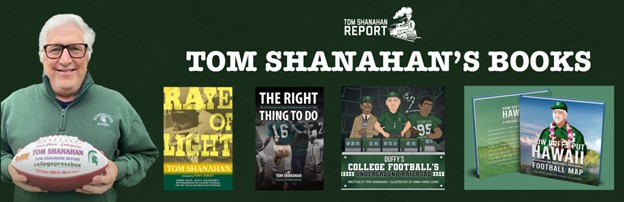
— Tom Shanahan is an award-winning sportswriter with two books on college football integration, “RAYE OF LIGHT, Jimmy Raye, Duffy Daugherty, the Integration of College Football and the 1965-66 Michigan State Spartans,” and “THE RIGHT THING TO DO, The True Pioneers of College Football Integration in the 1960s.” They are the most accurate accounts of college football integration in the 1950s and 1960s. They also debunk myths about the 1970 USC-Alabama game. The false narrative co-opted the stories of the true pioneers who stood up to Jim Crow and the KKK.
— Two children’s books also explain Michigan State College Football Hall of Fame coach Duffy Daugherty’s impact on integration through the Underground Railroad and the Hawaiian Pipeline: “DUFFY’S COLLEGE FOOTBALL UNDERGROUND RAILROAD” and “HOW DUFFY PUT HAWAII ON AMERICA’S FOOTBALL MAP.”
***
PURCHASE LINKS, non-fiction books
— RAYE OF LIGHT, August Publications or on Amazon.
— THE RIGHT THING TO DO, August Publications or on Amazon.
PURCHASE LINKS, children’s books
— DUFFY’S COLLEGE FOOTBALL UNDERGROUND RAILROAD, Order from Barnes and Noble here and Amazon here.
— HOW DUFFY PUT HAWAII ON AMERICA’S FOOTBALL MAP, coming soon on Barnes and Noble and Amazon.

