


NBC’s broadcast missed deeper story of Duffy Daugherty’s legacy and 60th anniversary of 1966 Game of the Century
PHOTO: Michigan State’s Duffy Daugherty and Ara Parseghian celebrate their 1966 national co-championship named by the National Football Foundation. NBC’s broadcast, among other omissions at the expense of Daugherty’s legacy, erroneously reported it was the Football Writers Association of America that split the title. Daugherty and Parseghian huddled around the MacArthur Bowl, symbolic of the NFF title, on December 6, 1966, at the NFF annual banquet.
Buy me a coffee to support my research to tell untold college football integration untold stories.
Thomas Shanahan | @Thomas-Shanahan-23
Order link:
Raye of Light: Jimmy Raye, The Integration of College Football 3rd Ed – August Publications
***
“History writes people out of the story. It’s our job to write them back in.”
— Pulitzer Prize winner David Maraniss
“How can we know who we are and where we are going if we don’t know anything about where we have come from and what we have been through, the courage shown, the costs paid, to be where we are?
— Pulitzer Prize winner David McCullough
By TOM SHANAHAN
Michigan State wisely announced on Tuesday plans to unveil a sculpture of Duffy Daugherty next year at Spartan Stadium. Good timing, with MSU and Notre Dame honoring the 60th anniversary of 1966 Game of the Century in Saturday’s game.
But NBC Sports wasn’t listening. The broadcast crew of Noah Eagle, Todd Blackledge, Kathryn Tappan and the producers fumbled the moment.
They told only the superficial story of the epic showdown that drew a record TV audience of 33-million viewers and ended in a controversial 10-10 tie. The game’s impact on the future, thanks to Daugherty’s leadership, was bigger than the result.
My follow-up story posted on September 25, 2026
Michigan State football needed former NBC broadcaster Tony Dungy in the booth. Yes, the Pro Football Hall of Fame coach worked Notre Dame games only one season out of his 17 with NBC, but with Dungy in the booth for No. 3-ranked Notre Dame’s 27-10 victory, he could have enlightened the audience. He knows the Spartans’ College Football Hall of Fame coach assembled the game’s first fully integrated rosters in the 1960s.
As does Oklahoma College Football Hall of Fame coach Barry Switzer.

Daugherty was the first coach to ignore college football’s long-standing unwritten quota limiting Black athletes to a half-dozen or so. For example, Minnesota’s 1960 national title team numbered only five Black players, USC’s 1962 national championship five and USC’s 1967 national title seven.
Why, you might ask, does Dungy know so much about Daugherty’s leadership? He’s better known as an NFL head coach for 13 years and the first Black head coach to win a Super Bowl.
— When Dungy was a kid, his father, who was earning a post-graduate degree at MSU, took him to Spartan Stadium games. Dungy saw for himself Jimmy Raye as a Black quarterback on the 1965 and 1966 national title rosters.
— Raye, whom Daugherty recruited aboard his Underground Railroad out of segregated Fayetteville, N.C., was the South’s first Black quarterback to win a national title. NBC flashed 1966 pictures of Raye in the 1966 Game of the Century, but it failed to note his place in history.
— When Raye was inducted into Michigan State’s Hall of Fame in 2018, Dungy narrated the video Michigan State produced about the pioneering quarterback and Daugherty’s inclusive teams.
— Dungy didn’t need the script explained to him. He wrote the Foreword for my book with Raye, “RAYE OF LIGHT, Jimmy Raye, Duffy Daugherty, the Integration of College Football and the 1965-66 Michigan State Spartans.” People ask me how did I get Dungy to write the Foreword? Easy, I tell them. Jimmy asked him. In 2023, the NFL Network’s Osahon Tongo produced, directed and wrote an award-winning film on Raye largely based on RAYE OF LIGHT. Curiously, Michigan State has never shown the film on campus.

If you don’t want to believe me, listen to Tony Dungy and Osahon Tongo.
How MSU Changed College Football Forever narrated by Tony Dungy
The End Game Episode 12 with Emmy Award-winner Osahon Tongo
My media interviews about the 60th anniversary of the 1966 Game of the Century – Tom Shanahan Report
There’s more to understand about Daugherty.
My research reveals in 1962 the Associated Press reported that Michigan State’s 17 Black players were the most in major college football history. But the report failed to note that the Spartans broke their own records. Daugherty’s numbers grew into the 20s by the time of his 1965 and 1966 teams that won shares of the national title.
The Daugherty sculpture includes five two-time All-American players posed behind Daugherty. Three were Underground Railroad recruits, Bubba Smith, Beaumont, Texas; George Webster, Anderson, S.C., and Gene Washington, La Porte, Texas. One was recruited from Hawaii as college football’s first Samoan All-American, Bob Apisa. And one was from the Spartans’ Midwest turf, Clinton Jones, Cleveland, Ohio.
But as Michigan State athletic director Dan Bartholomae stated in his announcement, the entire team is represented by the sculpture. After all, the predominately White roster followed Daugherty’s leadership by accepting the Black players. That wasn’t happening on other campuses.
In 1964, Michigan State was the first fully integrated team to play in the South in a game against North Carolina at segregated Chapel Hill. In those days, the 1960s media avoided race. The fact went unreported.
Also missed was a glaring question. Jim Crow ruled the South, so where did the 1964 Spartans stay? Unreported was the Holiday Inn West in Durham defied Jim Crow and housed and fed the Spartans’ Black players. This link includes my research on the 1964 game at North Carolina, which included help from Ben Phlegar of Michigan State Communications digging into the archives.
Listen to North Carolina’s Ken Willard and Michigan State’s Clinton Jones discuss the 1964 game at UNC’s Kenan Stadium.
Clint Jones and his 1964 touchdown at North Carolina that history ignored – Tom Shanahan Report
I tried to give NBC’s producers a heads up about the 1966 Game of the Century’s deeper impact on the game’s future. I emailed these stories from my website, TomShanahan.Report:
Facts about the 1966 Game of Century you need to know on its 60th anniversary – Tom Shanahan Report
Dungy also understands Daugherty’s influence on integration extends to coaching. At Michigan State, Duffy hired Sherman Lewis (1969), the Spartans’ first Underground Railroad All-American who was from Louisville, and Raye (1972), the NFL’s second coordinator in 1983 as the Los Angeles Rams’ offensive coordinator. In that 1972 season, Daugherty’s staff included two Black assistants at time other schools were getting around to hiring their first Black assistant.
Raye and Lewis went onto long NFL coaching careers. Raye was inducted into the inaugural class for the NFL Awards of Excellence sponsored by the Pro Football Hall of Fame, in 2021. Lewis was inducted in the second, 2022.
Video of Sherman Lewis at the Pro Football Hall of Fame’s NFL Awards of Excellence. Dan Fouts, the master of ceremonies, recognized Duffy Daugherty’s role recruiting Lewis and Jimmy Raye from the segregated South and hiring them as pioneer Black coaches. Video has a glitch from :45 thru 1:30. Lewis on stage with Dan Fouts, 2:52 to 4:52. Lewis died in May 15 at age 83.
Sherman Lewis, a Michigan State trailblazing athlete and coach, dies at 83 – Tom Shanahan Report
Dungy considers Raye a mentor. Raye considers Lewis a mentor. That tells you about their places in history, even though they never got a chance to be a head coach. What does that tell you about the national media’s failure to recognize their places in history?
However, we can credit NBC for recognizing Notre Dame (9-0-1) and Michigan State (9-0-1) shared the 1966 national title, although they got that part wrong, too. Play-by-plan man Noah Eagle (blame his producers feeding him bad information) said Notre Dame won the national titles voted by the Associated Press (writers) and United Press International (coaches) polls, while the Football Writers Association of America declared them co-champions.
Later, I watched the replay to make sure I heard Eagle correctly.
What Eagle said is not what happened. The FWAA members voted the same as AP and UPI. It was the National Football Foundation that named the Spartans and Irish co-champions. AP, UPI, FWAA and the NFF were the four polls sanctioned by the NCAA did the poll era.
“The reason are rather obvious why we dicvid3ed the award,” said the NFF’s Vincent DePaul Draddy. “It seemed like the only fair thing to do with excellent teams like Notre Dame and Michigan State.”
We also can credit NBC analyst Todd Blackledge for calling Daugherty “one of the game’s all-time great coaches,” even though he failed to tell the bigger picture. Does NBC not believe my research? If so, they’re not alone. ESPN, Sports Illustrated, the Athletic and other major outlets also settle for Duffy’s superficial story rather than the deeper one Daugherty’s profound influence.
In 2020, ESPN promoted a film about the 50th anniversary of the 1970 USC-Alabama game. Nothing in the media described USC’s 42-21 win as a watershed moment. The myth wasn’t made up until two decades after the game. The narrator was Jeremy Schapp, who certainly didn’t settle for the simple narrative when he wrote his book about Jesse Owens and the 1936 Berlin Olympics.
If you don’t want to believe me, click here to read a Twitter post from the honest people at PrideoftheTide.com they put up on September 12, 2026:
The simple narrative casts Alabama coach Bear Bryant as a leader for launching integration in the South by scheduling USC in 1970. It’s a fairytale made-up two decades after the game was played.
Bryant was an integration footdragger. Alabama’s was the seventh of 10 Southeastern Conference football programs to integrate. By 1970, 33 of 37 major southern programs included Black players.

USC coach John McKay also was a footdragger, waiting until 1969 to abandon the unwritten quota limitations. It’s true USC’s roster numbered 18 Black players in 1970, but 11 were transfers (nine junior college, two four-year schools) who arrived in 1969 or 1970. USC started only four Black players against Alabama.
But you won’t read that in the fairytale about the reason USC’s 1970 and 1971 teams underachieved with 6-4-1 records. USC College Football Hall of Famer Charle Young, a sophomore Black tight end, in 1970, revealed in a 2025 USC-centric podcast there was a racial divide. The older White players in 1970 and 1971 didn’t like increased number of Black players on the roster and White players losing their starting job. By 1972, when USC won the national title, Black players Young, Sam Cunningham, Lynn Swann and others were leading the roster.
You won’t read this either: On the same day USC and Alabama played at Legion Field in Birmingham, September 12, integrated Stanford upset No. 4-ranked Arkansas, which had one Black player, at War Memorial Stadium in Little Rock. Stanford, not USC, won the 1970 Pac-8 title. In the Arkansas game, Stanford’s Hillary Shockley, an African American fullback from Los Angeles, totaled 149 yards with three touchdowns. His totals outdid USC’s 135 yards rushing and two TDs at Alabama, but you never read that when the fairytale is recited.
Also on September 12, Georgia Tech’s Eddie McAshan, was the Deep South’s first Black starting quarterback, led an upset win over integrated South Carolina, the nation’s No. 17 team.
When was the last time you read about Stanford and Georgia Tech plaing on the same days as USC in ESPN, Sports Illustrated, The Athletic, et al? Documentaries on the USC-Alabama game by HBO and Showtime got it all wrong, too. Showtime duped Tom Selleck, a USC alum, into narrating a script filled with errors.
Imagine if Bear Bryant was involved in the 1966 Game of the Century. Coverage on NBC – and the rest of the uninformed media — might have matched the LSU-Ole Miss/Lane Kiffin soap opera.
Will NBC again miss Daugherty’s story fore the return game, the 61st anniversary in 2027 at Spartan Stadium? We can only hope for a Dungy comeback that night to straighten out history.
Michigan State needs to take the lead telling its own Duffy Daugherty story. Or it won’t get done by the 2027 Notre Dame-Michigan State game and sculpture unveiling.
***
I want to thank Colleen Jones at the Notre Dame Bookstore for inviting Notre Dame All-American Vagas Ferguson and myself a return engagement of our 2024 book signing. Unfortunately, I was unable to attend due a health problem (not serious) preventing me from traveling. With Ferguson as the draw, we had a great event in 2024 discussing the chapter on Duffy Disciple Dan Devine and his 1977 national championship season in THE RIGHT THING TO DO.
With Ferguson’s research help, I concluded Devine’s 1976 recruiting class with 10 Black freshmen was the most in Notre Dame’s history. Duffy’s former assistant coaches followed his example of expanding Black scholarship opportunities.
By the way, the invites from the Notre Dame Bookstore for a chapter about Dan Devine, is two more invites than I’ve received from the MSU Bookstore for two books on Duffy Daugherty and his teams.
***
For lengthier look at my stories debunking the myths about the 1970 USC-Alabama game and the fairytale falsely stating Bryant sent Black players to Daugherty, click here; My lengthy catalogue of 1970 USC-Alabama myths and Bear Bryant fairytales – Tom Shanahan Report
Bryant was a master manipulator of the media. Don’t believe the image of him as a grandfatherly figure. He didn’t know about or care about Black kids until he was sued in 1969 by the Alabama Afro American student association for failing to recruit Black athletes. If you don’t want to believe me, read these three stories:
Bo Knows: Matthews bares his thoughts on Bear Bryant’s 1970 recruiting audible – Tom Shanahan Report
My Dinner with The Bear – Tom Shanahan Report
***
Watch this three-minute teaser for our documentary project, “Game (Changers) of the Century.” Forward it to any potential investors. The investment opportunity is noted at the end.
Game Changers Sizzle 2025 | Videos & Movies on Vimeo
-30-
I invite you to follow me on Twitter @shanny4055
I’ll put my facts on the true pioneers of college football integration versus Bear Bryant fairytales against anybody, anytime, anywhere. Watch here.
Click here for my story on the 1962 Rose Bowl and Segregation and Alabama.
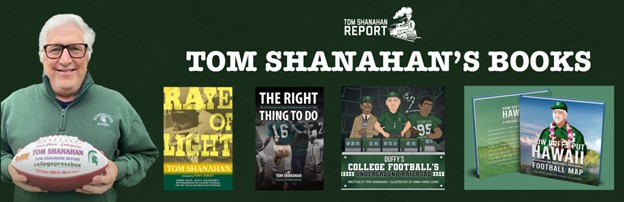
— Tom Shanahan is an award-winning sportswriter with two books on college football integration, “RAYE OF LIGHT, Jimmy Raye, Duffy Daugherty, the Integration of College Football and the 1965-66 Michigan State Spartans,” and “THE RIGHT THING TO DO, The True Pioneers of College Football Integration in the 1960s.” They are the most accurate accounts of college football integration in the 1950s and 1960s. They also debunk myths about the 1970 USC-Alabama game. The false narrative co-opted the stories of the true pioneers who stood up to Jim Crow and the KKK.
— Two children’s books also explain Michigan State College Football Hall of Fame coach Duffy Daugherty’s impact on integration through the Underground Railroad and the Hawaiian Pipeline: “DUFFY’S COLLEGE FOOTBALL UNDERGROUND RAILROAD” and “HOW DUFFY PUT HAWAII ON AMERICA’S FOOTBALL MAP.”
***
PURCHASE LINKS, non-fiction books
— RAYE OF LIGHT, August Publications or on Amazon.
— THE RIGHT THING TO DO, August Publications or on Amazon.
PURCHASE LINKS, children’s books
— DUFFY’S COLLEGE FOOTBALL UNDERGROUND RAILROAD, Order from Barnes and Noble here and Amazon here.
— HOW DUFFY PUT HAWAII ON AMERICA’S FOOTBALL MAP, coming soon on Barnes and Noble and Amazon.

