


Here’s what Michigan State players and Hall-of-Fame coaches say about Spartan Stadium sculpture honoring Duffy’s many milestones
PHOTO: Hugh Duffy Daugherty was a Time Magazine coverboy, October 8, 1956. Pulitzer Prize winner Marueen Dowd wrote in a 2013 New York Times column that Time publisher Henry Luce considered a Time cover the most coveted honor in American culture.
***
Watch our documentary development trailer: Game Changers
***
“History writes people out of the story. It’s our job to write them back in.”
— Pulitzer Prize winner David Maraniss.
“How can we know who we are and where we are going if we don’t know anything about where we have come from and what we have been through, the courage shown, the costs paid, to be where we are?”
— Pulitzer Prize winner David McCullough
By TOM SHANAHAN
Michigan State plans to unveil a sculpture of College Football Hall of Fame coach Duffy Daugherty next year on the Spartan Stadium grounds. A wide range of reactions greeted the announcement last week from athletic director Dan Bartholomae.
Excitement, praise and gratitude were expressed by Jimmy Raye, Bob Apisa, Pat Gallinagh and others who played for him on the Spartans’ 1965 and 1966 national title teams. Those were capstone seasons to Daugherty assembling college football’s first fully integrated rosters in the 1960s.
But a more direct response would have been heard from the late Bill Yeoman Sr., according to his son, Bill Yeoman Jr. The elder Yeoman was a Daugherty assistant prior to becoming a College Football Hall of Fame coach at Houston, 1962-86.
“I think my dad would say, ‘It should have been done the minute he left Michigan State. There wasn’t a better ambassador for Michigan State than Duffy Daugherty. Dad said Duffy was the best coach he ever met at handling people, whoever they were. Look at the group of people surrounding him.’”
Duffy’s first staff in 1954 included Yeoman along with Dan Devine (a head coach at Arizona State, Missouri and Notre Dame), Bob Devaney (Wyoming and Nebraska) and Sonny Grandelius (Colorado). Two former Daugherty players who became head coaches were Oklahoma’s Chuck Fairbanks and Arizona State’s Frank Kush, who succeeded Devine.
All six followed Daugherty’s incandescent leadership by expanding opportunities for Black athletes.
“They all wanted the best football players on the field,” Yeoman Jr. said. “Color wasn’t a consideration,”

Duffy’s tree includes coaching at MSU with Earle Edwards, who went on to desegregate NC State’s program in 1967. Daugherty also launched the pioneering Black coaching careers of Sherman Lewis, Jimmy Raye and Tyrone Willingham.
In 1964, Yeoman boldly challenged Jim Crow and the Ku Klux Klan in Texas when he recruited Warren McVea. Five years later the University of Texas followed Yeoman with its first Black recruit. Six years later Alabama coach Bear Bryant got on the bus.
“Dad wasn’t naïve — he understood what he was doing when he recruited Warren McVea,” said Yeoman Jr. “He also knew I don’t have a job if I don’t put the best people on the field.”
Yeoman, Devaney, Devine and Kush are College Football Hall of Famers with campus statues (Devaney at Nebraska, Devine at Notre Dame). Yeoman Jr., a retired judge who presided from benches in Kansas and Houston, said such irony was not lost on his father.
Daugherty earned his place standing alone as the first coach to ignore college football’s unwritten quota limiting Black players to a half-dozen or so. But as a result of the 1950s and 1960s sports media avoiding race for fear of alienating subscribers and advertisers, the omissions left Daugherty’s many milestone moments unappreciated in real time and lost to history.
NBC Sports dropped the ball with its coverage of Michigan State playing Notre Dame on September 19 to honor the 60th anniversary of the 1966 Game of the Century. The NBC producers provided announcers Noah Eagle and Todd Blackledge with erroneous information.
In 1962, the Associated Press reported Michigan State’s 17 Black athletes was the most in major college football history. The story was a rare example from an intrepid reporter, but it failed to note Daugherty’s teams broke their own records. The Spartans’ numbers grew into the 20s by the 1965 and 1966 championship seasons.
By comparison, Minnesota’s 1960 national title team numbered only five Black players, USC’s 1962 national championship roster five and the Trojans’ 1967 national title only seven. None of this is reflected in college football lore that falsely portrays the 1970 USC-Alabama game as an integration tipping point.
In 1964, Michigan State was the first fully integrated team to play in the South in a game against North Carolina contested at segregated Chapel Hill. The Holiday Inn West in Durham defied the state’s Jim Crow customs by housing and feeding the Spartans’ Black players. The on-field and off-field milestone moments weren’t reported.
“I think Duffy certainly should be honored beyond on the stadium façade (with his name alongside other MSU College Football Hall of Famers),” said Raye, who was recruited out of segregated Fayetteville, N.C., and was the South’s first Black quarterback to win a national title.
“Duffy showed courage as a coach with the social implications he encountered at the height of Civil Rights movement. Duffy took a lot of heat for recruiting the Black athlete and Black athletes in numbers. I think the fact he was able to navigate and negotiate that ground speaks to the courage and character of the man himself and the integration of college football.
“He certainly is deserving not only as a football coach, but for what he stood for in college football and Michigan State.”
Notre Dame’s Terry Hanratty, a College Football Hall of Fame quarterback who was recruited by Daugherty and later faced the Spartans in the 1966 Game of the Century, expressed another reaction — astonishment.
“I’m shocked he doesn’t have a statue already,” Hanratty said “He should have been up there a long time ago. I’m really surprised.”
With the sports media avoiding race until the subject was unavoidable following the Black athlete protests surrounding the 1968 Mexico City Olympics, responsible journalism emerged. In the 1970s, Oklahoma’s Barry Switzer gained a national reputation for building a model integrated program.
“Statues help your students and players learn their school’s tradition and history. You sell them tradition. You put it out there in front of them.”
barry switzer, OKLAMOMA’S College football hall of fame coach and three-time national champion
But Switzer, whose Sooners won national titles in 1974, 1975 and 1985, credits Daugherty with the first model program distinction.
“I can’t believe Duffy doesn’t have a statue already,” said Switzer, who turns 89 on October 5. “He had more to do with the emergence of the Black athlete in college football than any other coach, and he won championships. I was recruiting Black athletes and quarterbacks in the Big Eight before anyone in Southwest and Southeastern conferences, and Duffy was ahead of me.”
Although Switzer wasn’t from Daugherty’s coaching tree, he was close to him through Fairbanks. When Fairbanks was named head coach in 1967 and he promoted Switzer to offensive coordinator, they agreed to ignore the unwritten quota limits. In 1973 ,Daugherty wanted Switzer to succeed him, but the Spartans promoted Denny Stolz from within.
Oklahoma put up a statue of Switzer in 2011 alongside its other national championship coaches and seven Heisman Trophy winners.
“Statues help your students and players learn their school’s tradition and history,” Switzer said. “You sell them tradition. You put it out there in front of them.”
The Daugherty sculpture includes Michigan State’s five two-time All-Americans from the 1965 and 1966 seasons standing behind him. The pose is modeled after the iconic photo of them.

PHOTO (L-R): Standing behind Daugherty are Clinton Jones, Bob Apisa, Bubba Smith, Gene Washington and George Webster.
Four are College Football Hall of Famers: Bubba Smith (Beaumont, Texas), George Webster (Anderson, S.C.), Gene Washington (La Porte, Texas) and Clinton Jones (Cleveland, Ohio). Bob Apisa (Honolulu) is a Polynesian Football Hall of Famer.
Smith, Webster, Washington and Jones were the first four Black players from the same class enshrined in the College Football Hall of Fame. Apisa was college football’s first Samoan All-American.
The sculpture posthumously honors Webster, died in 2007, and Smith passed in 2011. Jones and Apisa are 81 and Washington is 82.
“The sculpture is a testament to our entire team,” Apisa said. “Five of us are included, but the whole team is standing with us behind Duffy. It’s also a testament to (president) John Hannah, (athletic director) Biggie Munn and our students on campus at the time. They welcomed us and encouraged us.”
Michigan State’s Pat Gallinagh, a White defensive lineman who was a 1966 second-team All-Big Ten pick and Academic All-American, said the players understood Daugherty’s program was a meritocracy.
“Duffy played the guys who deserved to play,” Gallinagh said. “There was no favoritism or influence from deep-pocketed alumni. To get a starting job at Michigan State, you had to earn it. It took me three years to earn my starting job, and I wasn’t going to let anyone take it away.”
A theory explaining how Daugherty came to be ahead of his time on race dates to his playing days at Syracuse as an offensive lineman, 1937-39. The influence was validated in the book INVISIBLE NO MORE. Authors Scott Pitoniak and Rick Burton in their book story of Sidat-Singh benched for a 1937 game at Maryland. In those days, the Gentleman’s Agreement required integrated teams to bench their Black athletes when playing in the segregated South.
On that same team was halfback Marty Glickman, a world-class sprinter who was Jewish. Glickman was scheduled to run a leg on the United States’ 400-meter relay team at the 1936 Berlin Olympics, but he was pulled by U.S. team officials in deference to anti-Semite German dictator Adolf Hitler.
Daugherty arrived at Michigan State as an assistant coach under Biggie Munn (1947-53) and was promoted to head coach, 1954-1972. Munn and Daugherty established a history of recruiting Black players from the Midwest that was underscored by the 1954 and 1956 Rose Bowls. In the 1950s, the most highly watched TV games were the Rose Bowl and the Army-Navy Game. African Americans and White southerners opposed to segregation noted Michigan State Black stars scoring touchdowns.
In the 1954 Rose Bowl, the Spartans’ Leroy Bolden and Ellis Duckett scored. In the 1956 Rose Bowl, Clarence Peaks and John Lewis scored. Bolden, Duckett and Peaks were from Flint, Michigan, and Lewis from Fremont, Ohio.
In the 1960s, Daugherty added an influx of Underground Railroad passengers from the segregated South. But the sports media, through sloppy journalism, failed to properly explain the role played by Daughert. An egregious example was uttered by television football analyst Charles Davis, who now works for CBS, in a 2019 ESPN film on the 150th anniversary of college football.
“For Duffy Daugherty, it wasn’t just about being progressive and being Abraham Lincoln. Duffy was about winning football games.”
If that quote from Davis was poorly edited and presented on film out of context, he needs to say so. What Davis and others fail to understand is Daugherty didn’t recruit the South. The South recruited Daugherty.
In 1959, Clifton Roaf of Pine Bluff, Arkansas, was Duffy’s first Underground Railroad passenger. Roaf’s high school principal and coach contacted him through Raymond Hatch, an MSU School of Education professor. Hatch was in Pine Bluff studying the city’s Jim Crow school system.
In 1960, a Louisville high school coach who knew Biggie Munn told him about Sherman Lewis, a diminutive halfback. Lewis was Daugherty’s first Underground Railroad All-American player in 1963. He also was third in the Heisman Trophy voting, just two years after Syracuse’s Ernie Davis was the first Black Heisman winner.
In 1963, Bubba Smith’s father, Willie Ray Smith Sr., a legendary Texas high school coach during segregation, called Daugherty and asked him to take his son. He also suggested he take Washington, who had been competing against Smith’s teams.
Webster’s coach, William Roberts, contacted Daugherty, although Webster was a rare southern Black athlete known beyond segregated circles. He also took trips to Ohio State and Minnesota.
Another star from the 1963 class was Charlie Thornhill of Roanoke, Virginia. Michigan State assistant coach Vince Carillot and Thornhill’s family credited Bob McLelland, a White sportswriter at the Roanoke Times and World News, for tipping off the Spartans. McLelland, who opposed segregation, had advocated for Black athletes to make the all-area team, and Thornhill was his breakthrough. That caught Carillot’s attention. He convinced Daugherty to offer a scholarship.
Years later, a myth with zero attribution credited Alabama coach Bear Bryant for telling Daugherty. Thornhill died in 2006, but his younger brother, William Thornhill, confirmed the story crediting McLelland. He added the Thornhill brothers attended McLelland’s funeral and hugged his widow.
Daugherty’s influence, it should be noted, on his players and coaches extended beyond the 1960s. Their families’ future generations built on the opportunities Daugherty provided.
“My dad owed Duffy everything,” Yeoman Jr. said. “There’s not a finer person who drew a breath, and I should include his wife, Francie. They made my mom’s and my dad’s life great – and thus mine. What he did trickled down his teams.”
-30-
NOTE: All facts cited in this story were researched by me as part of writing “RAYE OF LIGHT, Jimmy Raye, Duffy Daugherty, the Integration of College Football and the 1965-66 Michigan State Spartans” and “The RIGHT THING TO DO, The True Pioneers of College Football Integration in the 1960s.”
***
“Straightening out history is an endless task.”
— Howell Rains, former New York Times executive editor and author, “SILENT CALVARY: How Union Soldiers from Alabama Helped Sherman Burn Atlanta — and Then Got Written Out of History.”
MY COMMENTARY ON STRAIGHTENING OUT HISTORY
The 1960s sports media’s failure to report Daugherty’s trailblazing led to sloppy journalism shoving him into the shadows. The media later promoted myths falsely crediting Alabama coach Bear Bryant.
A 2004 Sports Illustrated article with zero attribution credits Bryant for sending Charlie Thornhill to Daugherty. Although it’s true Bryant was the keynote speaker as a favor to a friend at the Roanoke Touchdown Club awards banquet on January 14, 1963, Thornhill was committed to Michigan State prior to meeting Bryant. Thornhill took his recruiting trip in December 1962, with Clifton Roaf serving as his host.
The fabricated Sports Illustrated article claims Bryant called up Thornhill and sent him two tickets to visit Michigan State. Bryant never mentioned Thornhill or sending any other player to Daugherty in his 1974 book, BEAR, or in other interviews, But his legend provides the myth legs.
ESPN has printed similar errors. A 2013 story credited Bryant for sending Daugherty players – none of them named — and added Clemson coach Frank Howard sent George Webster to Daugherty.
A false narrative about the 1970 USC-Alabama game crafted two decades after the game has been promoted in print and HBO, Showtime and ESPN films.
The mythmakers were unaware of Michigan State’s 1964 game at North Carolina and brave Black pioneers at Maryland (1963), Houston and Wake Forest (1964), Southern Methodist (1965), Kentucky (1966), Tennessee (1967). Even Auburn coach Shug Jordan in 1969 was ahead of rival Alabama. Bryant sycophants plead Brynt’s hands were tied by racist Alabama Gov. George Wallacce. No one fired Jordan, and Wallace wasn’t in office, 1967-71. These facts are overlooked in the eagerness to promote a false image of Bryant.
Another story clouding Daugherty’s legacy incorrectly labels Jerome McFarland of Alabama as an Underground Railroad recruit preceding Roaf. McFarland was a U.S. Army veteran who walked on while taking while advantage of MSU’s reputation of embracing the GI Bill to build enrollment. Daugherty didn’t recruit McFarland, who lettered only one year, 1958.
The list of GI Bill walk-on athletes at Michigan State included Johnny Green, a basketball All-American who led the Spartans to the 1957 Final Four.
A statue at Spartan Stadium may be the only way to straighten out history with the correct information presented on a plaque or kiosk.
The myths are thoroughly debunked — not disputed – in RAYE OF LIGHT, THE RIGHT THING TO DO and my website, TomShanahan.Report.
***
I invite you to follow me on Twitter @shanny4055
I’ll put my facts on the true pioneers of college football integration versus Bear Bryant fairytales against anybody, anytime, anywhere. Watch here.
Click here for my story on the 1962 Rose Bowl and Segregation and Alabama.
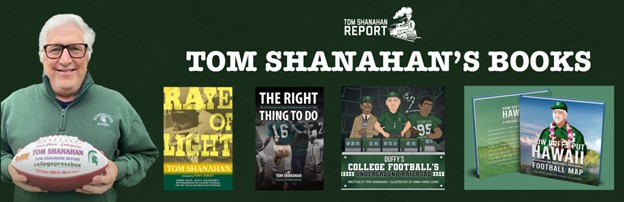
— Tom Shanahan is an award-winning sportswriter with two books on college football integration, “RAYE OF LIGHT, Jimmy Raye, Duffy Daugherty, the Integration of College Football and the 1965-66 Michigan State Spartans,” and “THE RIGHT THING TO DO, The True Pioneers of College Football Integration in the 1960s.” They are the most accurate accounts of college football integration in the 1950s and 1960s. They also debunk myths about the 1970 USC-Alabama game. The false narrative co-opted the stories of the true pioneers who stood up to Jim Crow and the KKK.
— Two children’s books also explain Michigan State College Football Hall of Fame coach Duffy Daugherty’s impact on integration through the Underground Railroad and the Hawaiian Pipeline: “DUFFY’S COLLEGE FOOTBALL UNDERGROUND RAILROAD” and “HOW DUFFY PUT HAWAII ON AMERICA’S FOOTBALL MAP.”
***
PURCHASE LINKS, non-fiction books
— RAYE OF LIGHT, August Publications or on Amazon.
— THE RIGHT THING TO DO, August Publications or on Amazon.
PURCHASE LINKS, children’s books
— DUFFY’S COLLEGE FOOTBALL UNDERGROUND RAILROAD, Order from Barnes and Noble here and Amazon here.
— HOW DUFFY PUT HAWAII ON AMERICA’S FOOTBALL MAP, coming soon on Barnes and Noble and Amazon.

