


“We Have Met the Enemy and He Is Duffy” — for telling his Bear Bryant jokes
PHOTO: The headline paraphrases a line from Walt Kelly’s cartoon strip, Pogo. When a San Francisco-based UPI writer didn’t realize Duffy Daugherty was pulling his leg, the Los Angeles Times picked up and published his 1986 wire story. But the Detroit Free Press rewrite (above) didn’t include Duffy’s joke.
Buy me a coffee to support my research to tell untold college football integration untold stories.
Thomas Shanahan | @Thomas-Shanahan-23
Order link:
Raye of Light: Jimmy Raye, The Integration of College Football 3rd Ed – August Publications
***
By TOM SHANAHAN
We can only guess how many games Michigan State football will win this year, the first under Spartans coach Pat Fitzgerald.
But there is one loss I can guarantee.
The defeat is repeated every season (year-round, actually). Someone misguided, someone uninformed will besmirch Michigan State coach Duffy Daugherty’s legacy leading college football integration.
They’ll claim Alabama coach Bear Bryant sent Daugherty recruits from the Jim Crow South. It’s a non-sensical fairytale regurgitated annually in the media and, distressingly, in MSU’s fanbase.
For a peculiar reason, a few fans think Daugherty’s place in history is enhanced by Bryant’s coattails. That’s backwards. Without sloppy journalism falsely casting Bryant as a crusader, the Alabama coach needed Daugherty’s open mind for a legitimate place in college football integration history.
Bryant didn’t know or care about Black players in his own backyard, dragging his feet into the 1970s. Bryant was the seventh of 10 South Southeastern Conference coaches to recruit his first Black player with Wilbur Jackson in 1970. By then, 33 of 37 major southern programs included Black players.
Daugherty learned about Black talent in the Jim Crow South through Black high school coaches trusting him with their players. The Spartans’ 1960s teams combining Midwest Black players and Underground Railroad passengers formed college football’s first fully integrated rosters.
So, who do we blame for the Bryant fabrication at Daugherty’s expense?
Duffy.
The jovial College Football Hall of Fame coach with 1965 and 1966 national titles liked to pull the legs of sportswriters. Big Ten sportswriters laughed along with him.
But in 1986, during Daugherty’s retirement years serving as ambassador for the East-West Shrine Game played at Stanford, a Duffy joke about Bryant, Joe Namath of Beaver Falls, Pennsylvania, and Charlie Thornhill of Roanoke, Virginia, was taken seriously by William Murray, a San Francisco-based United Press International writer.
His article on the UPI wire was picked up by the Los Angeles Times and published on December 14, 1986. Murray’s story was topped by Duffy telling recruiting tales regarding Bubba Smith and his father Willie Ray Smith Sr. and Michigan State’s Hawaiian players.
About two-thirds of the way through the article, Duffy is quoted he pursued Namath and was optimistic until the MSU admissions office informed there was no way to admit Namath with his abysmal grades. Maybe Murray put the Namath anecdote at the bottom of his report since he wasn’t quite sure about the tale’s credibility. Or the editors moved it.
Murray quoted Daugherty:
“So I called Bear Bryant down at Alabama and told him he should take a good look at this kid. Well, a couple years later Bryant called me up and told me about Thornhill. He had already talked to him about coming to Michigan State so when I called, he was all ready to come and play for us.”
Here’s what’s Murray didn’t hear accompanying Duffy’s humor: a rim-shot — “ba-dum-DUM!”
I’ve reported the true story of the Spartans recruiting Thornhill in “RAYE OF LIGHT, Jimmy Raye, Duffy Daugherty, the Integration of College Football and the 1965-66 Michigan State Spartans,” and on my website, TomShanahan.Report. No one involved tells a Bryant backstory, including Bryant.
Thornhill, who died in 2006, told the Roanoke Times he was committed to Michigan State before he met Bryant at an awards banquet honoring area high school and college players. Bryant was the keynote speaker as a favor to a friend.
This is the chronology based on my interviews and research. You can find it RAYE OF LIGHT, Chapter 10: Mad Dog, the Sportswriter, and the Myth.
— MSU assistant coach Vince Carillot said he learned about Thornhill through a phone call from Bob McLelland, a Roanoke Times & World News sportswriter. McLelland was opposed to segregation and advocated for Black athletes to make the all-area team. He finally broke through with Thornhill as a senior in the fall of the 1962 season. McLelland knew Michigan State was a place of opportunity and placed a cold call to the football office. Carillot said he just happened to be the one who took the call.
— Thornhill’s recruiting trip to MSU’s campus was before the December 1962 Christmas break, according to Clifton Roaf, who says he served as Thornhill’s host. Roaf was then a senior upon becoming Michigan State’s first Underground Railroad passenger in the fall of 1959. Daugherty didn’t recruit a southern Black player until Roaf’s principal, M.D. Jordan, and football coach, Ervin Phillips, contacted him through Raymond Hatch, an MSU School of Education professor. A year later, a coach in Louisville, Kentucky, contacted Michigan State athletic director Biggie Munn about Sherman Lewis. Munn relayed the information to Daugherty about the Spartans’ future All-American halfback. Daugherty hit the jackpot in 1963 with Willie Ray Smith Sr. of Charlton-Pollard High in Beaumont, Texas, sending him two future College Football Hall of Famers, his son Bubba and Gene Washington.
— Sidenote: you might have read elsewhere about three MSU Black players in the 1950s from the South, but they weren’t recruited by Daugherty out of high school. They arrived on their own through the GI Bill after serving in the military. I included this sidenote because there are so many inaccruate stories about Daugherty recruiting the South. Michigan State president John Hannah strategically used the GI Bill to increase enrollment in the post-World War II years. Michigan State basketball All-American Johnny Green served in the Marine Corps and arrived unannounced as a walk-on player in 1956. As the years went by, a story circulated that a Marine officer with Michigan State ties steered him to East Lansing, but Green told me that wasn’t true.
— Carillot added Daugherty was concerned about Thornhill’s 5-foot-9 height, and he had to talk his boss into offering a scholarship. Carillot pointed out Thornhill was built like a weightlifter without touching a weight. Carillot’s version demonstrates Daugherty didn’t take players sight unseen. Roaf didn’t get his scholarship offer until his high school coach drove him to East Lansing to meet Daugherty.
— William “Nay” Thornhill, Charlie’s younger brother, said when Charlie met Bryant at Roanoke banquet on January 14, 1963, Charlie was already committed to Michigan State. Nay added Bryant said nothing more to Charlie than he would enjoy playing for Daugherty.
— Josh Thornhill, Charlie’s son, said his father never spoke about Bryant influencing his career. Nay added years later Charlie grew irritated with people asking him about the Bryant story.
So, who are you going to believe? A Michigan State assistant coach, a Michigan State player, Charlie’s brother and Charlie’s son or a Bay Area UPI writer unfamiliar with Duffy?
There’s more. Listen to Bryant, Namath and Maryland coach Tom Nugent. You can’t get a better source than the horse’s mouth.
— Bryant stated in his 1974 book, “BEAR,” he learned about Namath through Nugent. The call was placed after Namath failed his Maryland entrance exam on the eve of fall camp. Namath spent the summer in College Park preparing for the exam. By the time Nugent called Bryant, Alabama’s preseason practices had started. Bryant got Namath admitted overnight.
— Namath tells the same story, including his academic failures, in the 2012 HBO documentary, “NAMATH.”
— Nugent told the same story in a 1969 SPORT Magazine article. He said he called Bryant because Alabama wasn’t on any of Maryland’s future schedules. And by the way, what does it say about Alabama’s admissions office that Daugherty and Nugent both thought of Bryant when Namath had no other options. It says Bryant didn’t have a boss — he told Alabama to admit Namath.
Yet all these years later, national outlets regurgitate Bryant myths at Daugherty’s expense. The most egregious error was by Sports Illustrated in a 2004 article about the Namath/Thornhill tale within in an article about athletes and the road not taken. There is not a single attribution – not even the 1986 UPI article – in the Sports Illustrated piece.
I’ve had other media members try to state that 1986 LA Times story is proof. One former Michigan radio guy, who moved on to New York, asked me if I was calling Duffy a liar. I replied I’m calling out Sports Illustrated and the UPI story as sloppy journalism. I should have added, “Are you calling Bear Bryant, Joe Namath, Tom Nugent, Vince Carillot, Clifton Roaf, Nay Thornhill and Josh Thornhill liars?”
The Namath/Thornhill story was an urban legend as early as the 1970s from other times Daugherty told the joke. But he stuck to facts in his 1974 book, “DUFFY,” without a mention of the Namath-Thornhill tale. He made a vague reference he talked to southern college coaches, but there are no names cited. Most likely, whatever he meant was probably simple double-checking.
Bryant could have exploited the urban legend with his own embellishment, but no such quotes exist. He was, though, willing to manipulate the media once he began to hear criticism for failing to recruit Black players until the 1970s.
In a 1980 Time Magazine cover story as Bryant’s career was winding down, he made a vague reference to sending players North. There are no names of players, coaches or schools cited, yet the writer, B.J. Phillips, used the quote. The media ever since has irresponsibly regurgitated the unsubstantiated claim as fact.
Legends get concessions not afforded others.
But the sloppy journalism doesn’t stop with Bryant stories. Clemson coach Frank Howard received incorrect credit for sending future College Football Hall of Famer George Webster to Duffy. ESPN’s Adam Rittenberg fell victim to others regurgitating the Howard/Webster fairytale in a 2013 ESPN story when he followed their lead without evidence.
The tale is wrong for two major reasons:
One, Webster’s coach contacted Daugherty. Duffy was quoted saying that in the 1986 UPI story. Hank Bullough, Daugherty’s defensive coordinator, said the same to me in RAYE OF LIGHT.
Two, unlike most Black stars in the South, Webster was so well known he made trips to other Big Ten schools, including Ohio State and Minnesota. Think of him as a 5-star recruit in today’s vernacular. Webster was anything but a Frank Howard secret in South Carolina.
I’ve pointed out these errors to Sports Illustrated editors and Rittenburg. No response.
Also consider this curiosity: Murray’s article was limited to the LA Times. The Detroit Free Press and Detroit News editors apparently understood Duffy was a joking and ignored the Namath “trade.” The Miami Herald included a note without a Namath mention.
The Free Press, however, did publish a UPI rewrite in a “Morning Line” column. The article was credited to Mike Fiorito and included a caricature of Duffy drawn by the great Dick Mayer. Fiorito used Duffy quotes picked up from the UPI story about Willie Ray Smith Sr, Bubba Smith’s father, Hawaii and a truncated Namath quote.
Duffy on Willie Ray Smith Sr.:
“I was speaking in Texas and met Bubba’s father, Willie Ray Smith, a high school coach. He and some other Black coaches wanted to talk about football, but in those days, they weren’t allowed into some bars, so I bought a couple cases of beer and we went up to my hotel suite and talked football.
“A few years later, Wilie Ray called me and said, ‘How would you like to try and make a man out of my son? I’ll try to make him a football player. He’s your son – you make him a man.”
Duffy on Hawaii:
“The one place I never delegated to an assistant was Hawaii. I got a lot of good players from Hawaii, too.”
Daugherty tells similar Willie Ray Smith and Hawaii stories in his fact-based book but nothing about Bryant and Thornhill. What does that tell you?
As for the Namath quote in the UPI story, I don’t doubt Duffy phoned Bryant. They were good friends. But that call might have been as early as December 1960 since Daugherty said he learned there was no way to admit Namath.
And remember this about Bryant getting Namath admitted overnight: In 1967, Bryant cut five Black players who attempted to make the team during Alabama’s spring football practices. In a TV interview, Bryant was asked why he didn’t have any Black players.
Bryant’s feeble response: “We haven’t so far found many, if any, who qualified athletically and academically.”
Put aside that by 1967 plenty of Black athletes played college football outside the Mason Dixon Line and increasing numbers within the segregation’s turf.
Outside the bubble they included Syracuse’s Ernie Davis as the first Black Heisman Trophy winner, 1961, and USC’s Mike Garret, the second, 1965. And what about the myth Bryant was sending Black players north? They needed better grades than Joe Namath to get admitted.
Nothing about the Bryant fairytale sending Duffy players adds up.
Other than the Thornhill fairytale, you won’t find a name, school or coach attached to the Bryant claims. My research includes a story on my website that explains none of Daugherty’s 16 Black players from the South who earned All-Big Ten or All-American honors included a Bryant backstory.
* Tom Shanahan, Author/Historian My segment July 21 on The Drive with Jack
What about programs such as Oklahoma desegregating in 1956 and Missouri in 1957. They were followed by Maryland, 1963; Wake Forest, 1964; Houston, 1964; Southern Methodist, 1965; Baylor, 1966; and Kentucky, 1966.
Where did they find Black players?
Any other coach would be ridiculed for such a racial trope, but Bryant is a legend. People don’t want to believe he was a segregationist until 1970. Bryant’s apologists and sycophants successfully wove a narrative that protects his legacy. One way they succeeded was cherry-picking Bryant items. The UPI story focused on Bubba Smith, but they pull Namath/Thornhill out of it.
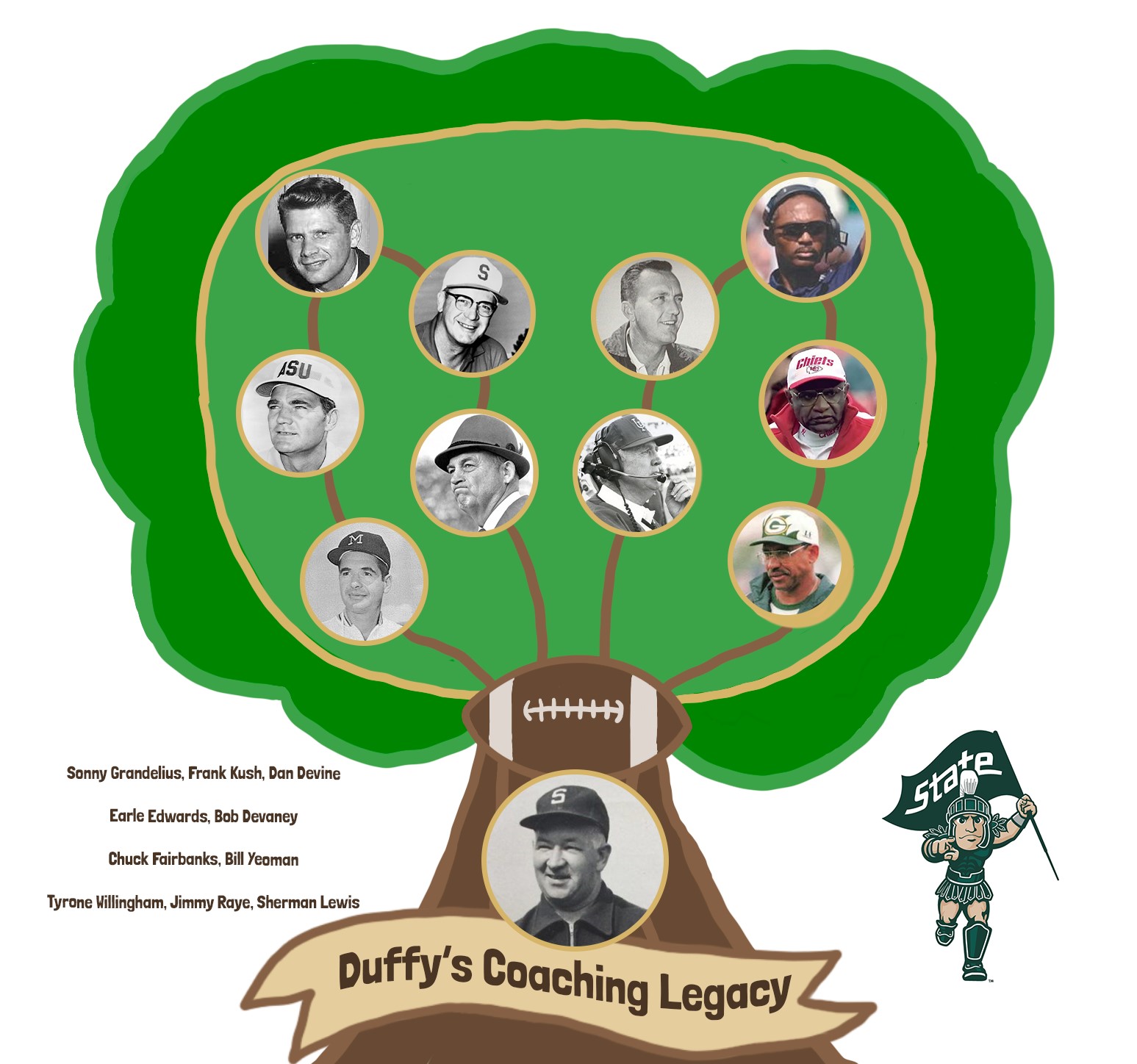
Sloppy journalism also fails to understand the impact of Duffy’s coaching tree. Dan Devine (Arizona State, Missouri, Notre Dame), Bob Devaney (Wyoming, Nebraska), Bill Yeoman (Houston), Sonny Grandelius (Colorado), Earle Edwards (NC State), Frank Kush (Arizona State) and Chuck Fairbanks (Oklahoma) all followed his blueprint of expanding opportunities for Black athletes.
The tree incudes influencing Black coaches with Sherman Lewis, Jimmy Raye and Tyrone Willingham. Lewis (2022) and Raye (2021) were honored by the Pro Football Hall of Fame with its NFL Awards of Excellence and Willingham was the first Black coach to take team to a Rose Bowl with his 1999 Pac-10 championship team.
If I had a question for Duffy, who died nine months after the UPI story, it would be why open the door to Bryant apologists writing him out of history? Duffy wasn’t a self-promotor so in my mind, these are the two best explanations:
One, Duffy couldn’t resist a good laugh. Jud Heathcote, Michigan State’s basketball coach known for his biting sense of humor, once told me he was laughing so hard he told Duffy, “to stop with the corny jokes.”
Two, maybe he wanted to defend Bryant when his friend began to draw criticism for dragging his feet on integration. Other than Jim Murray, the LA Times’ Pulitzer Prize winner, the sports media was afraid to confront Bryant while he was alive.
Civil Rights attorney U.W. Clemon, who represented the Afro American Student Association lawsuit against Bryant in 1969, said Bryant told him he didn’t know about Black players to recruit. Clemon also said he was prepared to show Alabama Black high school coaches said Bryant wasn’t serious about their players.
The USC/John Mitchell 1971 recruiting story – perhaps more than any other – shows how little Bryant knew about Black players in his backyard. Mitchell, who was from Mobile, Alabama, committed to USC coach John McKay out of Eastern Arizona College. But McKay said in his 1974 book, “McKay: A Coach’s Story,” he made the mistake of telling Bryant he got a player from his backyard.
Bryant instructed his assistant coaches to track down Mitchell, and Bryant flipped Mitchell. But instead of the media reporting it’s embarrassing Bryant was unaware of Mitchell, it’s told as Bryant the sly fox. Bryant’s media sycophants are the best spin doctors in the business.
If only the sports media would do some research, then it might understand Daugherty’s story. But it’s content with an unvetted fairytale.
College football lore fails to tell the story of Daugherty’s 1964 team as the first fully integrated roster to play in the South. The Spartans faced North Carolina at Kenan Stadium in segregated Chapel Hill. Michigan State College Football Hall of Famer Clinton Jones was the first Black player to score at Kenan.
To paraphrase President John F. Kennedy, Bear Bryant myths have a thousand fathers, but Duffy Daugherty’s true story is an orphan.
-30-
There is a cottage industry for books and documentaries that promote unfounded Bear Bryant myths:
— Bryant did not lead the way in the South with 1970 USC-Alabama game:
Bryant was not a grandfatherly figure:
Bo Knows: Matthews bares his thoughts on Bear Bryant’s 1970 recruiting audible – Tom Shanahan Report
— Bryant was not at the forefront of southerners encouraging integration the South:
— Bryant didn’t spring a secret on USC with a 1971 switch to the wishbone offense:
— Bryant was not a victim of Jim Murray spoiling his trip to the 1962 Rose Bowl:
My FWAA first-place story on the 1962 Rose Bowl and segregation – Tom Shanahan Report
— My dinner with the Bear:
My Dinner with The Bear – Tom Shanahan Report
— This is my latest story spelling out how ludicrous it is to suggest Bryant led the way in 1970:
***
If you foolishly believe the 1970 USC-Alabama myth, please read this quote from Lane Demas, an author on sports and integration and a Ph.D professor at Central Michigan University.
“Alabama football integrated because an organized, sustained movement of Black Americans nationwide forced it to, against its will. That’s the only answer that makes sense if you study the broader historical context.
“The USC-Alabama story is in a long line of white myths that serve to deny Black people their agency in terms of changing America. Focusing on figures like Branch Rickey and Bear Bryant creates narratives in which it is ultimately White people who make cautious, thoughtful, calculating decisions to create and integrate their own teams. They become the agents of change, not Martin Luther King, Rosa Parks, or thousands who struggled in the streets.”
-30-
Visit my homepage: TomShanahan.Report
— Watch a three-minute video to learn about our documentary at the fundraising stage, GAME CHANGERS OF THE CENTURY, and the Investment Deck.
I invite you to follow me on Twitter @shanny4055
I’ll put my facts on the true pioneers of college football integration versus Bear Bryant fairytales against anybody, anytime, anywhere. Watch here.
Click here for my story on the 1962 Rose Bowl and Segregation and Alabama that earned first place for Enterprise from the Football Writers Association of American.

— Tom Shanahan is an award-winning sportswriter with two books on college football integration, “RAYE OF LIGHT, Jimmy Raye, Duffy Daugherty, the Integration of College Football and the 1965-66 Michigan State Spartans,” and “THE RIGHT THING TO DO, The True Pioneers of College Football Integration in the 1960s.” They are the most accurate accounts of college football integration in the 1950s and 1960s. They also debunk myths about the 1970 USC-Alabama game. The false narrative co-opted the stories of the true pioneers who stood up to Jim Crow and the KKK.
— Two children’s books also explain Michigan State College Football Hall of Fame coach Duffy Daugherty’s impact on integration through the Underground Railroad and the Hawaiian Pipeline: “DUFFY’S COLLEGE FOOTBALL UNDERGROUND RAILROAD” and “HOW DUFFY PUT HAWAII ON AMERICA’S FOOTBALL MAP.”
***
PURCHASE LINKS, non-fiction books
— RAYE OF LIGHT,
Raye of Light: Jimmy Raye, The Integration of College Football 3rd Ed – August Publications
or on Amazon.
— THE RIGHT THING TO DO, August Publications or on Amazon.
PURCHASE LINKS, children’s books
— DUFFY’S COLLEGE FOOTBALL UNDERGROUND RAILROAD: Order from Barnes and Noble here and Amazon here.
— HOW DUFFY PUT HAWAII ON AMERICA’S FOOTBALL MAP. Order here:
How Duffy Put Hawaii On America’s Football Map by Tom Shanahan, Paperback | Barnes & Noble®
Amazon.com: How Duffy Put Hawaii On America’s Football Map eBook : Shanahan, Tom: Kindle Store

