

Coach Robinson’s dos and don’ts on adapting to the Wild, Wild West and embracing a program’s legend
PHOTO: Steve Robinson (left with Arizona coach Tommy Lloyd.
***
Buy me a coffee to support my research to tell untold college football integration untold stories.
Thomas Shanahan | @Thomas-Shanahan-23
Watch our documentary development trailer: Game Changers
***
By TOM SHANAHAN
Steve Robinson, a long-time assistant basketball coach under Roy Williams at Kansas and North Carolina and coach of his own NCAA Tournament teams at Tulsa and Florida State, discussed the game’s awkward transition to the Wild, Wild West at our weekly Raleigh Sports Club gathering.
He came out of a one-year retirement to serve this season as a special assistant at Elon University, a small school in North Carolina’s ACC country, but of his 42 on the bench he spent the last four as assistant under Arizona’s Tommy Lloyd, 2021-25.
Robinson observed how Lloyd, an old-school coach for 20 years as a Gonzaga assistant, adapted to NIL and the transfer portal as well as the pressure of coaching a national power built by a basketball icon, Lute Olson. Lloyd didn’t make the mistake of sidestepping Olson’s shadow as did Olson’s immediate successors.
He explained many old-school coaches grew weary of the Wild, Wild West, including Williams, who retired in 2021. Duke’s Mike Krzyzewski followed in 2022 and Virginia’s Tony Bennett in 2024. Before Robinson was off the stage, Oregon’s Dana Altman announced his sudden retirement.
What’s an old-school coach to do?
“Fans and donors can’t reach out and touch the program with so much player movement,” Robinson said. “But they can connect with coaches and people directly running the program. You’re no longer just a basketball coach. You need to be a fundraiser. That might mean sitting down to dinner with a small group of five people.”
Lloyd accepted that added job description. But my ears perked up when Robinson told a Lloyd story that applied to Michigan State basketball and football, although in contrasting ways.
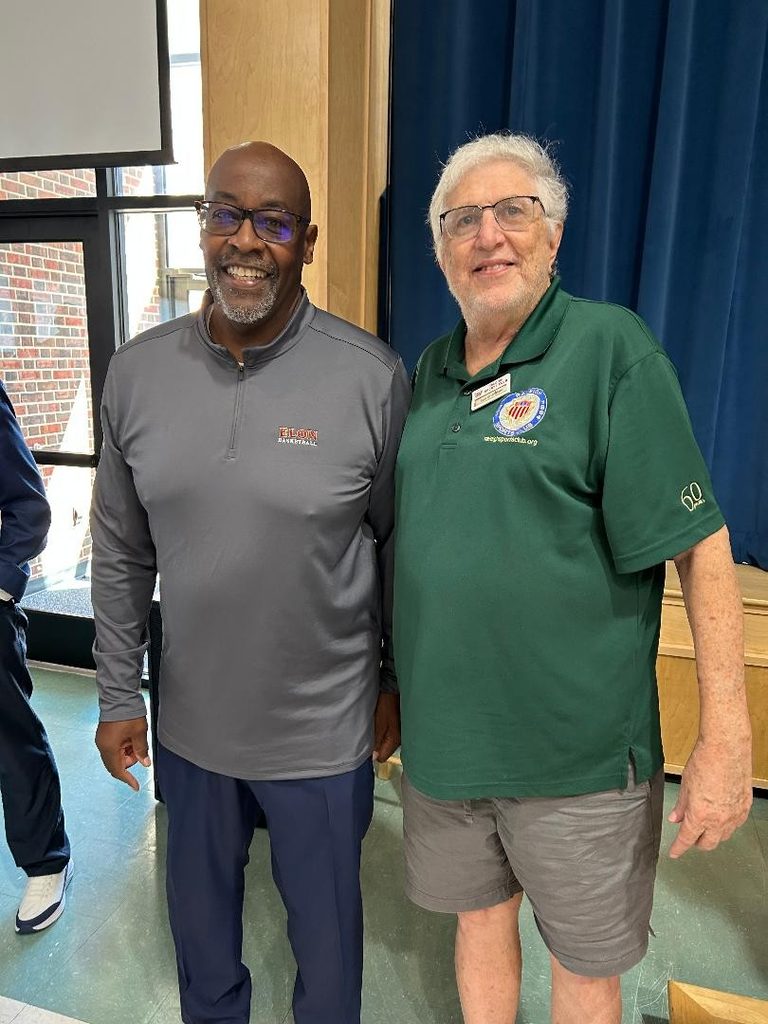
PHOTO: I enjoyed meeting Steve Robinson at the Raleigh Sports Club.
“Lloyd has a great deal of respect for what happened before him,” Robinson said. “He understands what that respect means for success.”
Well, Michigan State basketball coach Tom Izzo embraced Jud Heathcote’s legacy from Day 1 upon succeeding his boss, 1995-96. So, the 71-year-old coach was on the right path long before he accepted adapting to the Wild, Wild West.
Izzo took Heathcote’s legacy one step further by including Gus Ganakas (1969-70 to 1975-76) under his umbrella. Heathcote and Izzo understood Ganakas was key to the Spartans landing Earvin “Magic” Johnson as a freshman recruit in Jud’s second season, 1977-78. Ganakas, Heathcote and Izzo equal a 58th season and counting.
Before you say “of course Izzo embraced his former boss’ legacy,” that wasn’t the case with MSU football when Denny Stolz (1973-75) was promoted to succeed Duffy Daugherty (1954-72). Nor was it for successive MSU head coaches and administrations. The lack of respect for Duffy’s 1965 and 1966 national titles and assembling college football’s first fully integrated rosters in the 1960s was squandered.
Look where the program’s national stature is now. Daugherty’s leadership was lost to history and later co-opted by Alabama coach Bear Bryant fairytales.
One myth was made up two decades after the 1970 USC-Alabama was played. The national media continues to play up a segregationist coach based on an unvetted tale crafted by USC backers who attempted to sell a failed movie script. The other myth was Bryant sent Daugherty players from the South that, curiously, too many MSU fans believe. They don’t understand it reduces Duffy to a passive bystander.
You can read two stories debunking Bryant myths: a) Bear Bryant never sent Duffy Daugherty a player. So, why do so many smart people believe the myth? – Tom Shanahan Report; b) “We Have Met the Enemy and He Is Duffy” – for telling his Bear Bryant jokes – Tom Shanahan Report
Daugherty’s lost history was painfully evident to true Spartans who understand his legacy when NBC broadcast Michigan State playing at Notre Dame on September 19 to recognize the 60th anniversary of the 1966 Game of the Century. The NBC producers were made aware of Daugherty’s lost history, but they reduced his career to nothing more than dozens of college coaches who won national titles in a century and a half of college football. If the NBC producers are younger and unaware, maybe they bowed to old-timer fealty to the Bryant legend.
But in 2026, new Michigan State coach Pat Fitzgerald, who is an old-school coach like Tommy Lloyd, has accepted the Wild, Wild West and embraced Daugherty’s twin legacies.
There was no better example of Fitzgerald connecting with the fans than Saturday’s game against Illinois. Although the Spartans lost in overtime, 38-37, Fitzgerald got the crowd riled up after a controversial flag on an onside kick. Michigan State rallied behind the energy to tie the game.
I remember seeing Daugherty at Michigan State’s 1978 spring game my senior year as the State News sports editor. At halftime, Duffy was trotted out to midfield to be recognized by the crowd. I was out there with him trying to snap a photo in focus for my journalism photography class.
By then, Duffy had good reason to complain that the school was losing touch with its proud history. But that wasn’t Duffy’s character. He wasn’t a self-promoter as a coach or in retirement.
Although Duffy didn’t say anything publicly, we might know what he was thinking from his son Dan Daugherty’s words. Dan, who has since then passed away, said his father’s successors with the exception of Mark Dantonio ran the program into the ground. You can read it in RAYE OF LIGHT.
When Bear Bryant cried reverse racism for his 1966 Alabama team finishing No. 3 to Notre Dame and Michigan State, Duffy didn’t say anything then. Nor three months later at a sporting goods convention in Chicago when Bryant admitted to Duffy that he was wrong – his 1966 Alabama team was too small and too slow to compete against the Spartans. You can read about that in THE RIGHT THING TO DO.
Duffy waited until 1985 – two years after Bryant’s death – to reveal Bryant’s concession. He made it part of his speech when accepting the Robert Neyland Award from the East Tennessee Chapter of the National Football Foundation. You can read my website here: Duffy’s 1985 Knoxville response to Bear Bryant – Tom Shanahan Report.
In the pre-Internet age, the story in the Knoxville News-Sentinel, April 27, 1985, wasn’t picked up by the wire serves to be printed in other newspapers. It faded into the ether.
The national media – those duped by the Bryant myths and those who know they were fooled but too embarrassed to go public or challenge Bryant sycophants — continue to promote a fairytale over history.
But not everyone is afraid of the Bryant legend: Thanks to Jim Comparoni and Paul Konyndyk at Spartanmag.com and past stories by Chris Solari in the Detroit Free Press; Connor Earegood of the Detroit News; and Brendan Sanders of my Michigan hometown paper, the Big Rapids Pioneer. M-Live has yet to understand Duffy’s story. Lansing TV station WILS and Dexter Henry at the New York Post have also told Duffy’s true story. Also, thanks to radio shows such as Jack Ebling in Lansing, Adam Gold in Raleigh, Joe Rexrode in Nashville as well as Graham Couch’s podcast in Lansing, Matt Zemak’s podcast in Los Angeles and Dave Van de Walle’s podcast, The Vandy Project.
-30-
I invite you to follow me on Twitter @shanny4055
NOTE: All facts cited in this story were researched by me as part of writing “RAYE OF LIGHT, Jimmy Raye, Duffy Daugherty, the Integration of College Football and the 1965-66 Michigan State Spartans” and “The RIGHT THING TO DO, The True Pioneers of College Football Integration in the 1960s.”
I’ll put my facts on the true pioneers of college football integration versus Bear Bryant fairytales against anybody, anytime, anywhere. Watch here.
Click here for my first-place FWAA story on the 1962 Rose Bowl, Segregation and Alabama.
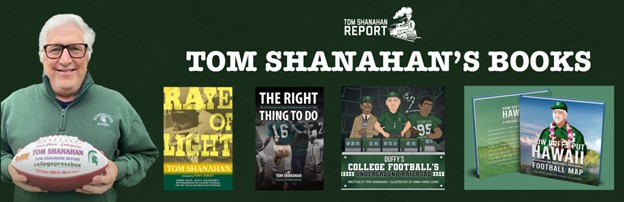
— Tom Shanahan is an award-winning sportswriter with two books on college football integration, “RAYE OF LIGHT, Jimmy Raye, Duffy Daugherty, the Integration of College Football and the 1965-66 Michigan State Spartans,” and “THE RIGHT THING TO DO, The True Pioneers of College Football Integration in the 1960s.” They are the most accurate accounts of college football integration in the 1950s and 1960s. They also debunk myths about the 1970 USC-Alabama game. The false narrative co-opted the stories of the true pioneers who stood up to Jim Crow and the KKK.
— Two children’s books also explain Michigan State College Football Hall of Fame coach Duffy Daugherty’s impact on integration through the Underground Railroad and the Hawaiian Pipeline: “DUFFY’S COLLEGE FOOTBALL UNDERGROUND RAILROAD” and “HOW DUFFY PUT HAWAII ON AMERICA’S FOOTBALL MAP.”
***
PURCHASE LINKS, non-fiction books
— RAYE OF LIGHT, August Publications or on Amazon.
— THE RIGHT THING TO DO, August Publications or on Amazon.
PURCHASE LINKS, children’s books
— DUFFY’S COLLEGE FOOTBALL UNDERGROUND RAILROAD, Order from Barnes and Noble here and Amazon here.
— HOW DUFFY PUT HAWAII ON AMERICA’S FOOTBALL MAP, coming soon on Barnes and Noble and Amazon.