


Belichick’s Pigskin Preview goof: He’s better at X’s and O’s than recapping player bios
PHOTO: North Carolina’s Bill Belichick presented a lighter side on the preseason college football circuit than he did as New England Bill in the NFL. Belichick (right) chatted with (L-R) NC State head coach Dave Doeren and Duke head coach Manny Diaz. Not pictured were NC Central head coach Trei Oliver and East Carolina offensive coordinator John David Baker. (News & Observer photo).
***
Visit my homepage: TomShanahan.Report
— Click here for review and purchase link: THE RIGHT THING TO DO, The True Pioneers of College Football Integration in the 1960s and here for a purchase link to RAYE OF LIGHT, Jimmy Raye, Duffy Daugherty, the Integration of College Football and the 1965-66 Michigan State Spartans.
— Learn about our documentary at the fundraising stage, GAME CHANGERS OF THE CENTURY, and the Investment Deck.
***
By TOM SHANAHAN
RALEIGH – Sorry, coach Bill Belichick. I need to correct you on something you said on the preseason college football circuit.
Fans appreciate that as North Carolina’s new coach you left your gruff NFL persona in New England, but you got something wrong at the 22nd annual Pigskin Preview. The lunch and football talk were sponsored by the National Football Foundation’s Bill Dooley Chapter on Friday at the Hilton Raleigh North Hills.
At one point, you played along with the question from Master of Ceremonies David Glenn. He asked the panel of coaches if they had an “ridiculous moment” story about the recent money influx dramatically changing the college football landscape. The question was meant to add a light touch.
North Carolina Bill politely said as a first-year coach he didn’t have an answer. New England Bill would have dismissed the question and growled, “On to Cincinnati.”
North Carolina Bill told an inspiring story about NCAA and international wrestling champion Stephen Neal, an undrafted free agent who asked Belichick for nothing but a chance to try out for the Patriots in 2001. Neal made the team, developed into a starter and won three Super Bowl rings in his 10-year NFL career.
But Belichick made a mistake reciting Neal’s path from the mat to the gridiron. If there’s one subject that I know better than Belichick, it’s Neal’s biography.
Belichick said Brock Lesnar ended Neal’s Olympic wrestling dream. Mentioning Brock Lesnar and Stephen Neal in the same sentence is like lumping Johnny Manziel with Tom Brady.
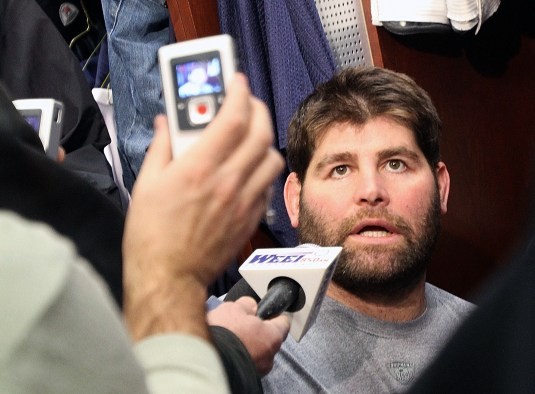
PHOTO: New England Patriots offensive lineman Stephen Neal won three Super Bowl rings in his 10-year NFL career.
Here’s what Belichick said:
“At the other end of the spectrum, when I was at New England there was a wrestler who was competing for the Olympics, but he wanted to make it to the NFL. He lost to Brock Lesner (in the U.S. Olympic trials), so I got call that said he wanted to play in the NFL.
“I asked if he played football. He hadn’t played football in high school or college, but he wanted to try out for the team. Alright. So, we brought him in, and he spent the first year on the practice squad. Then he started and won three Super Bowls. So, Stephen Neal started playing football at 24 years old, and he plays (10) years in the NFL. Pretty amazing story.”
To be fair, we all mix up names and dates when thinking back a couple decades. And his point was Neal only asked for an opportunity to prove himself, while too many of today’s athletes feel entitled.
Normally, I wouldn’t bother sitting down to write a story correcting Belichick on this kind of slip up. But if you respect the work ethic and skill of true wrestlers, you’re appalled to hear someone who should know better say Lesnar, who looked like he was fueled by steroids, denied Neal his Olympic dream.
Here’s what happened.
Neal finished the 1999 college wrestling season at Cal State Bakersfield with a second straight unbeaten NCAA championship title. He beat Lesnar in the final at Penn State’s arena. I was there covering the NCAA finals for the San Diego Union-Tribune.
Neal continued his career internationally with his eye on the 2000 USA team Olympic trials to earn a berth to the Olympics in Sydney, Australia. Five months after the NCAA finals, Neal won the 1999 World Championships gold medal in Ankara, Turkey.
But his Olympic dream was thwarted by one of those odd-matchup mysteries – like a weak baseball hitter who frustrates a great pitcher. The one wrestler in the world who could stop Neal was Kerry McCoy, a Penn State alumnus. Neal lost to McCoy in the 1997 NCAA finals when Neal was a sophomore and McCoy a senior.
Neal beat McCoy in another matchup, but he lost to McCoy in the 2000 U.S. Olympic team trial finals in Dallas. I was there for that epic battle.
McCoy earned the U.S. bid to the Sydney Games, but McCoy, who was competing against basically the same field Neal defeated in the World Championships, was unable to claim a medal of any shade.
Lesner was nowhere to be seen in the 1999 World Championships or 2000 Olympic competitions, although he did wrestle at Minnesota one more year and won the 2000 NCAA title. After college, Lesnar took the phony Hulk Hogan career path to acting in pro wrestling.
By 2004, though, Lesnar tried to make the NFL Minnesota Vikings roster. ESPN and other national media outlets fell all over themselves writing about Lesnar as he reported to training camp. Lesnar was cut. He never played in the NFL.
Lesnar’s career comes up short compared to Neal’s in another way. Neal won the 1999 Dan Hodge Award, the Heisman Trophy of college wrestling, and McCoy won it in 1997. Lesnar never earned it.
Coach Belichick, that’s why you should never mention Brock Lesnar in the same sentence as Stephen Neal. And I shouldn’t have to tell you that.
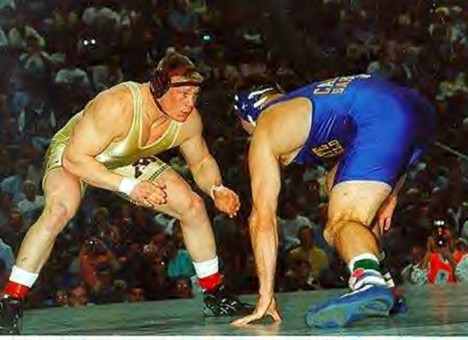
PHOTO: Cal State Bakersfield’s Stephen Neal defeated Minnesota’s Brock Lesnar the only time they met in the 1999 NCAA heavyweight championship match at Penn State’s arena. Neal won back-to-back unbeaten NCAA titles in 1998 and 1999.
To further understand how poorly Americans appreciate true wrestling, when Neal reported to the Patriots’ training camp as an unknown, teammates who had been to college with degrees asked him if he planned to go into pro wrestling.
Neal, who has more Dan Gable in him than Clark Gable, would calmly tell them, “I’m not into acting.”
But there’s one more Belichick correction I need to make. He said Neal didn’t play football until he was 24 years old.
Neal played football at San Diego High, and he planned to follow in his father’s basketball path in the winter season. Jack Neal had played at Hoover High in San Diego and in college for Lefty Driesell at Maryland. Jack once blocked a shot by the great Bill Walton when Bill was a junior at Helix High and Neal a senior.
But throughout Stephen Neal’s freshman year of high school football, a smallish teammate who wrestled in the lower weight classes jabbered in Neal’s ear that wrestling was tougher than football.
Neal scoffed at his friend. His friend challenged Neal to come out for wrestling. Neal planned to come out for one day, prove his point and then report to basketball practice. I know this story because I was the first write about Neal in the San Diego Union-Tribune. I was his Wendell Smith throughout his career.
“The first practice was so hard I almost died,” Neal told me. “I couldn’t quit. I had to prove I could take wrestling.”
One of Neal’s victims in high school wrestling was Patrick Henry’s Ricky Williams, the future Heisman Trophy winner in 1998 at Texas.
Throughout Neal’s college career, I wrote he said his goal was to make the Olympic team and then try the NFL. For me, writing this Neal story was so a fun trip down memory lane, and I have decided to sneak in another correction. This one was by one of my Union-Tribune sports editors, Stan McNeal.
At one point in Neal’s career McNeal grumbled condescendingly I was writing too much about Neal. He didn’t like I wrote Neal wanted to make an NFL team. Sometimes he buried the story.
McNeal never did say I was justified writing all the Neal stories (and probably more) as Neal continued collecting international wrestling and pro football titles – not to mention paychecks.
We all have something from our past that gnaws at us and needs a release. Yes, that felt good to write.
WAKE FOREST OFFENSIVE TACKLE/WRESTLER DEVIN KYLANY
Interestingly, Neal was on my mind at the ACC Kickoff media days in Charlotte prior to the Pigskin Preview in Raleigh.
Wake Forest was one of the teams at Wednesday’s ACC session. When senior offensive tackle Devin Kylany, a transfer portal arrival from Washington State, was at the podium, he was asked about his high school wrestling career.
“PSA to any high schooler who wants to play collegiate or wants to play in the trenches: Start wrestling,” Kylany said. “Wrestling is all about being in a powerful position and hand fighting, and those skills directly translate to offensive line play and defensive line play, and wrestling is some of the toughest training I’ve ever had to do in my life: Physical, one-on-one combat that you have to win.
“When you look at the bigger picture of football, it’s a whole bunch of one-on-one matchups happening at the same time. I thank my wrestling coaches, and I thank the wrestling team I was a part of for that.”
Kylany’s story, of course, reminded me of Stephen Neal’s tale. I shared it with Kylany at the breakout session, and he loved it. And, naturally, he wasn’t as surprised by Neals wrestling background as the average football fan.
-30-
Tom Shanahan is an award-winning sportswriter and frequent contributor to Spartanmag.com in addition to posting on his website. His new book on Michigan State leading college football integration is, “THE RIGHT THING TO DO, The True Pioneers of College Football Integration in the 1960s.” His first book was “RAYE OF LIGHT, Jimmy Raye, Duffy Daugherty, the Integration of College Football and the 1965-66 Michigan State Spartans.”
I invite you to follow me on Twitter @shanny4055
Below are links to click on to purchase my books focused.
My books tell the true story of college football integration in the 1960s and address the myths and fiction that allowed a false narrative surrounding the 1970 USC-Alabama game to usurp the credit from the true pioneers. As I said when I spoke at the National Sports Media Association book festival, no two books provide an accurate portrayal more than RAYE OF LIGHT and THE RIGHT THING TO DO.
I’ll put my facts up against anybody, anytime, anywhere. Watch here.
Click here for my story on the 1962 Rose Bowl and Segregation awarded first place by the Football Writers Association of America. I tell untold stories on Michigan State’s leading role and the true pioneers of college football integration. Click here to read the summary as a first-place story.
***
Click here to purchase The Right Thing To Do
THE RIGHT THING TO DO
The True Pioneers of College Football Integration in the 1960s
Foreword by Ruffin McNeill

***
Click here to purchase Raye of Light.
RAYE OF LIGHT
Jimmy Raye, Duffy Daugherty, the 1ntegration of College Football and the 1965-66 Michigan State Spartans
Foreword by Tony Dungy


