

Please ban Petros Papadakis from Duffy’s hallowed grounds
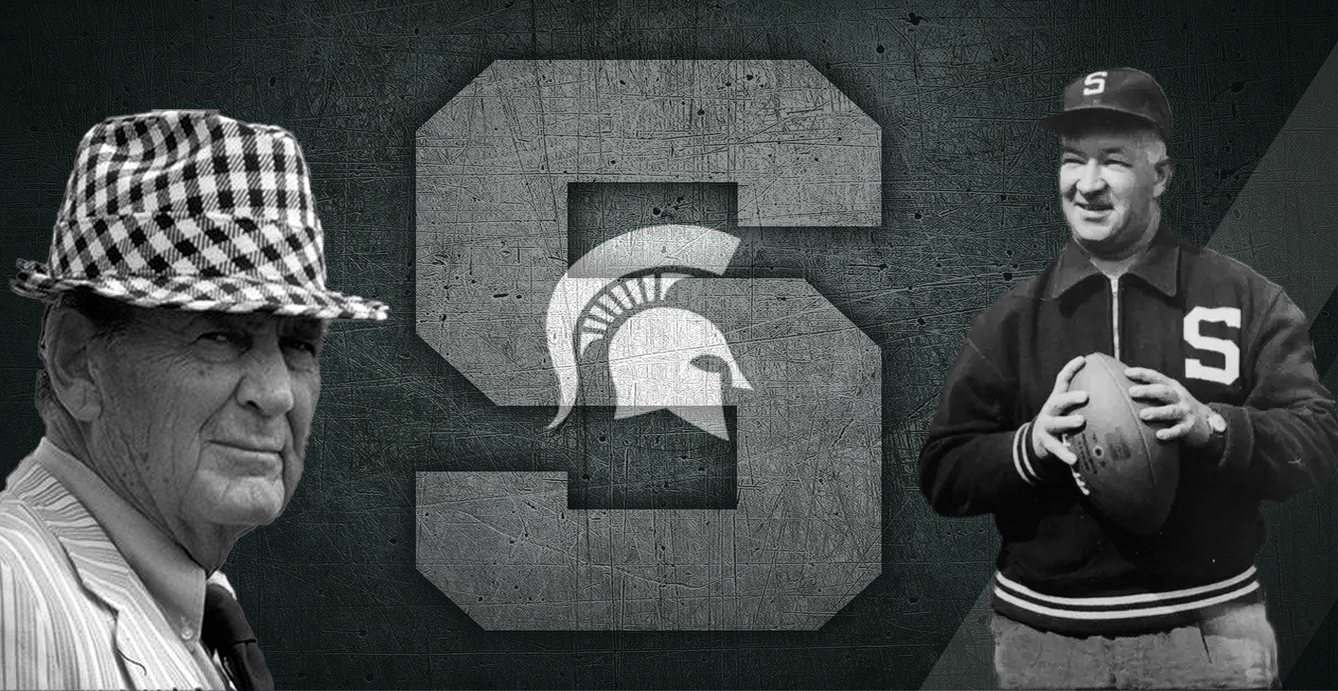
PHOTO: College football lore falsely credits the 1970 USC-Alabama game over Duffy Daugherty leading college football integration with his Michigan State teams.
Buy me a coffee to support my research to tell untold college football integration untold stories.
Thomas Shanahan | @Thomas-Shanahan-23
Order link:
Raye of Light: Jimmy Raye, The Integration of College Football 3rd Ed – August Publications
***
By TOM SHANAHAN
Here’s a hearty THANK YOU to the Fox Sports/Big Ten Network for the broadcast crew assigned to the Eastern Michigan-Michigan State game Saturday at Spartan Stadium. Matt Millen will serve as the analyst.
That’s not because I’m a Millen fan. It’s thanks for not assigning USC alumnus Petro Papadakis for a second straight week. Clearly, the assignment desk doesn’t understand the cruel irony of sending the son of John Papadaks to broadcast from Duffy Daugherty’s hallowed grounds.
John Papadakis, a former USC player on the Trojans’ 1970 team, was the primary driver among USC cronies selling the fairytale of the 1970 USC-Alabama game. The myth, crafted two decades after the game was played, falsely credits Alabama coach Bear Bryant for launching college football integration through that 1970 game at Legion Field in Birmingham.
As a result of sloppy journalism failing to vet the myth, Daugherty’s 1950s and 1960s legacy of blazing trails was shoved into Bryant’s shadows. The media bows at the knee of Bryant’s legend.
WHY THIS MATTERS
I once had the privilege of participating on a Zoom call with famed historian/documentarian Ken Burns. He was discussing unraveling myths vs. factual history.
I asked, Why the myth of the Bear Bryant/1970 USC-Alabama game changing college football integration in one night is entrenched in college football lore, while Duffy Daugherty’s two decades of leadership is lost to history.
He replied that Americans like their stories tied up into a nice bow. Bear Bryant waving a wand on night is a simple story to spread.
Duffy Daugherty challenging racial prejudice with a track record lasting throughout his 19-year career, 1954 to 1972, is complicated story to recite. It’s easy to get lost among the facts with many twists and turns.
Crediting Bryant and USC coach John McKay for leading college football integration in 1970 over Daugherty is like placing Barry Bonds, Mark McGwire and Sammy Sosa in charge of testing for performance enhancing drugs.
College football integration’s tipping point was Daugherty assembling the first fully integrated rosters in the 1960s. Daugherty was the first coach to ignore the unwritten quota limiting teams to a half-dozen or so Black players. His 1960s rosters were numbered in the 20s.
If you’re surprised to read that, it’s because the 1960s sports media avoided race. Daugherty’s milestones weren’t recorded.
On September 26,1964, Michigan State was the first fully integrated team to play in the South when the Spartans faced North Carolina at Kenan Stadium in segregated Chapel Hill. But the 1960s sports media avoided reporting on race. There was no mention of the milestone in the media. The press also ignored the Holiday Inn West in Durham, near Chapel Hill, defied the South’s Jim Crow customs by housing and serving the Spartans together.
That was six years prior to the 1970 USC-Alabama game.
The tipping point to college football integration was the 1966 Game of the Century matching No. 1 Notre Dame at No. 2 Michigan State on November 19 at Spartan Stadium.
That was four years before the 1970 USC-Alabama game.
The epic showdown launched the TV age with space-age satellite technology contributing to a record TV audience of 33 million out of a population of 195 million. Satellites allowed for first live broadcast to Hawaii – MSU’s roster included three Hawaiians, including Bob Apisa as the first Samoan All-Americna player — and U.S. troops serving in Vietnam.
The media didn’t report the racial contrast of rosters, but the nation saw it on screens in Black-and-White:
Michigan State lined up 20 Black players, 11 Black starters, two Black team captains, College Football Hall of Famers George Webster and Clinton Jones, and the South’s first Black quarterback to win a national title, Jimmy Raye, whom Duffy recruited out of segregated Fayetteville, N.C., aboard his Underground Railroad. Notre Dame lined up one Black player, Alan Page.
But Notre Dame wasn’t alone. USC, despite its diverse Southern California population, wasn’t much better in an era when college football followed an unwritten quota limiting Black athletes to a half-dozen or so.
USC lined up only five Black players on its 1962 national title team and only seven on its 1967 national championship roster. One of the seven was San Francisco City College import O.J. Simpson.
Another unreported fact about the 1970 USC-Alabama game was that the Trojans fielded only four Black starters. It’s true the Trojans numbered 18 Black players by 1970, but 11 were junior college (nine) or four-year school (two) transfers who arrived in 1969 or 1970.
Daugherty’s 1960s teams traveled parallel tracks to the Civil Rights movement. The Spartans influenced progress among brave pioneers lost to history who were the first Black players taking on Jim Crow and the Ku Klux Klan to desegregate southern programs.
They included Maryland’s Darryl Hill, 1963; Wake Forest’s Bob Grant and Butch Henry, 1964, Southern Methodist’s Jerry Levias, 1965; Kentucky’s Nate Northington and Greg Page, 1966; Tennessee’s Lester McClain, 1967; and Auburn’s James Owens, 1969.
To state Bryant saw the future with the 1970 game is wrong. He was catching up. Alabama was the seventh of 10 Southeastern Conference programs with its first Black recruit in 1970. By then, 33 of 37 major southern programs were integrated.
None of this was reported in real time, though.
ABC’s legendary Chris Schenkel, who broadcast the 1966 Game of the Century, said Michigan State College Football Hall of Famer Bubba Smith was from Beaumont, Texas. There wasn’t a word about Smith boarding Daugherty’s Underground Railroad to escape segregated Texas. Nor a word about Smith’s father, Willie Ray Smith Sr., a legendary Texas high school coach during segregation, steering his son to Daugherty. He and other Black high school coaches in the South trusted Daugherty. Duffy didn’t recruit the South. The South recruited Duffy.
Sports Illustrated magazine’s Dan Jenkins, the godfather of sportswriters, identified Raye as having a mustache. There wasn’t a word about his race as a transformative quarterback (and later college and NFL coach).
Negligent 1960s sports journalism failing to report racial milestones persisted until 1968. On July 1, 1968, Sports Illustrated published a landmark article as part of series: “The Black Athlete: A Shameful Story.” By the time of the 1968 Mexico City Olympics with Black protests, there was no turning back.
But the lack of 1960s national awareness created a void. John Papadakis and USC backers filled it without understanding the many milestones Daugherty and southern pioneers established.
In 1966, Wake Forest played at Auburn, and Auburn coach Shug Jordan helped find a hotel and caterer that served Wake Forest’s Black players.
In 1968, SMU All-American Jerry Levias scored eight points in the Mustangs’ win at Auburn.
In 1969, Tennessee’s integrated roster routed Alabama 41-14 at Legion Field in Birmingham. Linebacker Jackie Walker, the SEC’s first Black All-American, intercepted a first quarter pass he returned for a 21-0 lead.
On the same 1970 day that USC played at Alabama, September 12, Stanford upset No. 4-ranked Arkansas at War Memorial Stadium in Little Rock, and Georgia Tech’s Eddie McAshan, the Deep South’s first Black starting quarterback, led an upset up integrated South Carolina at Grant Field in Atlanta.
I’ve had members of the Alabama and USC media tell me I got the story correct about Bryant myths. One Alabama social media poster told me the only thing true about the 1970 USC-Alabama game was the final score, USC 42, Alabama 21. But no one writes it or broadcasts it. They’re afraid of the backlash challenging Bear Bryant’s legend.
If Michigan State finally places a statue of Duffy on campus for TV cameras to show and announcers to explain, maybe perception will change. A Duffy statue is a tribute to his integration leadership as well as his White players accepting the leadership of their Black teammates.
That racial harmony wasn’t happening at other schools until the 1970s.
In a 2025 USC-based podcast, Charle Young, a USC sophomore in 1970 and College Football Hall of Famer, said resentment among older White players losing starting jobs to younger Black players led to the Trojans’ disappointing 1970 and 1971. They finished with 6-4-1 records and no bowl trips. The 1972 Trojans, with Young and Cunningham seniors and Lynn Swann a junior, won the national title. The Spartans’ 1965 and 1966 national title teams played with such leadership ahead of its time.
Another example I learned from Michigan State’s Jerry West, an All-American offensive tackle on the Spartans’ 1966 team who was from Durand. He told me a high school teammate who played at Wyoming said the Cowboys’ Black players were forced to dress in a separate corner of the locker room.
To be clear, this isn’t criticism of Petros Papadakis. He knows football and does a good job. But, based on his broadcasts of MSU games, he knows nothing about Duffy changing the face of college football.
A Papadakis should never be allowed within Duffy’s hallowed grounds.
-30-
I will debate all of the above with anyone, anywhere, anytime. The next Alabama or USC sports talk show to invite me on to challenge Bear Bryant/1970 USC-Alabama myths will be the first. The other southern stations are Adam Gold on 99.9 The Fan Raleigh and Joe Rexrode on 102.5 The Game in Nashville.
I consulted former New York Times executive editor Howell Raines on exposing the Bryant myths. He advised me I needed to determine if it the myth was crafted duplicitously or out innocently out of ignorance. I determined the USC backers simply didn’t know 1960s history — their own or in the South.
This story is only USC’s Charle Young exposing a racial divide on the 1970 and 1972 teams.
Duffy’s 1985 Knoxville response to Bear Bryant – Tom Shanahan Report
My lengthy catalogue of 1970 USC-Alabama myths and Bear Bryant fairytales – Tom Shanahan Report
***
— Visit my homepage: TomShanahan.Report
— Watch a three-minute video to learn about our documentary at the fundraising stage, GAME CHANGERS OF THE CENTURY, and the Investment Deck.
I invite you to follow me on Twitter @shanny4055
I’ll put my facts on the true pioneers of college football integration versus Bear Bryant fairytales against anybody, anytime, anywhere. Watch here.
Click here for my story on the 1962 Rose Bowl and Segregation and Alabama that earned first place for Enterprise from the Football Writers Association of American.

— Tom Shanahan is an award-winning sportswriter with two books on college football integration, “RAYE OF LIGHT, Jimmy Raye, Duffy Daugherty, the Integration of College Football and the 1965-66 Michigan State Spartans,” and “THE RIGHT THING TO DO, The True Pioneers of College Football Integration in the 1960s.” They are the most accurate accounts of college football integration in the 1950s and 1960s. They also debunk myths about the 1970 USC-Alabama game. The false narrative co-opted the stories of the true pioneers who stood up to Jim Crow and the KKK.
— Two children’s books also explain Michigan State College Football Hall of Fame coach Duffy Daugherty’s impact on integration through the Underground Railroad and the Hawaiian Pipeline: “DUFFY’S COLLEGE FOOTBALL UNDERGROUND RAILROAD” and “HOW DUFFY PUT HAWAII ON AMERICA’S FOOTBALL MAP.”
***
PURCHASE LINKS, non-fiction books
— RAYE OF LIGHT,
Raye of Light: Jimmy Raye, The Integration of College Football 3rd Ed – August Publications
or on Amazon.
— THE RIGHT THING TO DO, August Publications or on Amazon.
PURCHASE LINKS, children’s books
— DUFFY’S COLLEGE FOOTBALL UNDERGROUND RAILROAD: Order from Barnes and Noble here and Amazon here.
— HOW DUFFY PUT HAWAII ON AMERICA’S FOOTBALL MAP. Order here:
How Duffy Put Hawaii On America’s Football Map by Tom Shanahan, Paperback | Barnes & Noble®
Amazon.com: How Duffy Put Hawaii On America’s Football Map eBook : Shanahan, Tom: Kindle Store