


PART II: Past is prelude, and Michigan State is back to 1980
PHOTO: Duffy Daugherty with quarterback Jimmy Raye. Daugherty launched the coaching careers of Sherman Lewis and Jimmy Raye. Lewis and Raye mentored Tyrone Willingham to get into coaching. he Spartans passed on hiring all three from Daugherty’s tree.
***
Visit my homepage: TomShanahan.Report
— Click here for review and purchase link: THE RIGHT THING TO DO, The True Pioneers of College Football Integration in the 1960s and here for a purchase link to RAYE OF LIGHT, Jimmy Raye, Duffy Daugherty, the Integration of College Football and the 1965-66 Michigan State Spartans.
— Watch a three-minute video to learn about our documentary at the fundraising stage, GAME CHANGERS OF THE CENTURY, and the Investment Deck.
— Documentary synopsis: Duffy documentary snynopsis.pdf – Google Drive
— How Duffy Daugherty and the MSU Team Changed College Football History
— My FWAA first-place story on the 1962 Rose Bowl and segregation
***
— PART I: Past is prelude for Michigan State football – Tom Shanahan Report
***
“The past is the present, isn’t it? It’s the future, too.”
— Eugene O’Neill from a “Long Day’s Journey into Night.”
By TOM SHANAHAN
By 1980 the season, Michigan State’s past administrations and hires of Denny Stolz and Darry Rogers had distanced the Spartans’ program from the Daugherty legacy. Stolz set out on his own path and Rogers arrived from San Jose State.
They school also surrendered the Spartans’ Great Lakes State preeminence under Biggie Munn (1947-53) and the assistant he brought with him and who succeeded him as head coach, Duffy Daugherty (1954-72). Daugherty beat Michigan one last time in 1969, but he lost his last three games, Stolz was 0-3 and Rogers 1-3.
Michigan State cut its football budget after 1969 when Hannah left the school to run U.S. Agency for International Development — the same office Elon Musk dismantled last winter. With Hannah gone, the charge that Michigan State deemphasized football was personified in 1980 by hiring Muddy Waters, who was 57 years old — 57 in 1980 was 67 today — and had no Division I experience. Three years of football blues ended with Waters’ records of 3-8, 5-6 and 2-9.
The Spartans followed Waters with George Perles, who rebuilt the program with a 1987 Big Ten title and Rose Bowl victory. But power-hungry Perles became distracted by his pursuit of the dual role as athletic director and football coach. Recruiting fell off. His final four seasons ended in chaos. Perles’ 5-6 record 1994 was changed to 0-11 for NCAA violations. Perles’ record his last four seasons was officially 14-31-1.
Here’s some of that cruel irony: The 1994 season also was McCartney’s last before he retired. In those same four seasons as Perles, 1991 to 1994, McCartney was 36-9-3.
Waters and Perles were Michigan State alums, but the Spartans lost more than games by the end of 1994. Past administrations abandoned Daugherty’s legacy of winning national championships and the school’s identity leading college football integration.
Worse, forsaking Daugherty’s history allowed imposters, USC and Alabama coach Bear Bryant, to claim Duffy’s torch leading the way. The national media’s sloppy journalism has been duped by a fairytale based on the 1970 USC-Alabama game crafted two decades after the game was played.
But this isn’t just about McCartney, a Missouri graduate who also had a background coaching at Detroit high schools before Schembechler hired him. What if Michigan State’s administration in the 1980s and 1990s was as forward-thinking as Daugherty in the 1950s and 1960s?
In 1980, Sherman Lewis hoped to be promoted from assistant on Rogers’ staff. Lewis, who was hired by Daugherty in 1969 as one of college football’s first Black coaches, was later retained by Stolz in 1973 and Rogers in 1976. He was a former Daugherty player and Underground Railroad passenger recruited out of segregated Louisville, Kentucky. He was a 1963 All-American halfback and third in the Heisman Trophy voting.
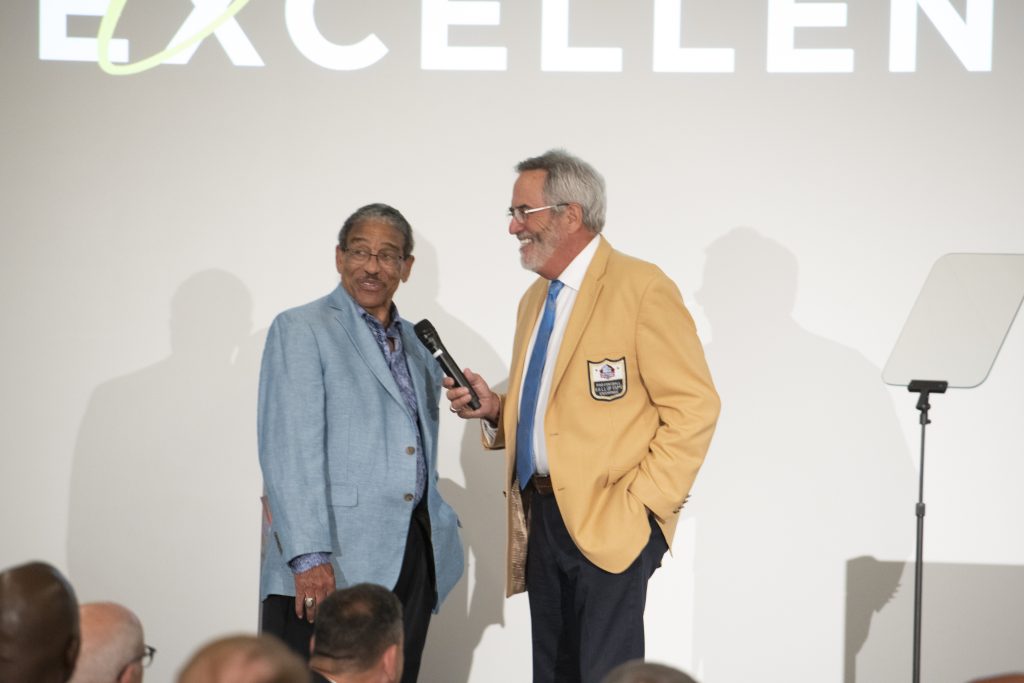
PHOTO: Pro Football Hall of Famer Dan Fouts interviews Sherman Lewis in 2023 upon the Pro Football Hall of Fame presenting with the NFL Awards of Excellence.
“The Michigan State job would have been the greatest thing that ever happened to me,” said Lewis on Page 269 of ‘RAYE OF LIGHT, Jimmy Raye, Duffy Daugherty, the Integration of College Football and the 1965-66 Michigan State Spartans.’ “I love that place so much. I felt I could have recruited, hired a great staff and done the job. I’ve always thought it was a great institution with great facilities. It’s the most beautiful campus in the country. They just needed to recruit better. I felt we could be playing for national titles again.”
At the time, Lewis was 38 years old. Don’t say Lewis wasn’t fit to be a head coach at his age without experience as a coordinator. In 2008, Clemson promoted 39-year-old Dabo Swinney, who had no coordinator experience, as head coach. That hire turned out well.
Lewis went on to the NFL, serving 21 seasons as an assistant and offensive coordinator. He won three Super Bowl rings with the San Francisco 49ers and one with Green Bay as the Packers’ OC.
Michigan State passed on Lewis again in 1995, when it hired Nick Saban. Back then, Nick Saban wasn’t Nick Saban. He was 25-22-1 in his first four MSU seasons before a 9-2 record in 1999. Then, without coaching in the 1999 season’s bowl game, he left for LSU.
Saban never won a Big Ten title in his five seasons. Perles claimed two conference titles in his fifth season (1987) and eighth (1990). Later, Mark Dantonio won three as the Spartans’ head coach in his fourth, 2010; seventh, 2013; and ninth, 2015.
In 1995, Michigan State also passed on another Daugherty legacy, Jimmy Raye. He was the South’s first Black quarterback to win a national title on Duffy’s 1965 and 1966 national title teams and later a pioneering coach. Daugherty recruited Raye out of segregated Fayetteville, N.C., and hired him as an assistant coach in 1972.
Raye’s place in history wasn’t understood by Michigan State until the research was revealed with the publication of RAYE OF LIGHT, in 2014. He was enshrined in the MSU Hall of Fame, 2018.
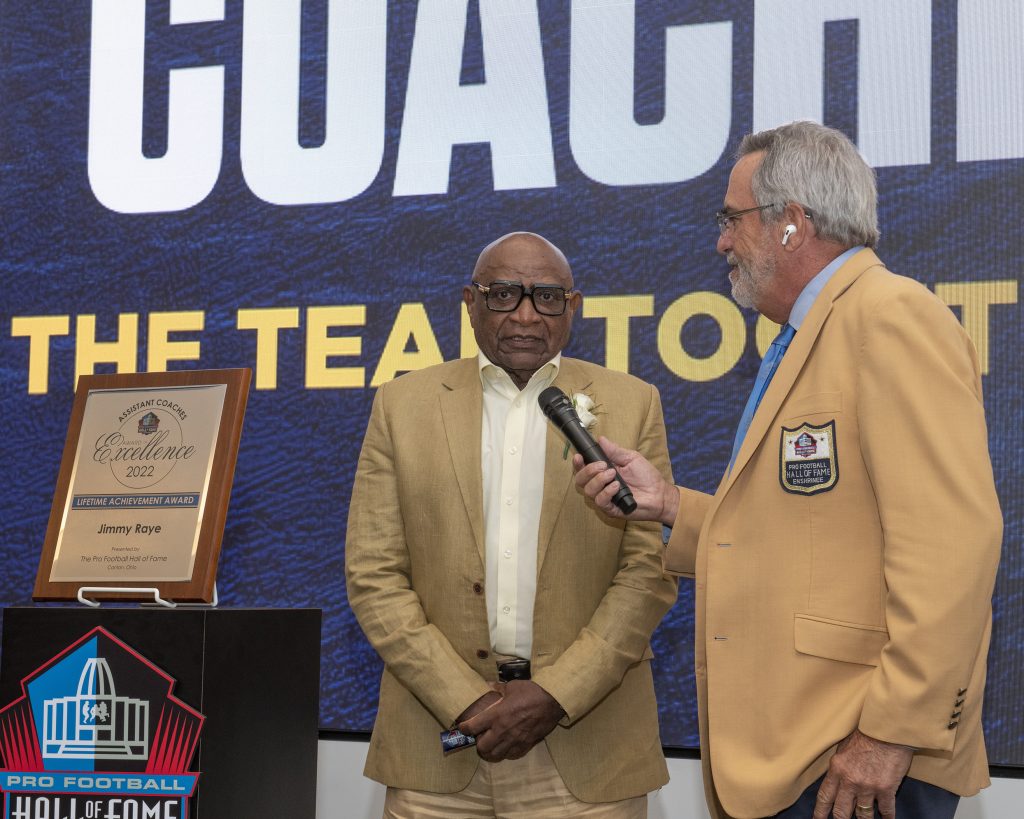
PHOTO: Jimmy Raye, interviewed by Pro Football Hall of Fame quarterback Dan Fouts, was honored in the NFL Awards of Excellence inaugural 2022 class.
Raye joined the NFL in 1977. He was the NFL’s second Black coordinator when hired by the Los Angeles Rams’ John Robinson in 1983.
Michigan State also passed on Raye again in 2003. Then-athletic director Ron Mason, whose travel plans were altered by a snowstorm, asked Raye if he could interview him on the phone rather than in person (Page 278, “RAYE OF LIGHT”). Raye knew what that lack of thoroughness meant.
Mason hired outside Daugherty’s tree, naming John L. Smith of Louisville. Smith was fired after four years with a 22-26 record, 0-4 against Michigan.
Smith, showing his lack of MSU history knowledge, got in a tiff with Hawaii coach June Jones, turning Hawaii fans against the Spartans when MSU’s basketball team played at Hawaii. Smith didn’t understand Hawaii adopted Michigan State as its team in the 1960s based on Daugherty’ success recruiting Hawaiian players, including Bob Apisa of Honolulu Farrington as college football’s first Samoan All-American player, 1965 and 1966.
We can’t say for sure, of course, if Lewis and Raye would have been successful head coaches. But we know in 2022 the Pro Football Hall of Fame honored Raye in its inaugural class for the NFL Awards of Excellence and in 2023 honored Lewis with the same award. Daugherty’s fingerprints are also on the NFL.
Another Daugherty disciple from the time frame was Tyrone Willingham. He was a member of Daugherty’s last Underground Railroad class in 1972 out of Jacksonville, N.C. Although the state was desegregated by Willingham’s high school years, he grew up largely under the thumb of Jim Crow.
Willingham was the first Black head coach to take a team to the Rose Bowl (Stanford, 1999) and the first Black head coach in any sport at Notre Dame (2002-04). Willingham’s 1996 Stanford team defeated Saban’s Spartans in the Sun Bowl, 38-0. Both teams were 6-5 entering the game.
Willingham’s Michigan State biography can’t be written without noting Michigan State left it to others to identify him as head coaching material. Willingham was hired by Condoleezza Rice in her time as Stanford provost before she was U.S. Secretary of State under President George W. Bush. In 1995, Willingham was 41 years old with no experience as a coordinator.
Imagine that, Michigan State. (Note: Jimmy Raye had a decade of NFL coordinator experience by the time decision-makers passed on him in 1995 and again in 2003.)
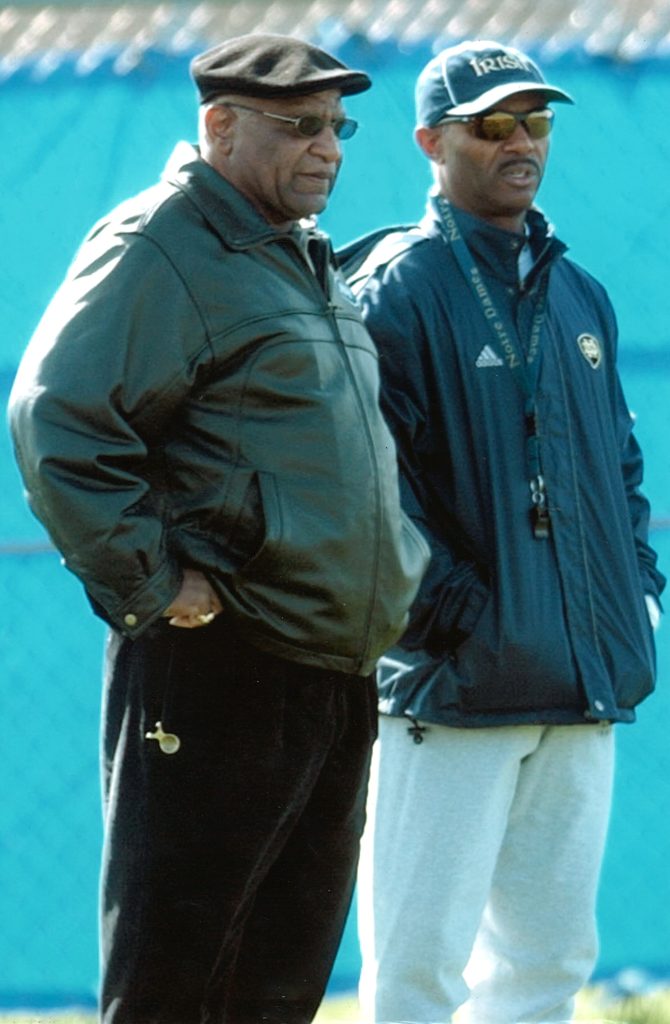
PHOTO: Jimmy Raye as an NFL assistant coach scouting Notre Dame talent when Tryone Willingham was the Irish’s head coach.
Although we can’t know if Lewis, Raye or Willingham would have enjoyed success leading Michigan State’s program, we know they would have celebrated the school’s Daugherty history. And we know Michigan State’s head coaches chosen over them didn’t teach or fully grasp MSU’s history.
Sadly, that includes Perles, who played for Duffy and coached under him. George turned more interested in his own legacy. He talked about Duffy as if George was Duffy’s favorite son, but he didn’t explain the significance of Daugherty’s career coaching college football’s first fully integrated rosters.
NFL veteran quarterback Tony Banks, who played for Perles in 1994 and Saban in 1995, told me he didn’t know Raye’s story until he played for Raye at Washington when Raye was the Redskins’ OC.
East Carolina quarterback Katin Houser, a Michigan State 4-star recruit in 2022 who left the Spartans after the 2023 season through the transfer portal, told me he wasn’t told Raye’s story.
That’s not Banks’ or Hauser’s fault. It’s Michigan State’s negligence.
The players might briefly hear about Michigan State’s history during the Civil Rights years, but they don’t learn enough to grasp Daugherty is a singular story. Michigan State has never understood Daugherty stood apart in college football. It has accepted the mistaken narrative that the Spartans were grouped with Minnesota and Illinois in those days. Only Michigan State’s rosters were fully integrated prior to the late 1960s.
The tipping point was the 1966 Game of the Century, Notre Dame at Michigan State. Michigan State lined up 20 Black players, 11 Black starters, two Black team captains, College Football Hall of Famers George Webster and Clinton Jones, and Raye breaking ground as a Black quarterback. Notre Dame had one Black player, Alan Page.
Michigan State was the future. Notre Dame and USC — the Trojans numbered only five Black players on the 1962 national title team and seven on their 1967 national championship roster — were the past.
Here’s my final point related to Michigan State losing out on McCartney and foolishly abandoning its Daugherty legacy. In 2015, ESPN produced a documentary on McCartney for its 30-for-30 series: “The Gospel of Mac.” The film covered McCartney’s success on the field and his deep religious beliefs. It also credited him as a leader recruiting Black athletes.
For teams in the 1980s and 1990s!
McCartney’s “progressive” years were a quarter-century after Daugherty assembled college football’s first fully integrated rosters in the 1960s. The 1964 Spartans were the first fully integrated team to play in the South when they faced North Carolina at Kenan Stadium in segregated Chapel Hill.
My hope is whoever coaches Michigan State in 2026 comprehends the significance of Daugherty’s legacy part and uses it as the program’s identity.
If Michigan State doesn’t understand its history, how are ESPN or the Big Ten Network going to get it? The don’t, believe me. I’ve tried pitching them and others. (Note: if you’re a potential investor, contact me about our documentary in development, Game Changers of the Century.)
Only NFL 360 has produced a documentary related to Daugherty following the Declaration of Independence and U.S. Constitution. “The Indelible Legacy of Jimmy Raye” explains his pioneering playing and coaching careers influenced by Daugherty.
The film was directed and produced by Osahon Tongo, who won a Sports Emmy for the film. Tongo and Raye were honored on the same New York stage on the same night that Bryant Gumble was honored with a lifetime achievement award.
The same Bryant Gumble whom I pitched a decade ago for a story on his HBO show Real Sports upon publication of RAYE OF LIGHT. Gumble told me in an email his “younger audience wouldn’t understand the story.”
Tongo, an African American and former Georgia Tech football player, explained to me that as college football player born after the Civil Rights movement, he wanted to learn what it was like for a Black athlete and coach to overcome Jim Crow. He wanted his film to educate people.
Imagine that, Bryant.
Of course, we can’t look only at the past. We need to seek a future. Dantonio’s 13 seasons, 2007 to 2019, restored the Munn/Daugherty world order with three Big Ten titles and an 8-5 record against Michigan. But six years later the Spartans are back where they were in 1980.
Worse, there’s no George Perles, Sherman Lewis, Jimmy Raye or Tyrone Willingham available in the wings with a Michigan State history background. Who might have been a Lewis, Raye or Willingham mentee in the coaching world now?
The Spartans lost touch with their history without understanding Daugherty is a singular story. Michigan State is not another Minnesota or Illinois, which is a simplistic summary the Spartans have allowed to overshadow their own story.
Ken Burns, the historian and award-winning documentarian, says, “We tend to resort to conventional, superficial understandings, tying things up to nice bows.” Burns’ deeper research avoids such simplicity.
That explains Michigan State’s failure. The school has allowed ESPN, the Big Ten Network and the national media to erroneously reduce the Spartans’ singular story to a common one tied in a bow with Minnesota and Illinois.
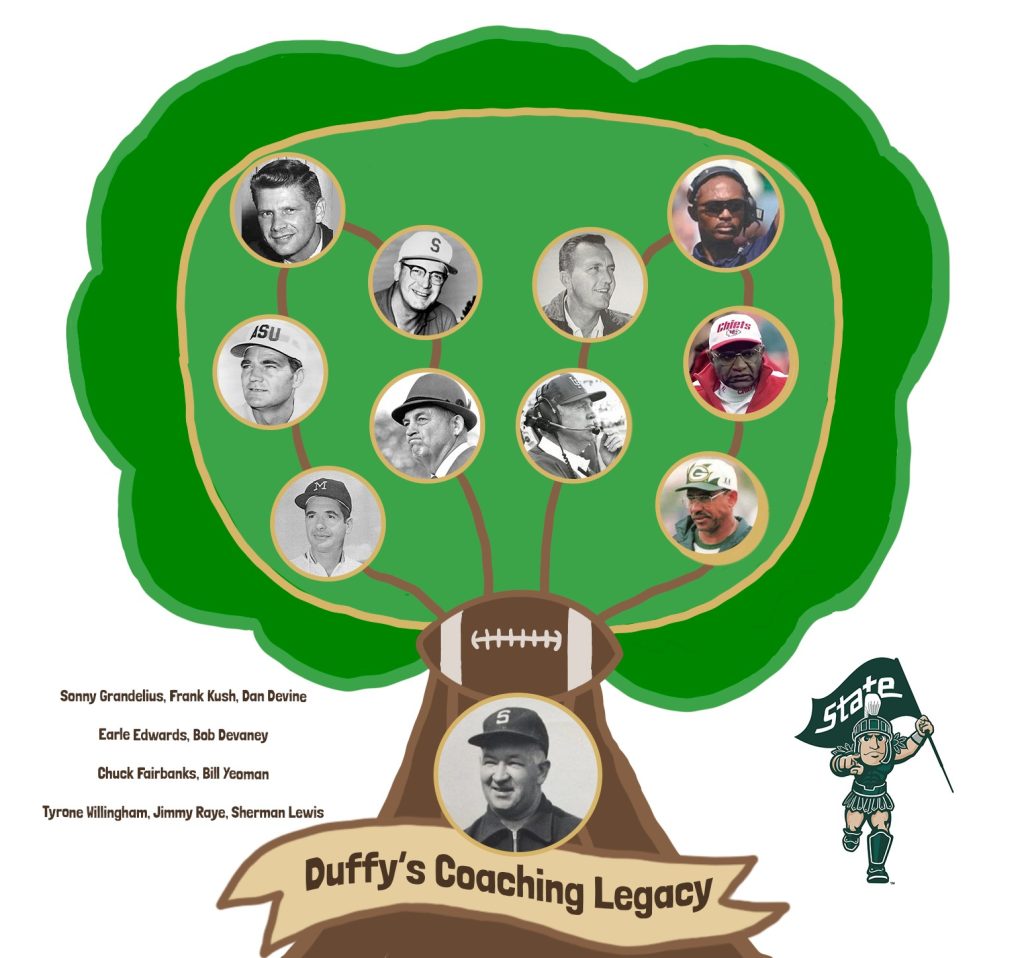
Michigan State has never grasped Daugherty’s deeper story that brought to an end of the college football’s unwritten quota limiting Black athletes to a half-dozen or so. Daugherty did it at Michigan State, and his assistants upon becoming head coaches, followed his blueprint.
They include Dan Devine (Arizona State, Missouri, Notre Dame), Bob Devaney (Wyoming, Nebraska), Bill Yeoman (Houston) and Sonny Grandelius (Colorado). Three others Spartans were former players Frank Kush (Devine’s ASU successor) and Chuck Fairbanks (Oklahoma) and former MSU assistant alongside Daugherty on Munn’s staff, Earle Edwards (North Carolina State).
In the 1966 Game of the Century matching Notre Dame at Michigan State, the Spartans numbered 20 Black players, 11 Black starters, two Black team captains, College Football Hall of Famers George Webster and Clinton Jones, and Raye breaking ground as the South’s first Black quarterback to win a national title.
Notre Dame numbered only one Black player, Alan Page. USC included only five Black players on its 1962 national title team and seven on its 1967 national championship roster. Notre Dame, USC and others were the past. Michigan State was the future.
All of the above is what you’ll learn from reading, “THE RIGHT THING TO DO, The True Pioneers of College Football Integration in the 1960s.”
Imagine if 31 years ago Michigan State ignored retiring basketball coach Jud Heathcote’s recommendation to promote Tom Izzo. Imagine if the Spartans turned away from Heathcote’s foundation built in 19 seasons.
We’re a long time removed from the Daugherty years, but his history that has been overlooked was written. It just needs to be dusted off. Michigan State can still recapture its Daugherty legacy and hang its hat on such a championship identity that changed the face of the game. That’s true whether Smith returns in 2026 or a change is made.
But only if the school learns to teach its own history to its players, students, and alumni. Otherwise, Daugherty unjustly remains in the shadow of a Bryant fairytale, and the rest of college football never understands Duffy’s rightful place in college football lore.
President Harry S. Truman said, “The only thing new in the world is the history you don’t know.” Daugherty’s history isn’t new, but it’s unknown among too many Spartans and college football fans in general.
-30-
invite you to follow me on Twitter @shanny4055
I’ll put my facts on the true pioneers of college football integration versus Bear Bryant fairytales against anybody, anytime, anywhere. Watch here.
Click here for my story on the 1962 Rose Bowl and Segregation and Alabama.

— Tom Shanahan is an award-winning sportswriter with two books on college football integration, “RAYE OF LIGHT, Jimmy Raye, Duffy Daugherty, the Integration of College Football and the 1965-66 Michigan State Spartans,” and “THE RIGHT THING TO DO, The True Pioneers of College Football Integration in the 1960s.” They are the most accurate accounts of college football integration in the 1950s and 1960s. They also debunk myths about the 1970 USC-Alabama game. The false narrative co-opted the stories of the true pioneers who stood up to Jim Crow and the KKK.
— Two children’s books also explain Michigan State College Football Hall of Fame coach Duffy Daugherty’s impact on integration through the Underground Railroad and the Hawaiian Pipeline: “DUFFY’S COLLEGE FOOTBALL UNDERGROUND RAILROAD” and “HOW DUFFY PUT HAWAII ON AMERICA’S FOOTBALL MAP.”
***
PURCHASE LINKS, non-fiction books
— RAYE OF LIGHT, August Publications or on Amazon.
— THE RIGHT THING TO DO, August Publications or on Amazon.
PURCHASE LINKS, children’s books
— DUFFY’S COLLEGE FOOTBALL UNDERGROUND RAILROAD, Order from Barnes and Noble here and Amazon here.
— HOW DUFFY PUT HAWAII ON AMERICA’S FOOTBALL MAP, coming soon on Barnes and Noble and Amazon.

