
WRITTEN OUT OF HISTORY: Here’s how Wikipedia aids sloppy journalism promoting 1970 Bear Bryant fairytales at expense of Duffy and true 1960s pioneers
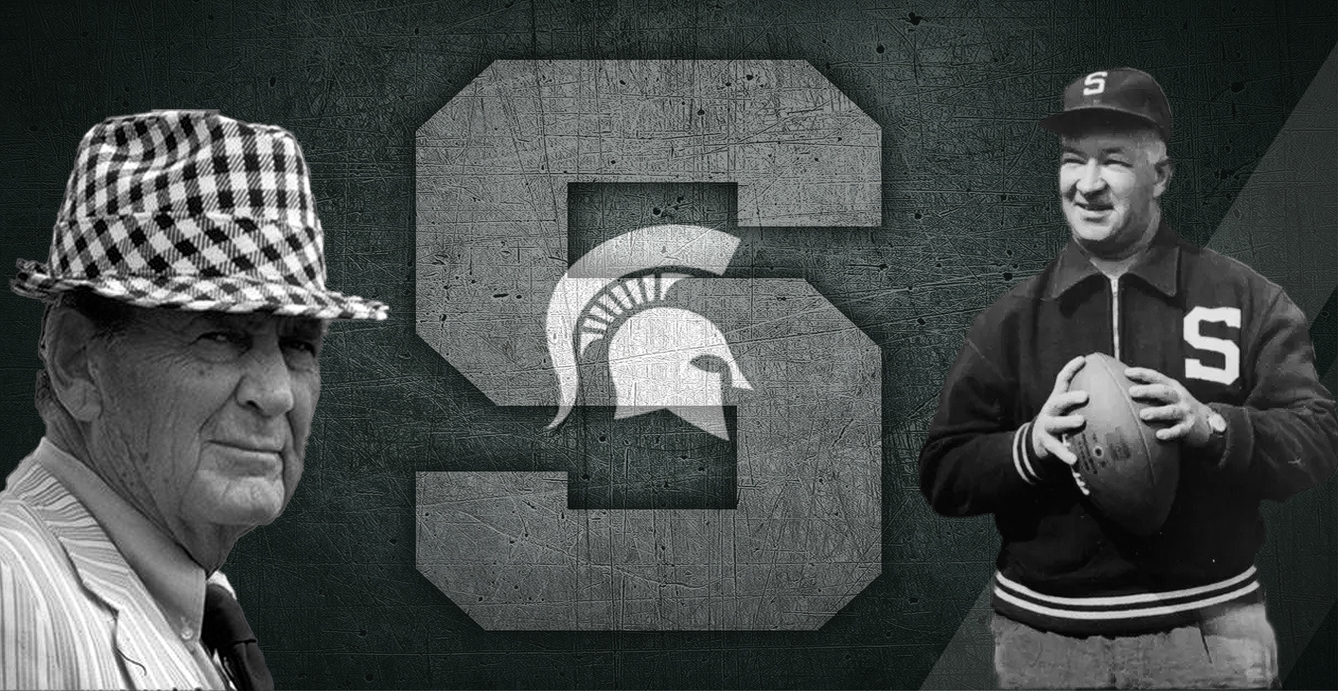
PHOTO: Bear Bryant and Duffy Daugherty are balanced in this graphic but not when it comes to the media explaining college football integration leadership. Daugherty is a paragon. Bryant led from behind.
Buy me a coffee to support my research to tell untold college football integration untold stories.
Thomas Shanahan | @Thomas-Shanahan-23
Watch our documentary development trailer: Game Changers
***
“History writes people out of the story. It’s our job to write them back in.”
— Pulitzer Prize winner David Maraniss
By TOM SHANAHAN
As a long-time newspaper sportswriter, I scoffed at people who said, “You can’t believe what you read in the paper.” They just didn’t like reading painful truths.
Well, upon researching two books, RAYE OF LIGHT and THE RIGHT THING TO DO, and devoting a website, TomShanahan.Report, to explaining Michigan State coach Duffy Daugherty’s factual story of leading college football integration in the 1960s, I’ve learned the Internet age is different.
This story explains how negligent sports journalism avoided the true stories of college football integration in the 1960s and the failure was compounded by sloppy journalism from the 1990s into the 21st century. Fairytales about Alabama coach Bear Bryant’s role filled the void with false narratives surrounding the 1970 USC-Alabama game as a pivotal moment.
The stories about Daugherty’s 1960s teams and the brave pioneers who desegregated southern programs – beginning in 1963 – aren’t found in the Internet ether archives and thus not posted on the website Wikipedia. At the same time, a plethora of stories promoting unvetted stories — based on a myth made up two decades after the game was played — flood Wikipedia pages.
You can read the true stories of those written out history here:
Now, let me make this clear: I use Wikipedia as a source of information. Its consistent format makes it easy to find biographical information on a player’s paths from their early days to college or the pros. The same is true about players turned coaches. You don’t have to sift through the bio of a team page that may not contain such earlier information.
Having said that, though, you need to be careful with facts found in Wikipedia stories. I’m still waiting for ESPN to correct a 2013 story claiming Bryant and Clemson coach Frank Howard sent Daugherty his southern Black stars to escape segregation. Adam Rittenberg, who wrote that ESPN story and still writes for ESPN, has never responded to me.
The evidence reveals it was southern Black high school coaches who sent Daugherty players. They trusted him. But you won’t find that on Daugherty’s Wikipedia page.
One reason Daugherty is lost to history and Bryant falsely praised was the 1960s sports media avoided race until it was no longer unavoidable following the Black athlete protests surrounding the 1968 Olympics. So, Duffy’s many 1960s milestones weren’t reported.
Another is sloppy journalism bending at the knee of Bryant’s royal legend. Stories of the unvetted myths about the 1970 USC-Alabama game are regurgitated as facts. The media, I’ve found, including nationally prominent journalists, is afraid of challenging Bryant myths — even at the expense of the truth.
Here’s what can go wrong when website editors and TV producers rely on archived stories about college football integration in the 1960s:
NBC Sports dropped the ball with its coverage of Michigan State playing Notre Dame on September 19 to honor the 60th anniversary of the 1966 Game of the Century. The NBC producers provided announcers Noah Eagle and Todd Blackledge with erroneous information.
Below is a link noting the second paragraph of a Wiki story posted on USC’s 1970 season.
1970 USC Trojans football team – Wikipedia
In that second paragraph, three of the four are misleading or inaccurate. The fourth is completely wrong. Curiously, the Bryant myth can be summed up in four sentences, but it requires paragraphs to explain the holes in the accepted narrative. Why is that? Ken Burns, the awarding winning historian and documentarian, explains:
“Americans like their stories tied up in a nice little bow.”
— First sentence: On September 12, 1970, USC opened the season visiting the University of Alabama under coach Bear Bryant and became the first fully integrated team to play in the State of Alabama.[2]
Although it’s true Alabama’s 1970 roster numbered 18 Black players, the “fully integrated team to play in the State of Alabama” description allows the Bryant myth to get around facts.
Of the 18, 11 weren’t recruited until the 1969 and 1970 classes. Nine were junior college transfers and two four-year school transfers. And Black athletes bravely integrating southern programs in the 1960s were appearing in games in the state of Alabama and throughout the Jim Crow South. Those players and schools are highlighted later in this story.
Until the late 1960s, USC coach John McKay followed college football’s unwritten quota limiting Black athletes to a half-dozen or so. USC’s 1962 national title numbered only five Black players. It’s 1967 national championship team only seven, with San Francisco City College import O.J. Simpson.
As a result of USC shedding its quota limit, there were only four Black starters for the game at Legion Field in Birmingham: Senior tailback Clarence Davis, East Los Angeles JC; senior defensive end Charlie Weaver, Arizona Western JC; senior defensive end Tody Smith, Michigan State; and junior quarterback Jimmy Jones, a high school recruit from Harrisburg, Pennsylvania.
Only Davis, a Washington High graduate, was from a Los Angeles-area high school. Are we to believe out of all of populous and divers Los Angeles that Davis was the only Black player in his class worthy of a USC starting job.
In 1966, Wake Forest (Winston-Salem, N.C.), with two Black athletes, lost a game at Auburn.
In 1968, Southern Methodist (Dallas, Texas), with three Black players, won at Auburn.
On October 19, 969, integrated Tennessee routed Alabama 41-14 at Legion Field. Tennessee’s Jackie Walker, the SEC’s first Black All-American player, returned a Pick Six to give the Volunteers a 21-0 lead in the first quarter. That had to be an eye-opener a year before USC arrived.
There’s more. On the same night USC played at Alabama, Stanford’s integrated roster upset No. 4-ranked Arkansas at War Memorial Stadium in Little Rock. Also on September 12, George Tech quarterback Eddie McAshan was the first Black starting quarterback in the Deep South. He led an upset of No. 17 South Carolina, which included its first Black player.
None of this is found in stories posted on Wikipedia.
In 1964, Michigan State was the first fully integrated team to play in South in a game against North Carolina in segregated Chapel Hill. MSU’s Clinton Jones, a College Football Hall of Famer, was the first Black player to score a touchdown in Kenan Stadium on a 42-yard run.
You can read about how the milestone wasn’t reported here: WRITTEN OUT OF HISTORY, Part I: Durham hotel housing Michigan State in 1964 defied Jim Crow – Tom Shanahan Report
Michigan State’s 1966 team that faced Notre Dame in the 1966 Game of the Century numbered 20 Black players, 11 Black starters, two Black team captains, College Football Hall of Famers George Webster and Clinton Jones, and the South’s first Black quarterback to win a national title, Jimmy Raye of segregated Fayetteville, N.C.
One of the USC backers behind spreading the myth made up 20 years after the 1970 USC-Alabama game was played recently admitted to me, sheepishly, that he didn’t know Daugherty’s 1960s teams numbered in the 20s.
— Second sentence: The game, scheduled by Bryant, resulted in a 42–21 win for the Trojans.
Other than the final score, this is inaccurate. A major premise of the myth was Bryant scheduled USC as a game to lose. The claim states he wanted Black players to run over his all-White roster to shock Alabama’s bigoted fans and racist Gov. George Wallace into allowing him to recruit Black players.
The “shock” premise is laughable. Black players had been playing for desegregated southern programs since 1963. As for crediting Bryant, McKay explains in his 1974 book, “McKay: A Coaches Story,” and a Los Angeles Times story he and Bryant discussed it while playing golf in the off-season. They awaited the NCAA’s decision to permit an 11th regular-season game.
McKay added once the NCAA passed the rule, he telephoned Bryant. He informed him the game was cleared from USC’s end and the Trojans were waiting on him.
The mythmakers also were unaware in 1968 USC athletic director Jess Hill announced the schools agreed to a home-and-home series in the 1977 and 1978 seasons. In those days, games were typically scheduled five to 10 years ahead of time.
In other words, a series was discussed long before Bryant and McKay played golf the offseason prior to 1970. With the NCAA approval, the Los Angeles Times reported on February 1, 1970, that the 1970 and 1971 games were set. The story was inside and all of six paragraphs.
Stories with shocking news aren’t reduced to six paragraphs.
And there’s this: In Bryant’s 1974 book, “BEAR,” he writes extensively about nearly taking the Miami Dolphins job for the 1970 season. Does that sound like a guy working on a secret to plan to win over bigots and Gov. Wallace? Aside from the Miami backstory, the mythmakers want us to believe Bryant was afraid of Wallace and bigoted fans.
Howell Raines, a former New York Times executive editor, author and Alabama fan, doesn’t believe that narrative: In the 2008 HBO documentary, “Breaking the Huddle,” Raines said, “Bear Bryant didn’t have a boss.”
— Third sentence: More importantly, all six touchdowns scored by USC were by African-American players, two by USC running back Sam “Bam” Cunningham, against an all-white Crimson Tide team.[3]
This is completely wrong. The 42 points were the result of five touchdowns (30 points), three field goals (nine) and three PATs (three). One of the five touchdowns was scored by Charlie Evans, a White the returning senior starting fullback. Sam Cuningham scored twice as Evans’ backup for the season opener. Third-team fullback Bill Holland scored once and Davis one time.
USC led 15-0 (two Cunningham touchdowns and one field goal) when Alabama rallied with a TD to trim the deficit to 15-7 midway through the second quarter. USC mounted a drive led by Evans, who scored just before halftime for a 22-7 lead. You won’t find Evans, who went on to play five NFL seasons, cited for his crucial touchdown in reports on the 1970 USC-Alabama game archived on Wikipedia.
— Fourth setence: The game hastened the racial integration of football at Alabama and in the American South.[2][4]
Completely wrong, By the 1970 season, Alabama was the seventh of 10 Southeastern Conference schools to recruit its first Black player and 33 of 37 major southern programs included Black players.
The brave pioneers desegregating southern programs began with Maryland’s 1963 team and Darryl Hill. It continued with Houston’s Warren McVea, 1964; Southern Methodist’s Jerry LeVias, 1965; Kentucky’s Nat Northington and Greg Page, 1966; and Tennessee’s Lester McClain, 1967. Among the southern schools recruiting Black players in 1969 was Auburn, Alabama’s in-state rival, with James Owens. No one fired Auburn coach Shug Jordan. In fact, Wallace wasn’t in office, 1967-71.
Houston played at southern stadiums spanning the South’s three segregated campuses, Atlantic Coast, Southeastern and Southwest.
Despite all that 1960s progress long before USC arrived in Birmingham, the Atlantic magazine posted a story as recently as May 21, 2026, that mistakenly credited Bryant for inviting USC’s Black players below the Mason Dixon Line to enlighten the South.
Many media members following Alabama and USC tell me they know the 1970 USC-Alabama myth isn’t true. But for some reason, Bryant is a sacred cow. Those same reporters seem to fear challenging Bryant’s legend through exposing myths.
As a result, Wikipedia remains flooded with Bryant myths, while Daugherty was written out of history. I’ve written this before and I’ll re-state it: To paraphrase President John F. Kennedy, Bryant has a thousand fathers and Duffy is an orphan.
***
You can read stories that USC’s Sam Cunningham, a Black fullback, ran for 135 yards and two touchdowns against Alabama. You won’t find one noting Stanford’s Hillary Shockley, a Black fullback from Los Angeles, outdid Cunningham on that same day with 149 total yards and three touchdowns at Arkansas.
When Cunningham died in 2021, he was hailed as an integration leader for the 1970 game throughout the national media.
When Grant, the ACC’s first Black player to earn all-conference honors, died in 2024, his story was ignored on ESPN or elsewhere. When McVea died in 2025, the headline was about him as a Super Bowl champion with the Kanas City Chiefs and not as an integration pioneer. The guys who did the dirty work defying Jim Crow and the Ku Klux Klan area lost to history in Cunningham’s shadow.
The pattern of sloppy journalism praising the wrong people continues to this day.
If you don’t want to believe me, listen to these two honest Alabama fans who operate the Twitter page, ThePrideOfTheTide.com.
Note to ESPN, The Athletic, Sports Illustrated, The Atlantic (for May 2026 story), HBO, Showtime and others: Pay attention to this tweet:
-30-
I invite you to follow me on Twitter @shanny4055
NOTE: All facts cited in this story were researched by me as part of writing “RAYE OF LIGHT, Jimmy Raye, Duffy Daugherty, the Integration of College Football and the 1965-66 Michigan State Spartans” and “The RIGHT THING TO DO, The True Pioneers of College Football Integration in the 1960s.”
I’ll put my facts on the true pioneers of college football integration versus Bear Bryant fairytales against anybody, anytime, anywhere. Watch here.
Click here for my first-place FWAA story on the 1962 Rose Bowl, Segregation and Alabama.
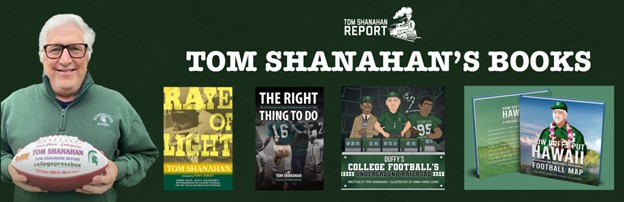
— Tom Shanahan is an award-winning sportswriter with two books on college football integration, “RAYE OF LIGHT, Jimmy Raye, Duffy Daugherty, the Integration of College Football and the 1965-66 Michigan State Spartans,” and “THE RIGHT THING TO DO, The True Pioneers of College Football Integration in the 1960s.” They are the most accurate accounts of college football integration in the 1950s and 1960s. They also debunk myths about the 1970 USC-Alabama game. The false narrative co-opted the stories of the true pioneers who stood up to Jim Crow and the KKK.
— Two children’s books also explain Michigan State College Football Hall of Fame coach Duffy Daugherty’s impact on integration through the Underground Railroad and the Hawaiian Pipeline: “DUFFY’S COLLEGE FOOTBALL UNDERGROUND RAILROAD” and “HOW DUFFY PUT HAWAII ON AMERICA’S FOOTBALL MAP.”
***
PURCHASE LINKS, non-fiction books
— RAYE OF LIGHT, August Publications or on Amazon.
— THE RIGHT THING TO DO, August Publications or on Amazon.
PURCHASE LINKS, children’s books
— DUFFY’S COLLEGE FOOTBALL UNDERGROUND RAILROAD, Order from Barnes and Noble here and Amazon here.
— HOW DUFFY PUT HAWAII ON AMERICA’S FOOTBALL MAP, coming soon on Barnes and Noble and Amazon.