
Facts about the 1966 Game of Century you need to know on its 60th anniversary
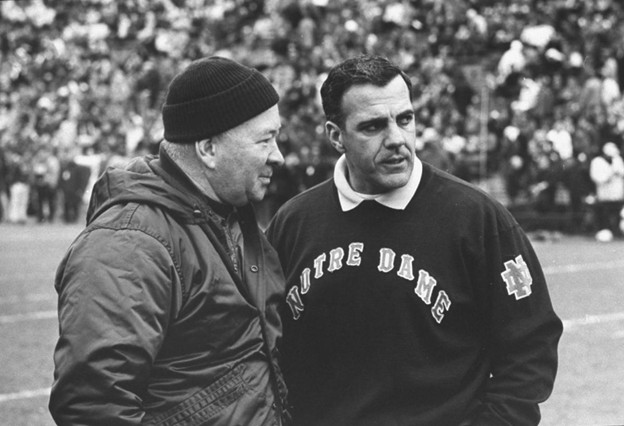
PHOTO: College Football Hall of Fame coaches Duffy Daugherty and Notre Dame during warmups.
Buy me a coffee to support my research to tell untold college football integration untold stories.
Thomas Shanahan | @Thomas-Shanahan-23
Order link:
Raye of Light: Jimmy Raye, The Integration of College Football 3rd Ed – August Publications
***
By TOM SHANAHAN
Michigan State and Notre Dame recognized the 60th anniversary of the 1966 Game of the Century with a two-year renewal of their historic rivalry in 2026 and 2027.
The 2026 game is September 19 at Notre Dame with a return match in 2027 at Spartan Stadium. The same was done for the 50th anniversary in the 2016 and 2017 seasons. The rivalry was an annual affair until conference realignments.
The four teams Notre Dame has played the most are Navy (98), USC (96, ), Purdue (89) and Michigan State 79).
Notre Dame leads the series against all four opponents, but USC (37) and Michigan State (27) have more win against the Irish than any other school. Notre Dame leads Navy, 82-13-1; USC, 51-37-5; Purdue, 59-20-2; and Michigan State, 33-27-1.
1966 GAME OF THE CENTURY
— Nov. 19, 1966, at Spartan Stadium: No. 1 Notre Dame 10, No. 2 Michigan State 10.
— Record TV audience, 33 million out of a population of 195 million.
— National co-champions: Michigan State and Notre Dame played to a 10-10 tie before overtime rules and finished with 9-0-1 records. They were named co-champs by the National Football Foundation. Notre Dame entered the game ranked No. 1 and MSU No. 2. The AP, UPI and FWAA polls kept Notre Dame No. 1.
— NFF’s Vincent DePaul Draddy: “The reasons are rather obvious why we divided the award. It seemed like the only fair thing to do with a couple of excellent teams like Notre Dame and Michigan State.”
— Seven 1967 first-round draft picks. Michigan State: Bubba Smith, Clinton Jones, George Webster and Gene Washington. Notre Dame: Paul Seiler, Alan Page and Tom Regner. Add in the juniors and sophomores (freshmen were ineligible until 1972) on the field that day and there were 10 first-rounders, 42 overall draft picks, 33 pro players and 25 with All-American honors. There were seven College Football Hall of Famers, Michigan State’s foursome and Notre Dame Alan Page, Jim Lynch and Terry Hanratty. Michigan State coach Duffy Daugherty and Notre Dame coach Ara Parseghian also are College Football Hall of Famers.
— Heisman Trophy voting, three players from the two schools finished in the Top 10 of the 1966 Heisman Trophy voting: Notre Dame’s Nick Eddy, third; Michigan State’s Clinton Jones, sixth; and Notre Dame’s Terry Hanratty, eighth.
— Nine College Football Hall of Famers: The total is the most among the half-dozen or so showdowns labeled a Game of the Century. The 1971 Game of the Century with Nebraska and Oklahoma included five. Technically, the 1946 Notre Dame-Army games numbered more, but many of the players on the 1946 roster returning from World War II and didn’t post All-American seasons until 1946, 1948 or 1949.
— Overall numbers tabulating draft picks, pro players and All-Americans among the three classes on the field (freshmen were eligible until 1972) totaled 10 first-round picks, 42 overall draft picks, 33 pro players and 25 All-Americans. The 1966 juniors were taken in the 1968 draft and the 1966 sophomores in the 1969 draft.
— Six players from the Game of the Century served in Vietnam — four Spartans and two Irish. The Notre Dame players were Rocky Bleier and Mike Burgner. The Michigan State players were Eric Marshall, Jimmy Hoye, Mitch Pruit and John Kuetnner. Don’t expect to see 2025 national championship game player serve in Iran.
— Terry Hanratty, Notre Dame’s quarterback: “I still say to this day those are the two best teams to ever play each other. You look at the amount of talent that was on both sides of the field.”
GAME OF THE CENTURY QUARTERBACK QUOTES
On the attendance, with 80,011 fans squeezing into 76,000-seat Spartan Stadium:
— Michigan State’s Jimmy Raye: “I think I’ve met all 80,011 based on how many have told me they were at the game.”
— Notre Dame’s Terry Hanratty: “Tell Jimmy I’ve surpassed him. I’m at 200,000. It’s like Woodstock.”
— Jimmy Raye on Duffy Daugherty starting a Black quarterback: “Daugherty was one of the most courageous persons I’ve had the privilege to be associated with in my athletic career. I can only imagine the pressure he must have been under and received when he made the decision to make me the starting quarterback in the mid-1960s. Most of the things that happened to me in my coaching career — if not all — came as a direct result of the opportunities he gave me. I will be forever grateful for the courage he had and the kind of individual he was to give a chance to a young man who was denied a chance in the South to pursue and academic and athletic career.”
— Terry Hanratty on Michigan State as his second choice to picking Notre Dame: “Duffy Daugherty was such a wonderful human being. No one can ever turn me against Michigan State. When I told Ara (Parseghian) I was coming to Notre Dame, I knew I had to call Duffy. I’m thinking, ‘This is going to be horrible’ because you hear all these stories about coaches jumping on kids. I told Duffy, and he went on for 20 minutes about what great school Notre Dame was and what a great guy Ara was. He made that very difficult call for a 17-year-old kid special. I’ll always have a fondness for Michigan State because of Duffy.”
-30-
NOTE: None of Daugherty’s Underground Railroad players were sent to him by Alabama coach Bear Bryant. There have been many myths created to obfuscate Bryant’s foot dragging on desegregation, and they have been at the expense of Daugherty and other true 1960s pioneers. Bryant was forced to state in a 1969 deposition he was unaware of an African American football recruits. He had been sued by the Alabama Afro American student association for failing to recruit Black athletes despite the campus having desegregated in 1963.
The success of Bear Bryant and 1970 USC-Alabama myths spread without facts has diminished the understanding of Daugherty’s leading role.
***
NATIONAL TITLE COMPARISONS
HBO, Showtime and ESPN trot out Alabama author Keith Dunnavant, providing him a platform for misleading information that obfuscates Bear Bryant dragging his feet on college football integration.
Here’s what Dunnavant and Bear Bryant’s Alabama apologists don’t tell you when they claim Alabama was robbed a third straight national title based on reverse racism.
They say since Alabama won 1964 and 1965 national titles voters were against naming a segregated team in 1966. This ignores that Texas was voted national champion in 1969 as the last all-white team. It also ignores Alabama’s split national titles in both 1964 and 1965.
The NCAA recognizes four organizations as designating an official national champion. Here’s how the numbers add up if we award one point for each title:
1964 national champions
AP, UPI — Alabama, 2.0
FWAA — Arkansas, 1.0
NFF — Notre Dame, 1.0
1965 national champions
AP and co-FWAA — Alabama, 1.5
UPI, NFF and co-FWAA — Michigan State, 2.5
1966 national champions
AP, UPI, FWAA, co-NFF — Notre Dame, 3.5
NFF co-champions — Michigan State, 0.5
So, how does the three-year period add up for the teams?
OUT OF 12 TOTAL POINTS
— Notre Dame 4.5.
— Alabama 3.5.
— Michigan State 3.0
— Arkansas 1.0.
As for total points, both USC and Texas finished with 8.0 for the decade by sweeping all four points with undisputed national title titles. USC won in 1962 and 1967 and Texas in 1963 and 1969.
When considering winning percentages for title seasons, MSU and Notre Dame both finish ahead of Alabama.
— Michigan State: 10-1-0 plus 9-0-1 = 19-1-1, 90.4 percent
— Notre Dame: 9-1-0 plus 9-0-1 = 18-1-1, 90.0 percent
— Alabama: 10-1-0 plus 9-1-1 = 19-2-1, 86.3 percent
By any accounting, Alabama didn’t dominate the 1964 and 1965 seasons as Bear Bryant’s apologists for his poor segregation record want college football fans to believe.
Another difference to consider is Alabama never played any of its 22 games in 1964 and 1965 above the Mason-Dixon Line and 21 of their 22 opponents were all-white teams. The same is true in 1966, when eight of 11 games were played within Alabama’s state borders. There were four at Legion Field in Birmingham, three at Denny Stadium in Tuscaloosa and one at Ladd Stadium in Mobile.
Daugherty didn’t respond to the reverse racism cries stoked by Bryant until he spoke in Knoxville at an event hosted by the East Tennessee chapter of the National Football Foundation.
“Bear and I are great friends,” said Daugherty from the podium. “He came on to me with that, ‘you robbed us’ stuff. When there was no way his all-white squad could have handled our squad that season. We had seven all-stars. Years later he realized that and admitted it to me.”
The “you robbed us” reference was Alabama finished No. 3 in the final polls behind No. 1 Notre Dame and No. 2 Michigan State.
Daugherty’s quote was published in the Knoxville News-Sentinel, April 27, 1985. Once again, I’ve found there is no end to Duffy Daugherty history lost in the misleading shadows of Bear Bryant folklore.
Duffy’s 1985 Knoxville response to Bear Bryant – Tom Shanahan Report
Another unfair myth at the expense of Daugherty’s legacy is Bryant sent him players. Bryant never sent Daugherty a player. Bryant was unaware of Black kids in the 1960s and didn’t care about them until he needed them to win games in the 1970s.
“We Have Met the Enemy and He Is Duffy” – for telling his Bear Bryant jokes – Tom Shanahan Report
-30-
I invite you to follow me on Twitter @shanny4055
I’ll put my facts on the true pioneers of college football integration versus Bear Bryant fairytales against anybody, anytime, anywhere. Watch here.
Click here for my story on the 1962 Rose Bowl and Segregation and Alabama.
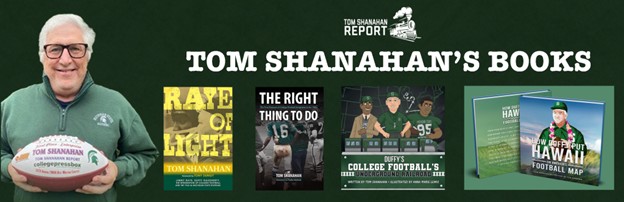
— Tom Shanahan is an award-winning sportswriter with two books on college football integration, “RAYE OF LIGHT, Jimmy Raye, Duffy Daugherty, the Integration of College Football and the 1965-66 Michigan State Spartans,” and “THE RIGHT THING TO DO, The True Pioneers of College Football Integration in the 1960s.” They are the most accurate accounts of college football integration in the 1950s and 1960s. They also debunk myths about the 1970 USC-Alabama game. The false narrative co-opted the stories of the true pioneers who stood up to Jim Crow and the KKK.
— Two children’s books also explain Michigan State College Football Hall of Fame coach Duffy Daugherty’s impact on integration through the Underground Railroad and the Hawaiian Pipeline: “DUFFY’S COLLEGE FOOTBALL UNDERGROUND RAILROAD” and “HOW DUFFY PUT HAWAII ON AMERICA’S FOOTBALL MAP.”
***
PURCHASE LINKS, non-fiction books
— RAYE OF LIGHT, August Publications or on Amazon.
— THE RIGHT THING TO DO, August Publications or on Amazon.
PURCHASE LINKS, children’s books
— DUFFY’S COLLEGE FOOTBALL UNDERGROUND RAILROAD, Order from Barnes and Noble here and Amazon here.
— HOW DUFFY PUT HAWAII ON AMERICA’S FOOTBALL MAP, coming soon on Barnes and Noble and Amazon.

