


“BEAR BRYANT & SAM CUNNINGHAM: Everyone LIED about 1970” is headline to Untold Stories video
Buy me a coffee to support my research to tell untold college football integration untold stories.
Thomas Shanahan | @Thomas-Shanahan-23
Order link:
Raye of Light: Jimmy Raye, The Integration of College Football 3rd Ed – August Publications
***
By TOM SHANAHAN
A college football historian sent me a Youtube video about the 1970 USC-Alabama game and the myths surrounding it.
He knew “Untold Stories” – not to be confused with American Untold Stories (I checked) — fit my website and books debunking myths Alabama coach Bear Bryant orchestrated integration through USC’s Sam Cunningham.
The “Untold Stories” video:
Bryant didn’t have a secret plan to schedule USC as a game to lose to gain permission from his bigoted fanbase to recruit Black players. And Bryant never took Cunningham into the Alabama locker room to show his team what “a football player looks like.”
But from there, the story veered off course. Sloppily. Think of a team breaking off a 25-yard gain on the first play but on ensuing plays losing yardage until a fumble in the end zone.
The video is poorly produced, probably relying on AI for audio and cheap illustrations/photos. I considered not commenting on this amateur video until I saw Warren Sapp repeating the fairytale in a Youtube video. Regurgitating the myth gives it more life.
Sapp, among his errors, lists John Robinson as the head coach. He wasn’t named USC’s head coach until 1976 after John McKay left the Trojans for the NFL. The myth draws conclusions without supportive facts.
Start with asking yourself when has America changed its stance on race overnight? The answer spanning 250 years: Never.
Here are some more errors with times noted (there are too many for me to list all of them). Bryant’s legend for some reason blinds the media without factchecking.
— 1:22: The film says the 1970 USC-Alabama is the “wrong story but the right game.” It was the wrong story AND wrong game. The film ignores groundbreaking courage from Maryland’s Darryl Hill (1963), Wake Forest’s Bob Grant and Butch Henry (1964), Houston’s Warren McVea (1964), Southern Methodists Jerry LeVias (1965), Kentucky’s Nate Northington and Greg Page (1966) followed by Wilbur Hackett and Houston Hogg (1967), Tennessee’s Lester McClain (1967) followed by Jackie Wallker (1968); Auburn’s James Owens (1969) and other pioneers. They blazed trails to open a path to the 1970 USC-Alabama game.
— 3:37: An “Untold Stories” graphic noting 1960s’ Black scholarship players was misleading. It lists Michigan State first and USC close behind. USC trailed the Spartans by decades. In 1962, the Associated Press reported Michigan State’s 17 Black players were the most in major college football history. That same season USC won the national title with only five Black players despite its campus located in populous and diverse Los Angeles.
Why the difference? Michigan State coach Duffy Daugherty was the first to ignore college football’s unwritten quota limiting Black athletes to a half-dozen or so. USC coach John McKay, whose 1967 national championship team numbered only seven Black players, didn’t abandon the unwritten quota limits until his 1969 and 1970 classes.
— 4:06: The film correctly states 33 of 37 major southern programs were integrated by 1970, which makes me think they used research from my stories. But it incorrectly noted only five Southeastern Conference schools were ahead of Alabama. Bryant was seventh, trailing Kentucky, Tennessee, Auburn, Mississippi State, Florida and Vanderbilt. The discrepancy may be Vanderbilt’s first Black player was a walk-on. That’s not a small point since Bryant cut five Black walk-ons from his 1967 spring football roster.
— 5:08: The film falsely credits Bryant for reading the future. He was blind to the arc of moral bending toward justice. His campus was desegregated in 1963. He had the law of the land on his side with the 1964 and 1965 Civil Rights Acts.
Based on Bryant’s 1974 book, “BEAR,” he revealed he was clueless about the future. In his own words, he describes having lunch at a Chicago airport while waiting for a connecting flight. This was the same day racist Alabama Gov. George Wallace stood in the schoolhouse door to block the enrollment of Vivian Malone and James Hood as the school’s first Black students.
Bryant says after he left a healthy tip, the waiter tracked him down and said he didn’t want his money. Bryant sarcastically noted he happily pocketed the money. It was 11 years later, and Bryant still didn’t get it. He was tone death to include that story in his book.
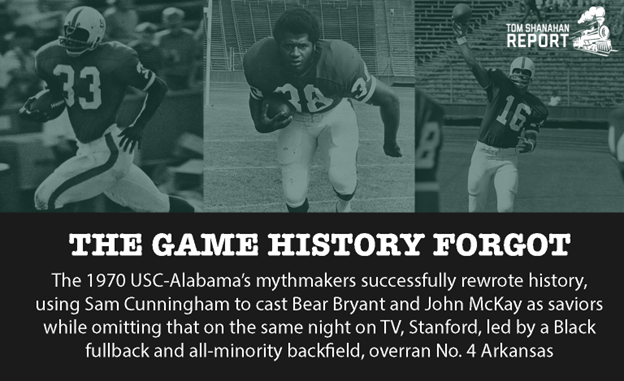
— 6:35: The film credits Cunningham for making history by rushing for 135 yards and two touchdowns, but he was outdone on the same day, September 12, 1970. Stanford fullback Hillary Shockley, a Black fullback from Los Angeles, finished with 149 yards and three touchdowns to lead a nationally televised upset of No. 4 Arkansas at War Memorial Stadium in Little Rock. USC-Alabama was limited to local radio networks.
A genuine historic milestone on September 12 took place at Grant Field in Atlanta. Georgia Tech’s Eddie McAshan, the Deep South’s first Black starting quarterback, led his team to an upset of No. 17 South Carolina, which included its first Black player.
So, of the three September 12 contests, why are Stanford and Georgia Tech forgotten game? Because no one at Stanford or Georgia Tech made up a story.
September 12, 1970: STANFORD vs. ARKANSAS at LITTLE ROCK – Tom Shanahan Report
— 7:15: The film stretches the truth when it states USC fielded the first all-Black backfield with starting quarterback Jimmy Jones, starting tailback Clarence Davis and backup fullback Sam Cunningham. In the 1970 opener, Cunningham was a sophomore backup to senior returning starter Charlie Evans, a White veteran who went on to play in the NFL five seasons.
The statement ignores Stanford’s all-minority backfield at Arkansas: Shockley, tailback Jackie Brown (Black) and quarterback Jim Plunkett (Native American/Mexican). It also disregards Michigan State’s teams fielded all-minority backfields in the mid-1960s.
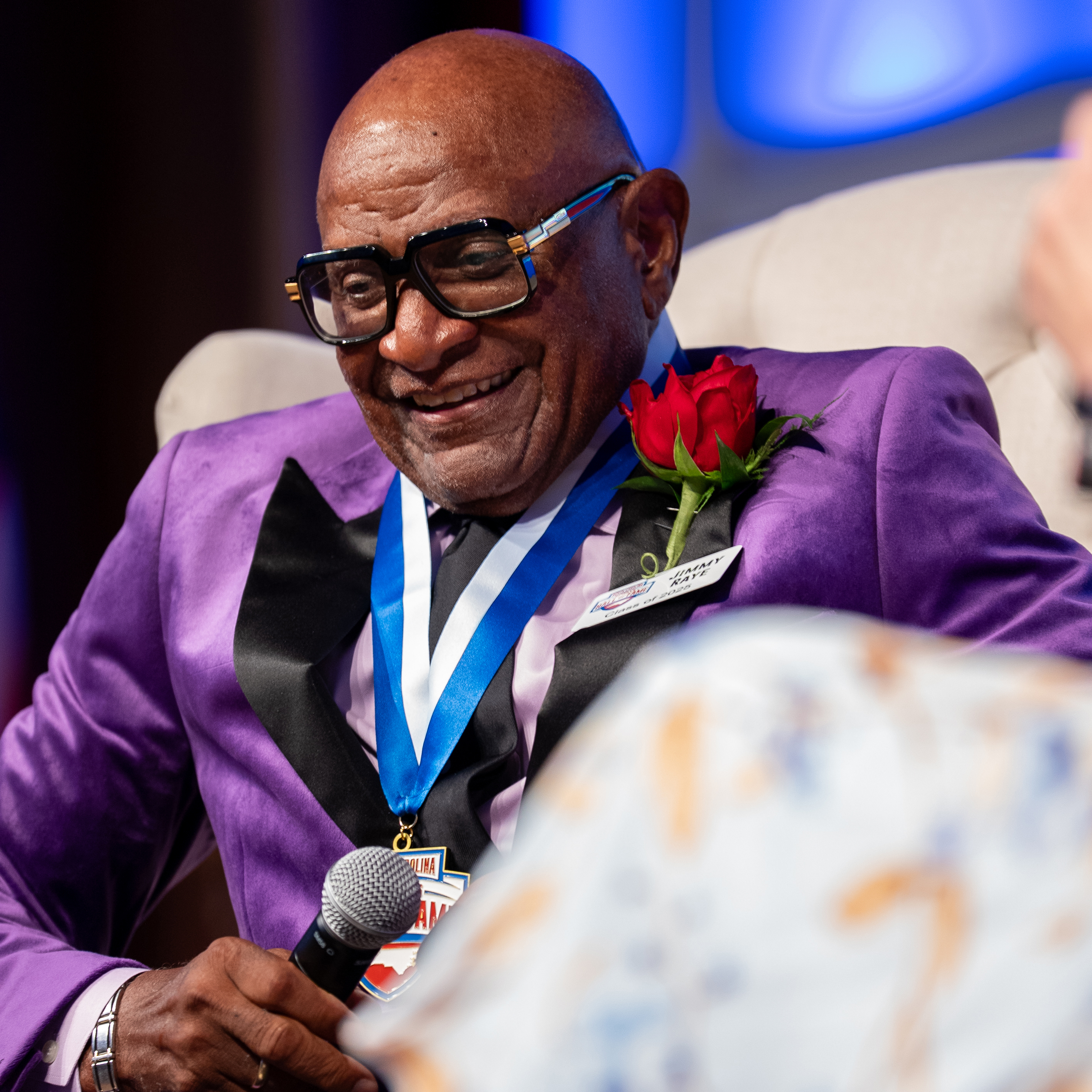
In the 1965 season, Michigan State was at times a four-man all-Black backfield with quarterback Jimmy Raye, fullback Eddie Cotton and halfbacks Clinton Jones and Dwight Lee. Raye and Cotton were backups who played frequently.
In 1966, Raye, the South’s first Black quarterback to win a national title while recruited out of segregated Fayetteville, N.C., took over as the starter. The Spartans started an all-minority backfield: Raye, Jones, Lee and fullback Bob Apisa, the first Samoan All-American.
It’s not hard to make a case Raye, Wake Forest’s Freddie Summers as the South’s first Black quarterback in 1967 and McAshan own more profound places in history than Cunningham.
— 7:55: The film incorrectly states the crowd went quiet in the second quarter. Yes, USC jumped out to a 15-0 lead, but Alabama scored in the second quarter to make it a one-score game, 15-7.
— 8:35: USC’s six touchdowns weren’t all scored by Black players as the film states. After Alabama closed the score to within 15-7, Evans’ touchdown made the halftime score 22-7. On the drive, Evans broke off the longest run, a 15-yarder.
— 9:00: The Legion Field didn’t recognize “injustice” in the USC game. Alabama fans witnessed injustice a year earlier when Tennessee’s integrated 1969 team routed the Crimson Tide at Legion Field, 41-14. Tennessee’s Jackie Walker, the SEC’s first Black All-American linebacker, returned an interception for a 21-0 first-quarter lead. By 1970, injustice was being repeated.
— 10:55: Bryant didn’t decide on his own to integrate. He was sued on July 2, 1969, by the Alabama Afro American student association for failing to recruit Black players. The suit went away when Bryant signed Wilbur Jackson and Bo Matthews to SEC letters of intent on December 13, 1969. Jackson was a freshman in 1970, although Matthews ended up playing at Colorado.
— 12:18: John Mitchell of Mobile, Alabama, is highlighted as a junior college transfer who was Alabama’s first Black player to take the field. He was 1971 starter when Alabama played at USC, while Jackson began his sophomore year as a backup. Mitchell was a transfer from Eastern Arizona who committed to USC. But when McKay mentioned to Bryant that he had a recruit from his backyard, Bryant told his assistants to find Mitchell. They were oblivious to Mitchell but found him and managed to flip him.
Mitchell leaving Alabama after is 1968 high school football season for Eastern Arizona falls in line with Bryant saying in his 1969 deposition that he was unaware of Black players to recruit.
The media needs to learn the words of Dr. Lane Demas, an author of college sports integration and Ph.D professor at Central Michigan University:
“Alabama football integrated because an organized, sustained movement of Black Americans nationwide forced it to, against its will. That’s the only answer that makes sense if you study the broader historical context.
“The USC-Alabama story is in a long line of white myths that serve to deny Black people their agency in terms of changing America. Focusing on figures like Branch Rickey and Bear Bryant creates narratives in which it is ultimately White people who make cautious, thoughtful, calculating decisions to create and integrate their own teams. They become the agents of change, not Martin Luther King, Rosa Parks, or thousands who struggled in the streets.”
-30-
30-
Visit my homepage: TomShanahan.Report
— Watch a three-minute video to learn about our documentary at the fundraising stage, GAME CHANGERS OF THE CENTURY, and the Investment Deck.
I invite you to follow me on Twitter @shanny4055
I’ll put my facts on the true pioneers of college football integration versus Bear Bryant fairytales against anybody, anytime, anywhere. Watch here.
Click here for my story on the 1962 Rose Bowl and Segregation and Alabama that earned first place for Enterprise from the Football Writers Association of American.

— Tom Shanahan is an award-winning sportswriter with two books on college football integration, “RAYE OF LIGHT, Jimmy Raye, Duffy Daugherty, the Integration of College Football and the 1965-66 Michigan State Spartans,” and “THE RIGHT THING TO DO, The True Pioneers of College Football Integration in the 1960s.” They are the most accurate accounts of college football integration in the 1950s and 1960s. They also debunk myths about the 1970 USC-Alabama game. The false narrative co-opted the stories of the true pioneers who stood up to Jim Crow and the KKK.
— Two children’s books also explain Michigan State College Football Hall of Fame coach Duffy Daugherty’s impact on integration through the Underground Railroad and the Hawaiian Pipeline: “DUFFY’S COLLEGE FOOTBALL UNDERGROUND RAILROAD” and “HOW DUFFY PUT HAWAII ON AMERICA’S FOOTBALL MAP.”
***
PURCHASE LINKS, non-fiction books
— RAYE OF LIGHT,
Raye of Light: Jimmy Raye, The Integration of College Football 3rd Ed – August Publications
or on Amazon.
— THE RIGHT THING TO DO, August Publications or on Amazon.
PURCHASE LINKS, children’s books
— DUFFY’S COLLEGE FOOTBALL UNDERGROUND RAILROAD: Order from Barnes and Noble here and Amazon here.
— HOW DUFFY PUT HAWAII ON AMERICA’S FOOTBALL MAP. Order here:
How Duffy Put Hawaii On America’s Football Map by Tom Shanahan, Paperback | Barnes & Noble®
Amazon.com: How Duffy Put Hawaii On America’s Football Map eBook : Shanahan, Tom: Kindle Store
Tags: Chapel Hill, Duffy Daugherty, Durham, Holiday Inn, Michigan State, North Carolina

