


WRITTEN OUT OF HISTORY, Part II: Mr. October met Bear Bryant in Jim Crow Birmingham, 1967
PHOTO (L-R): Dave Duncan, manager John McNamara and Reggie Jackson with the 1967 Birmingham A’s at Rickwood Field.
**
Buy me a coffee to support my research to tell untold college football integration untold stories.
Thomas Shanahan | @Thomas-Shanahan-23
***
“When someone shows you who they are, believe them the first time.”
— Maya Angelou, writer and poet.
“Part of history is not excusing people for what they believed in real time.”
— Jon Meacham, historian, author and Pulitzer Prize winner.
By TOM SHANAHAN
The 1960s sports media missed the true stories of college football integration through negligence. The long-standing custom of sticking to game results and avoiding race resulted in milestones lost to history.
That’s one consequence.
An ongoing outgrowth starts with Alabamians viewing football coach Bear Bryant’s 1960s Alabama teams as the good old days. The curious brand of pride overlaps a Jim Crow decade, and the attitude infects 2026 politics. Alabama politicians are gerrymandering voting districts to disenfranchise African American voters.
That makes this a good time to recall Reggie Jackson’s comments two years ago upon his return to Rickwood Field in Birmingham, where he played minor league baseball in 1967. The Baseball Hall of Famer took part in honoring Willie Mays, June 202, 2024. The San Francisco Giants’ Hall of Famer made his pro debut in 1948 at Rickwood playing for the Negro Leagues’ Birmingham Black Barons.
In 2024 interviews, Jackson discussed enduring Jim Crow Alabama, saying he said he wouldn’t “wish it upon anyone.” He also recounted meeting Bryant among a group in the Rickwood clubhouse after a 1967 game.
“He said to the group, ‘This is just the kind of n—–boy that we need in order to compete with Bo, Woody, Ara and Johnny.”
With those words, Jackson exposed Bryant for who he really was – an antebellum figure content to drag his feet on Jim Crow into the 1970s.
Thank you, Mr. October.
But without a follow-up question, the modern media missed Jackson’s softball. Bryant didn’t care about American idealism until he needed Black players to win games. In the turbulent 1960s, Civil Rights leader Dr. Martin Luther King Jr. lamented “the appalling silence and indifference of good people who say sit around and wait on time.”
Bryant remained silent, indifferent and waited until the 1970s.
SWING AND A MISS
Jackson’s full quote described Bryant as a friend, so to be fair a hagiography warning may not have been his intent. Here’s the longer quote on Al.com:
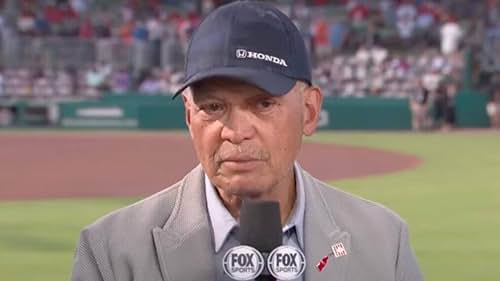
PHOTO: Reggie Jackson on the FOX Sports set in 2024 at Rickwood Field. The Fox announcers failed to ask Jackson proper follow-up questions on Bryant’s poor integration track record.
“The most impactful memory I ever had at Rickwood … it’s tough to hear if you’re from Alabama. At the same time, it came from a friend (Bryant). He never apologized for it, but he was a friend.”
“I hit two triples in the game, and I could run like a deer. After the game a few people were around. Charlie Finley (A’s franchise owner) had come to that game, Paul Bryant (Jr.) was there. Alf Van Hoose, who was a sportswriter in this town, and Bear Bryant. I was getting changed, a shower and putting my shirt on.
“Bear Brant walked up to me and paid me a compliment – 1967. He said to the group, ‘This is just the kind of n——boy that we need in order to compete with Bo, Woody, Ara and Johnny.’
“Johnny Robinson of USC, Ara Parseghian of Notre Dame, Bo Schembechler of Michigan, Joe Paterno of Penn State.
“He meant it as a compliment. If we don’t get one of these, we’re not going to be able to compete with them. And about a few months later, USC came here with Sam Cunningham and beat Alabama 42-10.”
THE UNVETTED FAIRYTALE
There is a lot to unpack, including Jackson was conflicted about Bryant’s folklore squared with his racist language.
A good place to start unpacking is clarifying Jackson’s words in the last sentence, “a few months later.” We’re all guilty of running dates and times together, but this needs to be straighted out.
USC and Cunningham, a Black fullback, came to Legion Field in Birmingham THREE YEARS later, September 12, 1970 (the final score of 42-21 is the least necessary clarification). In 1967, Cunningham was a junior at Santa Barbara High.
In newspaper reports the day after the 1970 game, no one wrote Bryant opened eyes in the South. Los Angeles Times columnist Jim Murray mocked Alabama for finally joining the 20th century by playing team outside its Mason-Dixon Line bubble, but he certainly wasn’t praising Bryant for thinking progressively.
The fairytale claimed Bryant scheduled USC as a game to lose to gain permission from his fanbase to recruit Black players. Cunningham’s performance of running over Bryant’s all-White roster with 135 yards and two touchdowns was backed into the myth to fit the narrative.
The USC backers who were behind the myth took a shortcut through the facts. They were unaware of 1960s progress in the South due to sports media failures.
The overlooked athletes pushing progress by 1970 included Maryland’s Darryl Hill (1963), Wake Forest’s Bob Grant and Butch Henry (1964), Houston’s Warren McVea (1964), Southern Methodist’s Jerry LeVias (1965), Kentucky’s Nate Northington and Greg Page (1966) followed by Wlbur Hackett and Houston Hogg (1967), Tennessee’s Lester McClain (1967) followed by Jackie Walker (1968) and others.
They paid a price confronting Jim Crow and the Ku Klux Klan. Cunningham simply ran through massive holes opened by five White offensive linemen.
If the role of USC mythmakers sounds out of place for a Bryant-centric tale, the subplot was embellishing USC’s poor integration history along with distorting Bryant’s track record. The myth crafted in the late 1980s from a failed USC-based movie script jumped unvetted into the media in the mid-1990s.
The media, similar to Jackson, is conflicted about Bryant dragging his feet into the 1970s. Respected journalists were eager to promulgate the myth. When holes were pointed out, they took a page from The Man Who Shot Liberty Valance: “When the legend becomes fact, print the legend.”
An ignored Alabama fact was Bryant signed two Black players, Wilbur Jackson and Bo Matthews, nine months before USC arrived. Jackson was an Alabama freshman in 1970, although Matthews ended up at Colorado.
Bo Knows: Matthews bares his thoughts on Bear Bryant’s 1970 recruiting audible – Tom Shanahan Report
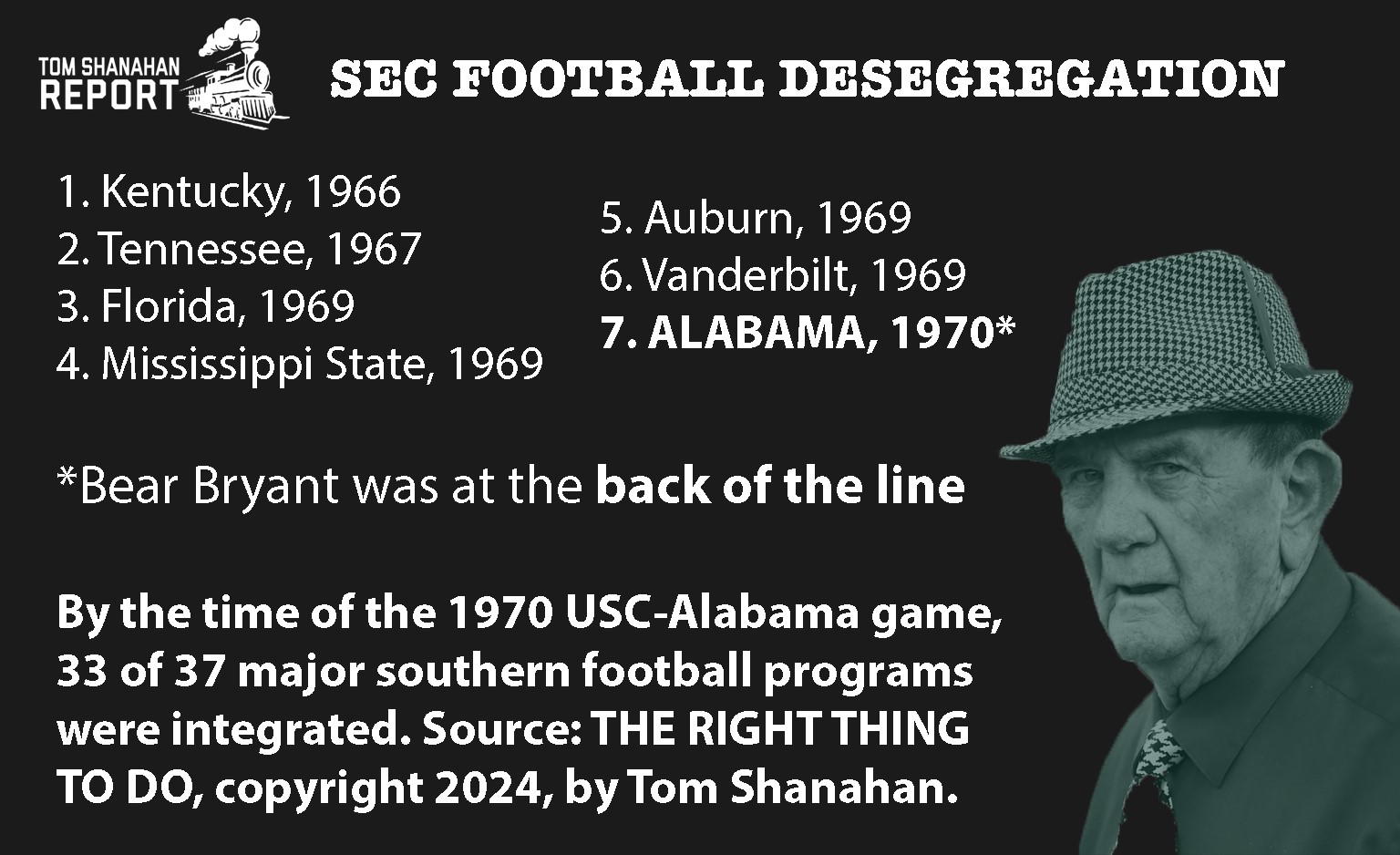
As the 1970 season opened, Alabama was the seventh of 10 Southeastern Conferences football programs to integrate along with 33 of 37 major southern programs. The only four trailing Bryant were Georgia, Mississippi, LSU and Tulane. Not coincidentally, they represent states also pushing gerrymandering.
An ignored USC fact was Trojans coach John McKay followed college football’s unwritten quota limiting Black players to a half-dozen or so.
USC’s 1962 national title team numbered only five Black players and its 1967 national championship roster only seven despite the Trojans’ campus located in populous and diverse Los Angeles. One of the 1967’s seven was San Francisco City College import O.J. Simpson.
McKay didn’t alter his recruiting until his 1969 and 1970 recruiting classes. They included 11 Black players as transfers – nine from the junior college ranks and two from four-year schools.
It’s true there were 18 Black players on the roster for the 1970 Alabama game, but it’s a misleading note to bolster the myth. The process of shedding the quota imitation years meant there were only four Black starters with only one recruited out of high school, Jimmy Jones of Harrisburg, Pennsylvania. The other three Black starters were transfers — senior tailback Clarence Davis (JC transfer) and two senior defensive players, Charlie Weaver (JC transfer) and Tody Smith (four-year school transfer).
Another fact overlooked by the media was neither Bryant nor McKay cited a word in their 1974 books about the 1970 USC-Alabama game as a transformative moment. A 5,100-word Time Magazine cover story in 1980 on Bryant as his career was winding down didn’t mention the 1970 USC-Alabama game. A 1991 documentary, “The Legacy Lives,” which was written by Bryant friend Al Browning, doesn’t include the 1970 game.
Nevertheless, the popular misconception worked its way into the national folklore with the aid of poorly researched sportswriting.
Two exceptions to promulgating the myth the past 30-plus years were a 2002 ESPN story by Pulitzer Prize winner David Halberstam and 2013 story in The Atlantic by Allen Barra, a Bryant biographer.
Halberstam: “But the Bear was very late to the dance, especially because people are always talking about football coaches as leaders. In this case, he did not lead very well.”
The headline to Barra’s Atlantic story: “The Integration of College Football Didn’t Happen in One Night.”
Not even the combined stature of Halberstam and Barra has nudged college football lore into reality.
LOST HISTORY
Many more overlooked facts reveal the 1970 USC-Alabama was not a singular moment. One is Michigan State was the first fully integrated team to play in the South in 1964 against North Carolina at Kenan Stadium in Chapel Hill.
Michigan State’s Duffy Daugherty was the first coach with rosters numbering double-digit Black players. In 1962, the Associated Press reported Michigan State’s 17 Black players were the most in major college football history, although the story failed to note the Spartans were breaking their own records in those days.
Daugherty’s rosters were Midwest-based with Underground Railroad talent recruited from the segregated South. He was driving the Spartans down tracks laid by the Civil Rights movement of Rosa Parks and Dr. Martin Luther King.
But with so many 1960s pioneers written out of history, Jackson’s 2024 Cunningham quote demonstrates the myth remains entrenched in college football lore. The 1960s blank pages were filled with Bryant/Alabama/USC revisionist history.
There is a litany of ignored facts:
— I: On the same date USC-Alabama played, September 12, 1970, Stanford upset No. 4-ranked Arkansas at War Memorial Stadium in Little Rock. Stanford was led by a Hillary Shockley, a Black fullback from Los Angeles, with 149 total yards and three touchdowns. He outdid Cunningham’s totals at Alabama.
But nobody at Stanford made up a myth two decades later that the South was enlightened by Stanford’s all-minority backfield — Shockley, tailback Jackie Brown (Black) and quarterback Jim Plukett (Native American/Mexican). Curiously, Stanford-Arkansas is forgotten, although it was ABC-TV’s national game of the week, while USC-Alabama was limited to their local radio stations.
That’s the power of an unchallenged myth rooted in Bryant hagiography. It overshadows facts.
September 12, 1970: STANFORD vs. ARKANSAS at LITTLE ROCK – Tom Shanahan Report
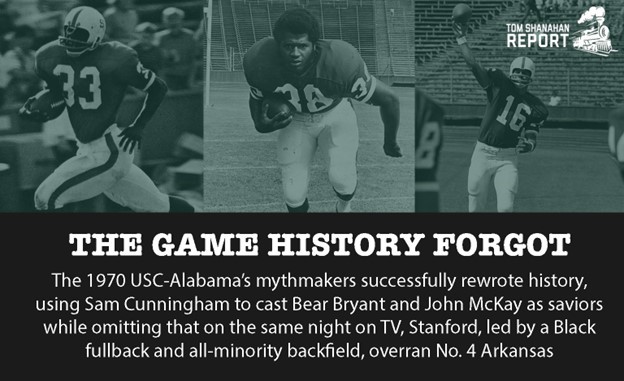
— II: The 1970 USC-Alabama myth implies USC was a juggernaut and Cunningham unstoppable. That’s not how the final 10 games played out. The Trojans (6-4-1) lost 24-14 to Stanford, the Pac-8 and Rose Bowl champions, and to rival UCLA, 45-20. Cunningham gained only 353 yards with three touchdowns in the next 10 games.
In a 2025 podcast, “100 Yards of Football,” USC tight end Charle Young, a sophomore in 1970, said a racial divide developed in 1970 and 1971 when White veteran players lost starting jobs to younger Black players. By 1972, when Cunningham and Young were seniors, the Trojans had shed their past and won a national title.
— III: Another integration milestone on September 12, 1970, took place at Grant Field in Atlanta. Georgia Tech, led by Eddie McAshan, the Deep South’s first Black starting quarterback, upset No. 17 South Carolina, which included its first Black player. Again, there was nothing new about Black players competing in the Deep South by 1970.
— IV: Auburn coach Ralph “Shug” Jordan signed James Owens as the Tigers’ first Black player in 1969, a year before Alabama broke ground. Jordan’s Tigers hosted integrated Wake Forest in 1966 and integrated Southern Methodist in 1968. USC wasn’t the first integrated team to visit an Alabama stadium.
But Auburn, unlike Alabama, apologized for not integrating earlier and for not providing more support for Owens as a lone Black player on the team. Auburn established the James Owens Courage Award in 2012. Alabama still sells the myth Bryant led integration, including a 2021 plague placed on campus stating Bryant was a leader by recruiting Jackson and John Mitchell to play on the 1971 varsity.
— V: On October 18, 1969, SEC rival Tennessee’s integrated team routed Alabama 41-14 before 72,443 fans at Legion Field in Birmingham. Tennessee led 21-0 in the first quarter after linebacker Jackie Walker returned an interception for a 21-0 lead. Walker was the first Black player to score at Legion and the first SEC Black player to earn All-American honors.
If Bryant’s bigoted fanbase truly needed a shock, Walker provided it a year before USC played at Legion Field before 72,175 fans.
— VI: Bryant’s campus desegregated in 1963. He had the law of the land on his side with the 1964 and 1965 Civil Rights Acts. And yet Bryant failed to use his voice as the most powerful in the South. Bryant sycophants excuse him with the claim racist Alabama Gov. George Wallace would have fired him if he recruited a Black player. But no one fired Jordan in 1969. And Wallace wasn’t in office, 1967-71.
— OVII: Bryant was asked in a 1967 TV interview after spring football why his roster remained all-White. He replied, “I so far haven’t found many, if any, qualified academically or athletically qualified.”
If you punch that quote into an Internet search, a response praises Bryant for only taking athletes with good academic records. The AI computer got its signals crossed. In 1961, Alabama admitted overnight Joe Namath, a White quarterback who led Alabama to a share of the 1964 national title. This was after Maryland coach Tom Nugent informed Bryant — a fact both Bryant and Namath confirm in biographies — that Namath failed his entrance exam on the eve of fall camp and was still available.
Namath earlier was denied admission at Michigan State and other schools. Daugherty abandoned pursuing Namath when MSU’s admissions office informed him there was no way to admit Namath.
There is another irony consider: Another long-standing myth was Bryant sent Daugherty Black players from the South. But Bryant said in 1967 he couldn’t find any academically qualified Black players.
But major outlets such as ESPN, The Athletic and Sports Illustrated continue to tell that Bryant myth that makes Bryant sound like a crusader and Daugherty a passive bystander. It’s the other way around.
WHERE’S DUFFY?
Now, let’s address the coaches Jackson mentioned.
Nothing wrong with citing Ohio State’s Woody Hayes. He was right behind Daugherty in the 1960s recruiting Black players in double-digit numbers. But Michigan’s Bo Schembechler wasn’t hired until 1969 and USC’s John Robinson until 1976. To be fair, Jackson meant John McKay (1960-75).
Paterno and Parseghian also require clarification. Paterno’s first season as head coach in 1966 finished 5-5. Entering the 1967 season, he wasn’t “Joe Paterno” the national powerhouse coach. Notre Dame didn’t start recruiting rosters with double-digit Black players until the 1970s.
If there was a coach on Bryant’s mind when he met Jackson in the spring of 1967, it was Daugherty. The Spartans were coming off back-to-back shares of the 1965 and 1966 national titles with fully integrated rosters that included Black players Daugherty recruited from the segregated South. Those players were steered to Daugherty by southern Black high school coaches and principals who viewed Michigan State as a place of opportunity.
In the final 1966 Associated Press Top 10, five teams were segregated, No. 3 Alabama, No. 4 Georgia, No. 8 Georgia Tech and No. 9 Miami; two had only one Black player, No. 1 Notre Dame and No. 10 SMU; and only three had multiple Black players, No. 2 Michigan State, No. 5 UCLA and No. 6 Nebraska.
Yes, Daugherty’s program began to fall off in 1967, but the Spartans opened the 1967 season ranked No. 3. Jackson met Bryant at Rickwood months prior to the 1967 preseason poll’s release.
Another reason Notre Dame and Michigan State were on Bryant’s mind at the end of the 1966 season was the 1966 Game of the Century that ended in a 10-10 tie with Notre Dame No. 1 and Michigan State No. 2. Bryant, with his team ranked No. 3, sparked cries of reverse racism among his fanbase.
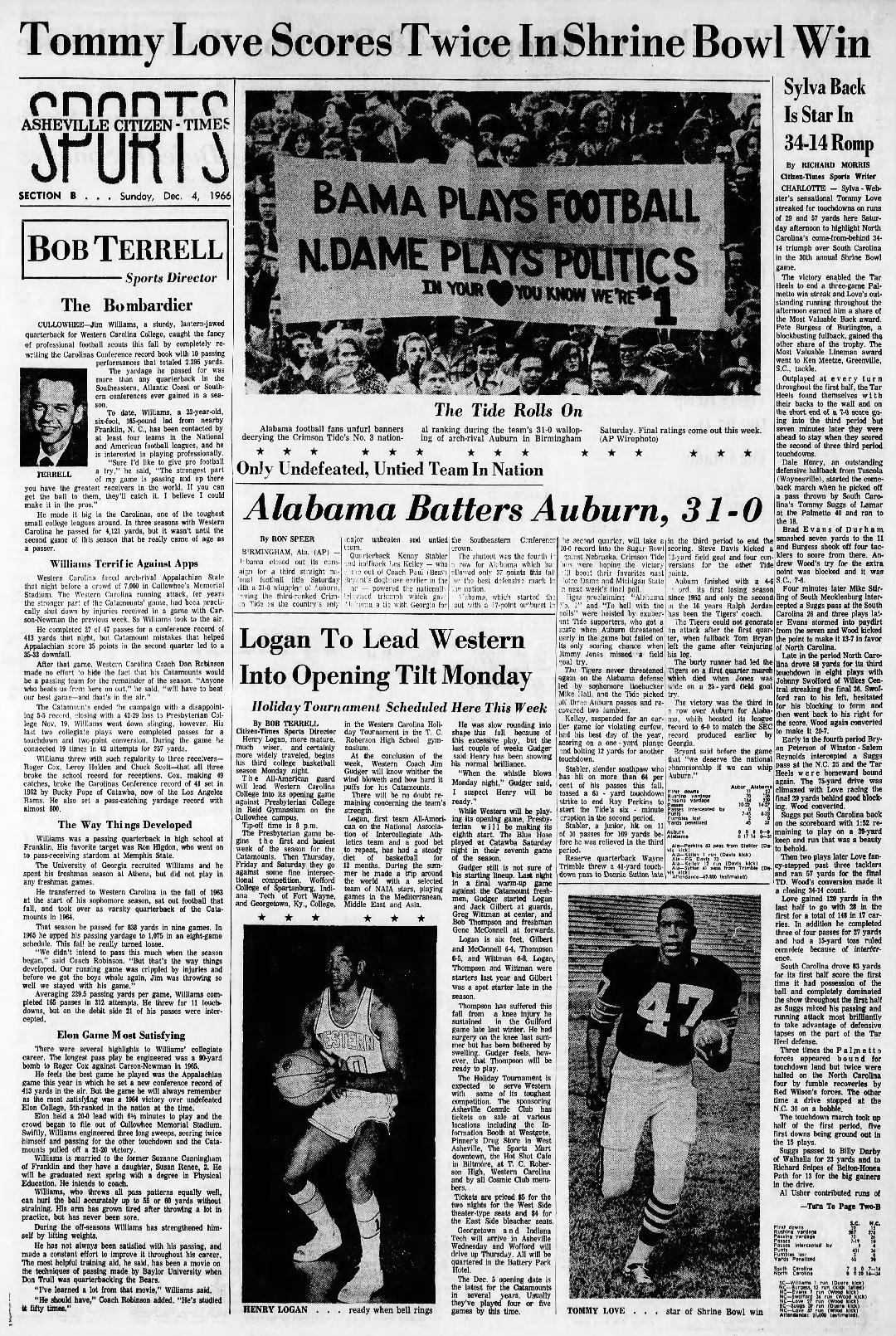
After the Game of the Century was played on November 19, Alabama was 8-0 with two regular-season games remaining, including December 3 against Auburn. In the Legion Field stands for the Auburn game, Alabama fans hoisted a banner that read:
“BAMA PLAYS FOOTBALL
“N. DAME PLAYS POLITICS
In your (heart symbol) you know we’re #1.”
BREAKFAST WITH DUFFY AND THE BEAR
In February 1967, Michigan State assistant equipment manager Marty Daly was a 22-year-old attending the National Sporting Goods Association convention in Chicago. He was eating breakfast alone in the Palmer House restaurant when Daugherty entered alone and joined him. Bryant showed up moments later, saw his friend Daugherty and sat down.
On Page 300 of “THE RIGHT THING TO DO, The True Pioneers of College Football Integration in the 1960s,” Daly recalled listening to Daugherty and Bryant talk shop. Daly used the word “Black” when reciting the Bryant encounter, although recalled hearing Bryant say in his southern drawl, “Nig-ruhs.” Negro was then still an accepted term, so Daley wasn’t sure if he heard Negros or the N-word.
Here’s how Daly quoted Bryant speaking to Daugherty: “I know what you’re doing up there. I’ve got to get me some of those Black players.”
Daly said Daugherty replied he was going to continue to recruit the segregated South.
Once again, that exchange contradicts the myth Bryant sent Daugherty players. And complementing such a conclusion was Bryant’s 1969 deposition taken by U.W. Clemon, a Civil Rights attorney. Clemon represented the Alabama Afro-American student association that sued Bryant for failing to recruit Black players.
Clemon said Bryant admitted he was unaware of Black players. Clemon added he was prepared to show in court Black high school coaches didn’t believe Bryant was serious about recruiting their players, but the suit went away when Bryant signed Jackson and Matthews.
The fumbles failing to report Daugherty’s leadership included iconic media members Chris Schenkel and Dan Jenkins covering the 1966 Game of the Century. A record TV audience of 33 million saw the contrast of Michigan State with 20 Black players and Notre Dame with one.
In the ABC broadcast, Schenkel noted the outsized talent and size of Michigan State’s 6-foot-7, 280-pound Bubba Smith. Schenkel said Smith was from Beaumont, Texas, but he didn’t mention Smith and other Spartans escaped segregation aboard Daugherty’s Underground Railroad.
In Sports Illustrated, Jenkins, the godfather of sportswriters, identified quarterback Jimmy Raye as having a thin mustache. He failed to note Raye, recruited out of segregated Fayetteville, N.C., was one of only two Black quarterbacks in major college football that season.
Research decades later for “RAYE OF LIGHT, Jimmy Raye, Duffy Daugherty, the Integration of College Football and the 1965-66 Michigan State Spartans,” revealed Raye was the South’s first Black quarterback to win a national title. The fact ignored by 1960s sports journalism was verified by the National Football Foundation.
But don’t fault Jackson for what he didn’t know about college football integration progress in the 1960s. President Harry Truman said, “There is nothing new in the world except the history you do not know.”
WHAT ABOUT DAN DEVINE AND FRANK KUSH?
A future suggestion for Mr. October is citing two Duffy Daugherty Disciples he’s familiar with from his Arizona State football and baseball days, Dan Devine and Frank Kush.
Devine was a former Daugherty assistant and Kush played for Daugherty. When Devine was named Arizona State’s coach (1955-57), he brought Kush with him as an assistant. When Devine left for Missouri, Kush (1958-79) was promoted.
The two coaches followed Daugherty’s blueprint of recruiting Black players beyond a half-dozen. Kush recruited Jackson out of Philadelphia for football in his 1964 class until the future Mr. October focused on college baseball and the then-Kansas City A’s drafted him in 1966.
Oh, and it’s also worth mentioning Devine coached Missouri’s first two Black players in 1958, Mel West and Norris Stevenson. That was 12 years before the 1970 USC-Alabama game’s myth poses the moment as singular.
Based on 30-plus years of regurgitating a myth and Bryant hagiography, expect ESPN, The Athletic, Sports Illustrated, The Atlantic and other major outlets to hail Bryant with 60th anniversary stories. In the process, they’ll write out of history the true 1960s pioneers who made it possible for USC and Cunningham to play in Birmingham.
The media needs to learn the words of Dr. Lane Demas, an author of college sports integration and Ph.D professor at Central Michigan University:
“Alabama football integrated because an organized, sustained movement of Black Americans nationwide forced it to, against its will. That’s the only answer that makes sense if you study the broader historical context.
“The USC-Alabama story is in a long line of white myths that serve to deny Black people their agency in terms of changing America. Focusing on figures like Branch Rickey and Bear Bryant creates narratives in which it is ultimately White people who make cautious, thoughtful, calculating decisions to create and integrate their own teams. They become the agents of change, not Martin Luther King, Rosa Parks, or thousands who struggled in the streets.”
-30-
Visit my homepage: TomShanahan.Report
— Watch a three-minute video to learn about our documentary at the fundraising stage, GAME CHANGERS OF THE CENTURY, and the Investment Deck.
I invite you to follow me on Twitter @shanny4055
I’ll put my facts on the true pioneers of college football integration versus Bear Bryant fairytales against anybody, anytime, anywhere. Watch here.
Click here for my story on the 1962 Rose Bowl and Segregation and Alabama that earned first place for Enterprise from the Football Writers Association of American.

— Tom Shanahan is an award-winning sportswriter with two books on college football integration, “RAYE OF LIGHT, Jimmy Raye, Duffy Daugherty, the Integration of College Football and the 1965-66 Michigan State Spartans,” and “THE RIGHT THING TO DO, The True Pioneers of College Football Integration in the 1960s.” They are the most accurate accounts of college football integration in the 1950s and 1960s. They also debunk myths about the 1970 USC-Alabama game. The false narrative co-opted the stories of the true pioneers who stood up to Jim Crow and the KKK.
— Two children’s books also explain Michigan State College Football Hall of Fame coach Duffy Daugherty’s impact on integration through the Underground Railroad and the Hawaiian Pipeline: “DUFFY’S COLLEGE FOOTBALL UNDERGROUND RAILROAD” and “HOW DUFFY PUT HAWAII ON AMERICA’S FOOTBALL MAP.”
***
PURCHASE LINKS, non-fiction books
— RAYE OF LIGHT, August Publications or on Amazon.
— THE RIGHT THING TO DO, August Publications or on Amazon.
PURCHASE LINKS, children’s books
— DUFFY’S COLLEGE FOOTBALL UNDERGROUND RAILROAD: Order from Barnes and Noble here and Amazon here.
— HOW DUFFY PUT HAWAII ON AMERICA’S FOOTBALL MAP. Order here:
How Duffy Put Hawaii On America’s Football Map by Tom Shanahan, Paperback | Barnes & Noble®
Amazon.com: How Duffy Put Hawaii On America’s Football Map eBook : Shanahan, Tom: Kindle Store
Tags: Chapel Hill, Duffy Daugherty, Durham, Holiday Inn, Michigan State, North Carolina

