


Sorry, Chris Matthews, Bear Bryant and his ilk ignored the Kennedys (and the Constitution)
PHOTO: Attorney General Bobby Kennedy and President John F. Kennedy.
***
Visit my homepage: TomShanahan.Report
— Click here for review and purchase link: THE RIGHT THING TO DO, The True Pioneers of College Football Integration in the 1960s and here for a purchase link to RAYE OF LIGHT, Jimmy Raye, Duffy Daugherty, the Integration of College Football and the 1965-66 Michigan State Spartans.
— Watch a three-minute video to learn about our documentary at the fundraising stage, GAME CHANGERS OF THE CENTURY, and the Investment Deck.
— Documentary synopsis: Duffy documentary snynopsis.pdf – Google Drive
— How Duffy Daugherty and the MSU Team Changed College Football History
***
By TOM SHANAHAN
Let me make this clear: Chris Matthews is an expert on all things John F. Kenndy and Robert F. Kennedy. I have great respect for his work as writer and political commentator. I buy his books.
But he was wrong crediting the Kennedys for college football integration in the Southeastern Conference. Matthews appeared recently on multiple MSNBC shows to promote his new book, “Lessons from Bobby: Ten Reasons Robert F. Kennedy Still Matters.”
Matthews’ mistake was a leap too far to the football field. A host asked him to cite an example of the Kennedys influencing integration in the South, and he replied look at the rosters of SEC football teams, which, we all know, are dominated by Black athletes.
But a timeline of the 1960s makes it clear Alabama coach Bear Bryant, the preeminent voice in the South, ignored the Kennedys — not to mention the U.S. Constitution and Declaration of Independence. Bryant dragged his feet on integration into the 1970s. The Kennedys were tragically gone by then.
To clarify, Matthews was correct explaining President Kennedy and Bobby as Attorney General facilitated the admission of James Meredith as the first Black student at Mississippi and Vivian Malone and James Hood as the first Black students at Alabama. They ordered the national guard and U.S. Army troops to Mississippi’s campus to quell a riot and federal marshals to Alabama’s campus.
But Meredith was admitted in 1962. Malone and Hood were admitted in 1963.
Bryant and Mississippi coach Johnny Vaught and other segregationist coaches, prominent among them Clemson’s Frank Howard, continued to field Jim Crow rosters. They didn’t care if their campus or other sports were already desegregated. They ran their all-White football program – not the Kennedys.
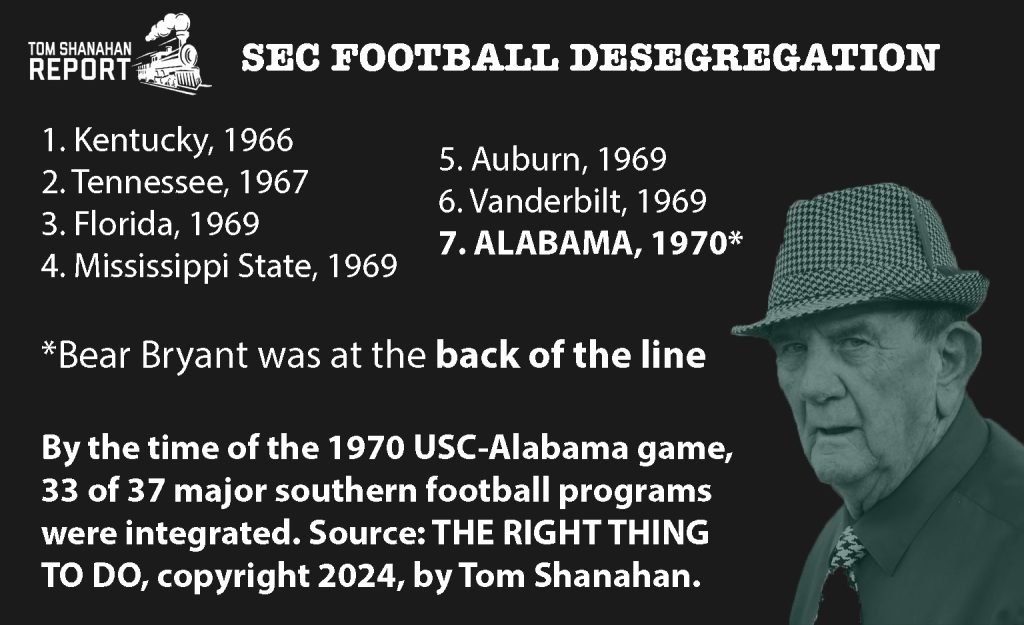
Bryant didn’t join the 20th century until he reluctantly signed his first Black player 1970 while under the threat of a Civil Rights lawsuit brought by the Alabama Afro American Student Association.
By then, Bryant trailed SEC rivals Kentucky, 1966; Tennessee, 1967; Auburn, 1969; Florida, 1969; Mississippi State, 1969; and Vanderbilt, 1969. By 1970, 33 of the 37 major southern programs were integrated.
Alabama was the seventh of 10 SEC schools to integrate, and Bryant trailed nearly all the Atlantic Coast Conference schools. Maryland, then an ACC member, was first with Darryl Hill as a senior transfer, in 1963. But Wake Forest, under coach Bill Tate, was the first to commit to integration with recruiting classes each year, starting with signing Bob Grant and Butch Henry among three Black high school prospects, in 1964.
In the Southwest Conference, Southern Methodist and coach Hayden Fry desegregated with Jerry LeVias, in 1965. Texas’s Darryl Royal, who said after winning the 1963 national title he didn’t need to recruit Black players to win a national title, was nevertheless ahead of Bryant, signing his first Black player in 1969.
My lengthy catalogue of 1970 USC-Alabama myths and Bear Bryant fairytales – Tom Shanahan Report
Don’t believe the fairytale Bryant led the way with the 1970 USC-Alabama game. The myth was made up two decades after the game by USC backers. It has been falsely spread by Bryant sycophants and sloppy reporting in the media.
Do the 21st-century Black athletes recruited by Alabama coach Nick Saban to win national titles — including 2009 Heisman Trophy winner Mark Ingram, the son and grandson of Michigan State football players — understand why the faces in photos of Alabama’s teams from 1963 through 1970 remained all-White? The answer is no.
Alabama promoted the Bryant myth in 2021 video. Alabama manipulates its own stars to sell a film with Bear Bryant revisionist history. The video includes Saban and former Alabama players Patrick Surtain II and Roman Harper regurgitating the Bryant myths.
As for Vaught and Howard, they retired rather than be forced to coach a Black player. Clemson’s president, Robert Edwards, pushed his coaches since the mid-1960s to desegregate their programs, but Howard resisted. He retired after the 1969 season without recruiting a Black player. His successor, Hootie Ingram, promptly signed his first Black player his first season, 1970.
Vaught retired after the 1970 season. Mississippi, Georgia and Louisiana State were the last three SEC schools with a Black player on their varsity roster, in 1972.
Integration was taking place ahead of the SEC throughout the South. Houston, an independent in the 1960s, integrated in 1964 under head coach Bill Yeoman, a former Duffy Daugherty assistant at Michigan State. Yeoman signed Warren McVea as the Cougars’ first Black player in 1964.
Daugherty had more influence on college football integration, coast to coast, than the Kennedys. He was the first coach to field fully integrated rosters in the 1960s when he ignored college football’s unwritten quota limiting Black athletes to a half-dozen or so.
USC was an example of following quota limitations. The Trojans, despite their campus located in populous and diverse Los Angeles, numbered only five Black players on coach John McKay’s 1962 national championship team and seven on McKay’s 1967 national championship roster.
The first fully integrated team to play in the South was Daugherty’s 1964 Spartans when they faced North Carolina in segregated Chapel Hill at Kenan Stadium. That was six years before the 1970 USC-Alabama game.
A true national tipping point was when Michigan State and Notre Dame played in the 1966 Game of the Century viewed by a record TV audience of 33 million in nation of 195 million (one in six). Michigan State lined up 20 Black players, 11 black starters, two Black team captains, College Football Hall of Famers George Webster and Clinton Jones, and the South’s first Black quarterback to win a national title, Jimmy Raye, a Daugherty Underground Railroad passenger from segregated Fayetteville, N.C.
Notre Dame had one Black player, Alan Page.
I believe if President Kennedy had lived and been re-elected in 1964, he would have attended the 1966 Game of the Century. He loved college football. He attended the Army-Navy Game and the Orange Bowl while in office. JFK, a World Wara II Navy hero, planned to attend his third straight Army-Navy Game and conduct the coin toss upon returning from Dallas, where he was assassinated a week earlier on November 22, 1963.
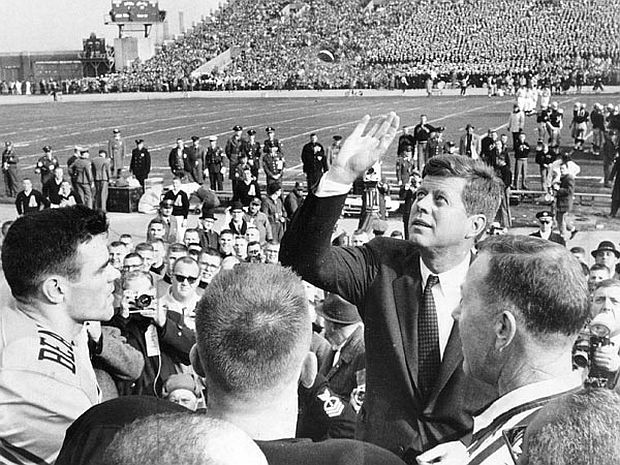
PHOTO: President John F. Kennedy conducts the coin toss at the 1962 Army-Navy Game.
JFK would have understood and recognized the progress Duffy was leading more than any other college coach. And at the time college football was more popular than the NFL and college basketball was barely a blip on the screen compared to college football TV ratings.
Matthews’ mistake was a product of accepting sloppy journalism that bows at the knee of Bryant’s legend.
The MSNBC host should have challenged Matthews on the timeline of the Kennedys not matching up with Bryant’s rosters, but the host no doubt had no clue. The media has negligently regurgitates a false narrative that USC backers and Bryant sycophants captured when they made up a myth about the 1970 USC-Alabama game two decades after the game was played.
Remember all of the above the next time someone falsely tries to tell you Bryant led the way with the 1970 USC-Alabama game. The real Bear Bryant didn’t care about Black athletes until they were forced upon him and then later realized he couldn’t win without them. Bryant never sent Daugherty players despite what ESPN and other outlets have falsely stated. Not a single Daugherty Underground Railroad passenger — there were 44 of them from 1959 to 1972 — tells a Bryant backstory.
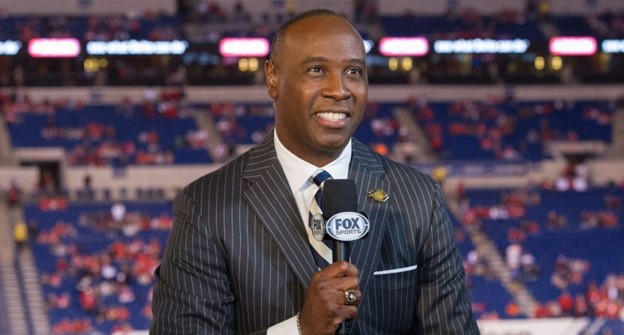
This is an example of an egregious error by Charles Davis aired on ESPN: Milestone Minutes Episode 8 Davis now works for CBS.
Chris, I’d love to send you a copy of my book, “THE RIGHT THING TO DO, The True Pioneers of College Football Integration in the 1960s.”
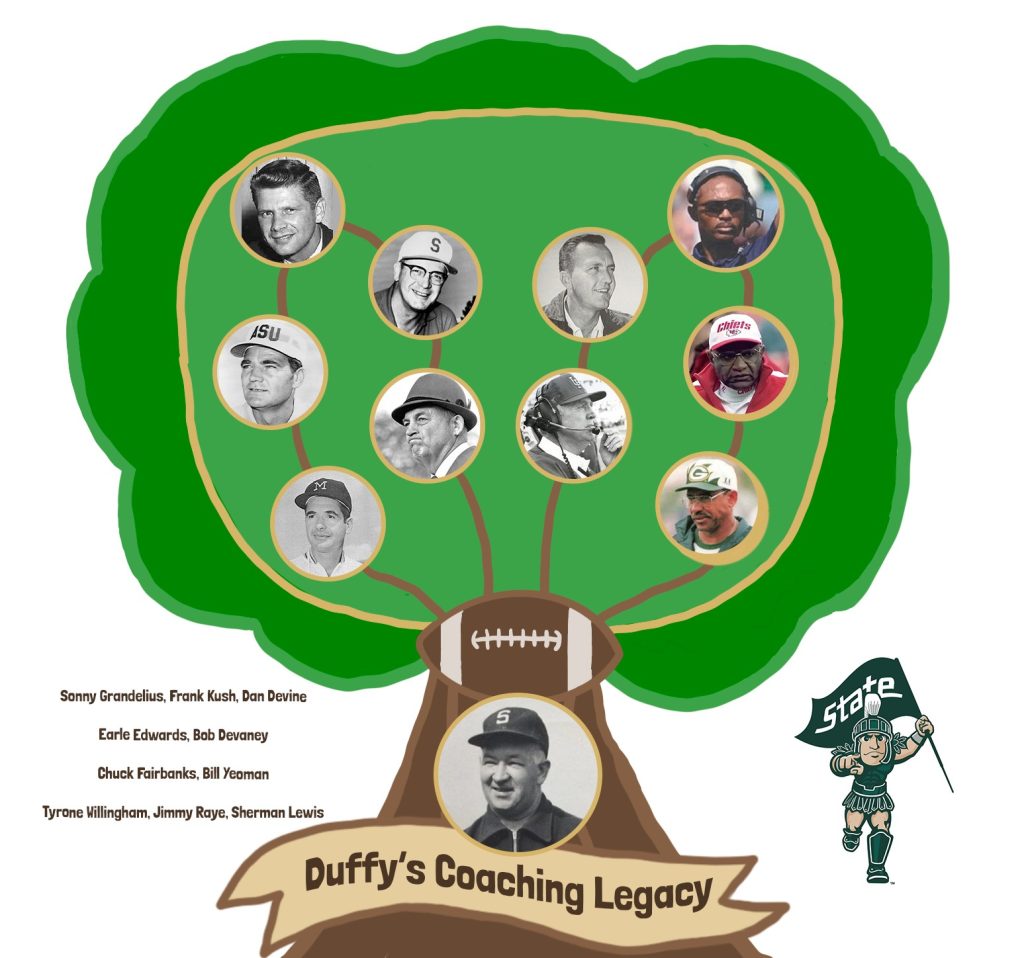
It explains how Daugherty changed the face of the game through his own efforts and his assistant coaches who followed his blueprint. Once they became a head coach, they recruited Black athletes beyond the quota limitations.
Four were Daugherty assistant coaches: Dan Devine (Arizona State, Missouri, Notre Dame), Bob Devaney (Wyoming, Nebraska), the aforementioned Yeoman at Houston; and Sonny Grandelius, Colorado.
Three others were Earle Edwards, NC State, who coached alongside Daugherty at Michigan State; Frank Kush, Devine’s successor at Arizona, who played for Daugherty; and Chuck Fairbanks, Oklahoma, who also played for Daugherty.
Chris, I’ve got the facts on my side. The media has never understood Duffy’s pioneering leadership. Some outlets are content telling the Bryant fairytale. Others are afraid to take on Bryant’s myth.
I tried sending copies of my book to Joe Scarborough, Willie Geist and Reverand Al Sharpton at MSNBC, but I received no response. Maybe I should have sent it instead to Mika Brzezinski, so she can educate them on sports history. That’s a dig at Joe and Willie. Mika patiently waits for Joe and Willie to stop talking sports and get back to the news.
Chris, I could use your help with Joe, Wilie and Reverand Al the next time you’re in the studio rebranded as MS NOW. You’re admitted to the old and now the new studio. I couldn’t get past the mall cop at the front desk at 30 Rockefeller Plaza.
But rest assured, Chris, I won’t challenge you on anything else about the Kennedys. I’m already reading your new book. Please read mine.
-30-
EDITOR NOTE: Alabama renamed Denny Stadium Bryant-Denny Stadium and has a statue of Bryant outside the stadium Mississippi renamed Hemingway Stadium Vaught-Hemingway Stadium and there is a statue of Vaught outside the campus athletic training center. Clemson has a bust of Frank Howard at Memorial Stadium and “Howard’s Rock” at the stadium is a Clemson tradition.
There is no statue of Duffy Daugherty at Michigan State. Why?
The Duffy Daugherty Building was named for him, but the title has since been squeezed by the naming rights granted to the Skandalaris Center and the Tom Izzo Football Building.
***
Bryant’s sycophants used racist Alabama Gov. George Wallace as an excuse for Bryant not desegregating sooner, which ignores the fact Auburn was a year ahead of Bryant with James Owens in 1969 and that Wallace wasn’t in office, 1967-71.
Wallace eventually apologized for his racist stances in the early 1990s. Bryant never apologized or explained dragging his feet prior to his death in 1983.
“Past error is no excuse for its own perpration. We do ourselves our best justice when we measure against ancient texts as in Sophocles. All men make mistakes, but a good man yields when he knows his course is wrong and he repairs the evil.”
— Robert F. Kennedy, Lesson three from Chris Matthews’ new book, “Lessons from Bobby. RFK referred to his quest to end the Vietnam War escalated under President Lyndon Johnson that was had its roots in the JFK administration.
***
I invite you to follow me on Twitter @shanny4055
I’ll put my facts on the true pioneers of college football integration versus Bear Bryant fairytales against anybody, anytime, anywhere. Watch here.
Click here for my story on the 1962 Rose Bowl and Segregation and Alabama.

— Tom Shanahan is an award-winning sportswriter with two books on college football integration, “RAYE OF LIGHT, Jimmy Raye, Duffy Daugherty, the Integration of College Football and the 1965-66 Michigan State Spartans,” and “THE RIGHT THING TO DO, The True Pioneers of College Football Integration in the 1960s.” They are the most accurate accounts of college football integration in the 1950s and 1960s. They also debunk myths about the 1970 USC-Alabama game. The false narrative co-opted the stories of the true pioneers who stood up to Jim Crow and the KKK.
— Two children’s books also explain Michigan State College Football Hall of Fame coach Duffy Daugherty’s impact on integration through the Underground Railroad and the Hawaiian Pipeline: “DUFFY’S COLLEGE FOOTBALL UNDERGROUND RAILROAD” and “HOW DUFFY PUT HAWAII ON AMERICA’S FOOTBALL MAP.”
***
PURCHASE LINKS, non-fiction books
— RAYE OF LIGHT, August Publications or on Amazon.
— THE RIGHT THING TO DO, August Publications or on Amazon.
PURCHASE LINKS, children’s books
— DUFFY’S COLLEGE FOOTBALL UNDERGROUND RAILROAD, Order from Barnes and Noble here and Amazon here.
— HOW DUFFY PUT HAWAII ON AMERICA’S FOOTBALL MAP, coming soon on Barnes and Noble and Amazon.

