

Colorado Iron Man Travis Hunter, single-platoon football and the Heisman vs. the Maxwell
PHOTO: Colorado two-way player Travis Hunter.
By TOM SHANAHAN
College Football Hall of Famer Joe Romig played in the game’s single-platoon era when named the 1961 UPI Lineman of the Year. That’s as good as it gets for offensive linemen since Heisman Trophy voters don’t consider them worthy.
But awards and honors aren’t all that make Romig, a Colorado alumnus, more than qualified to speak on Travis Hunter, Colorado’s Iron Man Heisman candidate. How does he view Hunter playing both ways in the game’s modern era? Hunter is the only one, after all.
“When I played, everyone was gassed from playing both ways,” Romig said. “He plays both ways against guys who only play one way. He’s playing against guys who had a chance to rest.”
In other words, don’t underestimate Hunter averages 125 snaps a game as a wide receiver and cornerback yet he still dominates on both sides of the ball against opponents who gain breathers between possessions.
And those are just Romig’s X’s and O’s reasons. His brain power includes an academic side. He was a Rhodes Scholar and went on to a career as an astrophysicist.

PHOTO: Joe Romig was a consensus two-time All-American playing at Colorado in the 1960 and 1961 seasons and a three-time All-Big Eight pick.
Hunter is setting a standard no other Heisman winner has established. Don’t bring up Michigan’s Charles Woodson winning in 1997. Hunter is setting a higher standard than Woodson.
Woodson was a defensive back who also returned punts and played some offense. Woodson saw spot duty on offense with only 11 catches to rank seventh on the team. Hunter ranks at the top of the Big 12 Conference in multiple offensive and defensive categories.
When Woodson won the Heisman over Tennessee quarterback Peyton Manning, what put him over the top was his Heisman moment on TV. In a game against Ohio State with a large television audience, he caught a touchdown pass, returned a punt for a touchdown and intercepted a pass in the end zone. It was his lone TD out of 33 punt returns and one of only two touchdown catches as a receiver, but TV moments sway Heisman voters.
Hunter on offense caught 92 balls for 1,152 yards and 14 touchdowns in 12 games. His yards rank fourth in the nation and first in the Big 12, his catches fifth and first and his touchdowns second and first.
On defense, he finished with 31 tackles and four interceptions. His 15 passes defended led the Bigs 12, his 11 pass breakups tied for first and his four interceptions tied for second. He also forced a fumble that helped clinch a win.
The Big 12 voters named him the Defensive Player of the Year while teammate Shedeur Sanders, his quarterback, was the Offensive Player of the Year. But a case could have been made for Hunter as Offensive or Defensive Player of the Year.
He’s a Heisman finalist along with Boise State’s Ashton Jeanty, Oregon’s Dillon Gabriel and Miami’s Cam Ware as well as a finalist for Maxwell Award along with Jeanty and Gabriel. The Maxwell has been presented to the nation’s top player since 1937. The Maxwell will be announced December 12 and the Heisman on December 14.
I don’t have a Heisman vote, but I voted for Hunter on my Maxwell ballot. The Maxwell, to its credit, has a track record of not limiting its award to quarterbacks, running backs or receivers.
The Maxwell departed from norm most recently with Notre Dame linebacker Manti Te’o, in 2012. Other winners were Pitt defensive lineman Hugh Green, 1980; Michigan State linebacker/safety Brad Van Pelt, 1972; and Notre Dame linebacker Jim Lynch, in 1966.
It should be noted, though, Lynch, who died in 2022, said the best player in the country in 1966 was Michigan State linebacker George Webster. I quoted him in my new book, “THE RIGHT THING TO DO, The True Pioneers of College Football Integration in the 1960s.”
I saw comments from Fox commentator Brock Huard that Jeanty deserves the Heisman for leading his team to a conference title and College Football Playoff berth. It’s a fair argument, but Boise won the Mountain West Conference for second straight year.
Hunter helped flip more than Colorado’s record from 4-8 in head coach Deion Sanders’ first year to 9-3. He flipped the conversation on Sanders.
Sander drew criticism for relying on the transfer portal and thus defying old-school coaching customs. His critics smugly pointed to his 4-8 record, but they’ve gone silent since the Buffaloes won seven of eight games after a shaky 1-1 start. Flipping conversations on Deion Sanders – a controversial figure – might be Hunter’s most impressive feat.
For the record, Romig also dismissed any arguments many old-timers bring up that the game was tougher when they played. That is true to an extent, but the reasons are primarily because safety precautions were crafted to eliminate cheap shots.
Besides, if the game is softer now, why is Hunter the only two-way example? Romig not only doesn’t romanticize his days he also makes a confession.
“Every year I hoped the NCAA would change to rule to two-platoon football,” said Romig, “so I could just play middle linebacker.”
There is extreme irony in that comment. Romig’s UPI Lineman of the Year and two-time All-American honors drove his 1984 College Football Hall of Fame induction.
The NFL and college both played two-platoon football after World War II, but college football switched back to single-platoon in 1953 to save money on scholarships. However, the college game gradually modified substitution rules until full two-platoon football in 1964.
“What Hunter has done is tougher than what we did when I played,” Romig said.
***
My book, THE RIGHT THING TO DO, also includes a chapter on Romig in his role as Colorado’s team captain forcing Jim Crow to back down at the 1962 Orange Bowl. Chapter 6: “Colorado, Sonny Grandelius and the Orange Bowl.”
After Colorado won the Big Eight title, Romig informed Orange Bowl officials Colorado wouldn’t play until their Black teammates were able to stay at the same hotel and eat in the same restaurants. They had been denied such access when Colorado played a regular-season game in Miami.
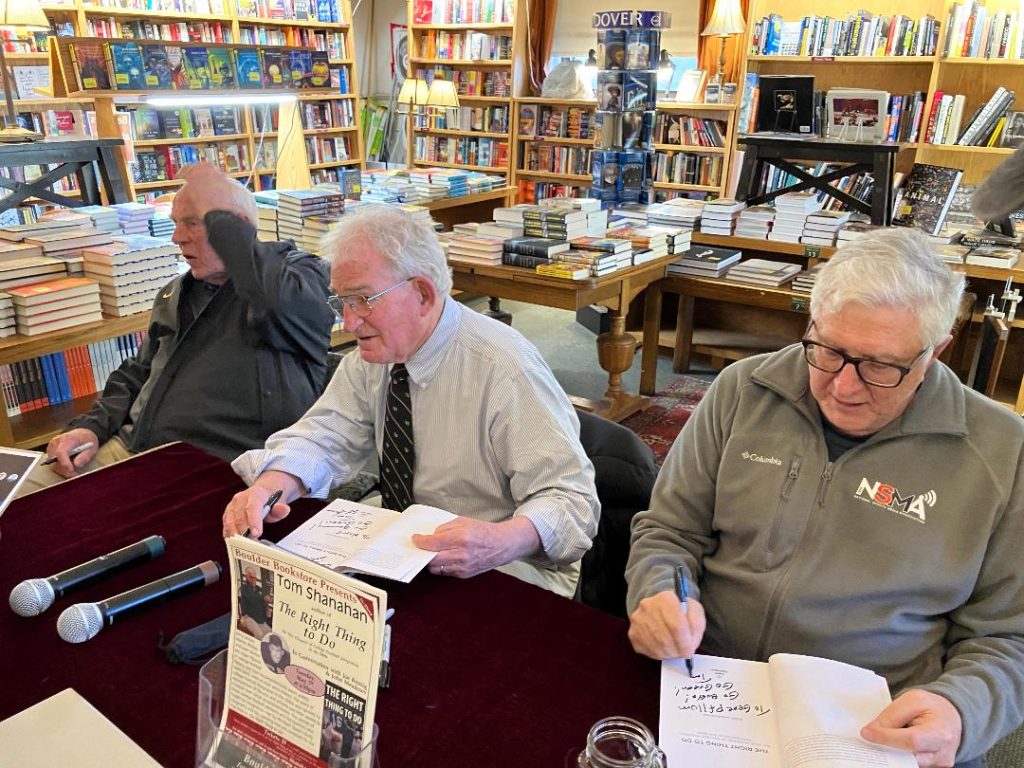
PHOTO: Joe Romig (C) and John Meadows (L) signed books with me at the Boulder Bookstore.
The Orange Bowl backed down. It’s an untold story, though, because the sports media avoided race in the 1960s. The modern media focuses only on desegregation stories that credit Alabama coach Bear Bryant in the 1970s.
-30-
Tom Shanahan is an award-winning sportswriter and frequent contributor to Spartanamag.com. His new book on Michigan State leading college football integration is, “THE RIGHT THING TO DO, The True Pioneers of College Football Integration in the 1960s.” His first book was “RAYE OF LIGHT, Jimmy Raye, Duffy Daugherty, the Integration of College Football and the 1965-66 Michigan State Spartans.”
I invite you to follow me on Twitter @shanny4055
Below are links to click on to purchase my books focused.
My books tell the true story of college football integration in the 1960s and address the myths and fiction that allowed a false narrative surrounding the 1970 USC-Alabama game to usurp the credit from the true pioneers. As I said when I spoke at the National Sports Media Association book festival, no two books provide an accurate portrayal more than RAYE OF LIGHT and THE RIGHT THING TO DO.
I’ll put my facts up against anybody, anytime, anywhere. Watch here.
Click here for my story on the 1962 Rose Bowl and Segregation awarded first place by the Football Writers Association of America. I tell untold stories on Michigan State’s leading role and the true pioneers of college football integration. Click here to read the summary as a first-place story.
***
Click here to purchase The Right Thing To Do
THE RIGHT THING TO DO
The True Pioneers of College Football Integration in the 1960s
Foreword by Ruffin McNeill

***
Click here to purchase Raye of Light.
RAYE OF LIGHT
Jimmy Raye, Duffy Daugherty, the 1ntegration of College Football and the 1965-66 Michigan State Spartans
Foreword by Tony Dungy

***
Click here to purchase my children’s book, Bubba’s Dad, Duffy and College Football’s Underground Railroad
The book for now is only a Kindle version on Amazon. Print and audio platforms available soon.


