


WRITTEN OUT OF HISTORY: Johnny Roland’s three-dimensional story and Dan Devine’s influence
PHOTO: Missouri’s Johnny Roland, a pillar of football integration at three levels, stands among the campuses iconic limestone pillars. A local newspaper story 60-some years ago can’t compete with Bear Bryant myths spread in a digital world.
Buy me a coffee to support my research to tell untold college football integration untold stories.
Thomas Shanahan | @Thomas-Shanahan-23
Order link:
Raye of Light: Jimmy Raye, The Integration of College Football 3rd Ed – August Publications
***
By TOM SHANAHAN
Johnny Roland’s journey knocking down Jim Crow football doors began in 1960 as a high school senior. This happened in Corpus Christi, Texas, despite Black and White school athletics run by separate governing bodies.
His path continued to college, where he broke ground playing for Missouri coach Dan Devine, 1962, 1964 and 1965. He was the Tigers’ first Black team captain, first Black All-American and first Black College Football Hall of Famer.
Roland played eight NFL seasons and then added a third trailblazing dimension as an NFL assistant coach. Devine, who was then the Green Bay Packers’ head coach, named him to his 1974 staff at a time coaching in the NFL wasn’t a promising job prospect for an African American. A year earlier, there were only three Black assistant coaches in the 26-team NFL coaching fraternity.
Devine’s open mind branched off from the coaching tree of Michigan State’s Duffy Daugherty, whose teams led college football integration with players on the field and coaches on the sidelines. Daugherty’s assistants followed his blueprint upon becoming a head coach.
“Dan Devine is right at the top among the coaches breaking integration ground,” said Roland, who is now 83 and living in St. Louis. “Duffy Daugherty and Dan Devine were trailblazers.”
Yet Roland’s three levels breaking ground and Devine’s influence remain largely untold stories. Where was the media to tell these stories? Well, the 1960s sports media negligently avoided racial milestones when covering games.
Benchmarks that Roland and many others established were ignored — outside of a local newspaper report. But since hometown newspaper stories didn’t go viral, blank pages that belonged to 1960s pioneers were later filled in college football lore by myths surrounding the 1970 USC-Alabama game. The fairytale was crafted two decades after USC traveled to Legion Field in Birmingham.
The narrative claims Alabama coach Bear Bryant orchestrated events to end Jim Crow through one game. Ask yourself this question: When in America’s 250-year history were racial issues solved in one night?
Nevertheless, the unvetted popular misconception worked its way into national folklore with the aid of poorly researched sportswriting. It spread slowly until ballooning in the digital age.
A piece of Roland’s saga was touched upon for a new documentary on the Prairie View Interscholastic League, “The PVIL Story: Separate … But Equal?” The PVIL governed Texas Black high school athletics. Roland was interviewed and attended a public showing of the film on June 18 at the Texas Sports Hall of Fame in Waco.

But the Roland/Devine story covers much more ground.
The more you read this story, the more you should wonder why pioneers representing Missouri, the Atlantic Coast Conference, Southeastern Conference, Southwest Conference and other teams from Daugherty’s coaching tree were pushed into the background. Those teams included Devine’s teams at Arizona State and Notre Dame, Nebraska’s Bob Devaney, Oklahoma’s Chuck Fairbanks, Houston’s Bill Yeoman, Colorado’s Sonny Grandelius, North Carolina State’s Earle Edwards and ASU’s Frank Kush upon promotion as Devine’s successor.
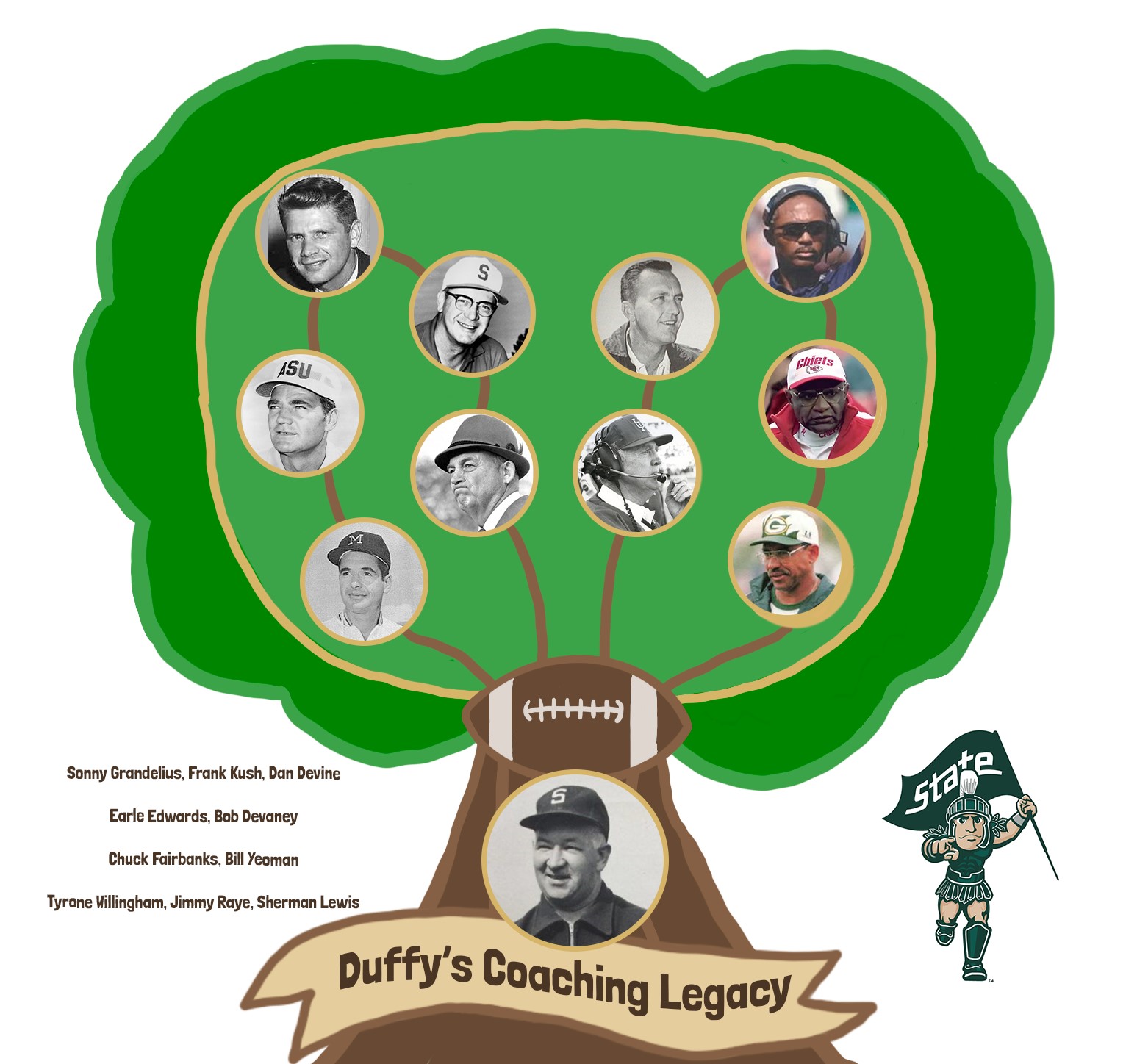
Each time the USC’s 42-21 win over Alabama is presented as an impactful moment, an opportunity is missed to tell authentic stories. Don’t count on the PVIL documentary receiving a national reach accorded Bryant’s dubious portrayals in HBO’s “Breaking the Huddle,” 2008; Showtime’s “Against the Tide,” 2013; or ESPN films in 2019 and 2020.
The rest of this article is a deeper look at Johnny Roland traversing history through high school, college and the NFL. The last section asks how the media continues to get so much history so wrong.
THE HIGH SCHOOL DOOR
In 1960, Roland led Roy Miller High’s roster of six Black players, 17 Hispanics and 18 White athletes as the first integrated team to win a Texas state title.
“We were young kids on our own little island in Corpus Christi,” Roland said. “We played sports together, we went to school together and we went to church together. We had great leadership from our coach, Pete Ragus. He had a job to do coaching a football team and didn’t care about skin color.”
Miller won the 4A title, the largest division in the University Interscholastic League. The UIL governed athletics for White schools during segregation but there was no rule against Black players competing in the playoffs. Miller marched to the title with a 13-1 record, and Roland was named to the UIL all-state team.
This happened in 1960s redneck Texas?
Yes, following the Supreme Court’s 1954 Brown v. Board of Education ruling, the Corpus Christi Independent School District set aside bigotry in 1955. This, of course, was an extreme contrast to other Texas districts resisting integration.
Where was the CBS Sports version of Dan Rather — a Texan who covered Civil Rights for CBS and Walter Cronkite — to report this remarkable story?
Corpus Christi’s small African American population was one reason given for the district complying with the law of the land, according to Robert D. Jacobus, author of “Black Man in the Huddle: Stories from the Integration of Texas Football.” But don’t discount Corpus Christi was another example of White southerners opposing segregation despite White supremacists dictating the South.
Civil Rights leader Dr. Martin Luther King often criticized “the appalling silence and indifference of good people who sit around and say, wait on time.” The good people of Corpus Christi didn’t wait on time.
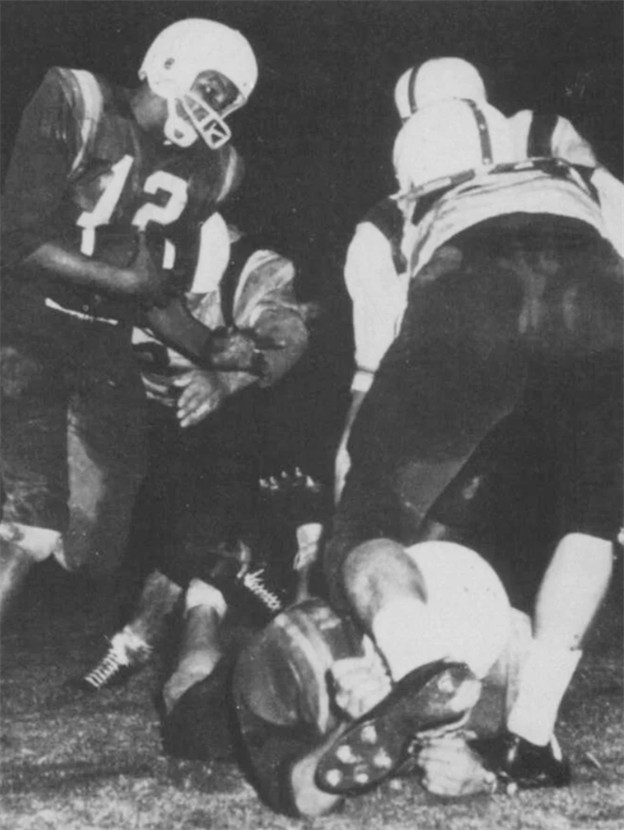
PHOTO: In 1960, Johnny Roland led Miller High to the 4A division state title — the first Texas state title won by an integrated team.
Other Black high school Texans weren’t as fortunate as Roland and his Black teammates prior to the 1967 merger of the UIL and PVIL. For example, Michigan State College Football Hall of Famer Bubba Smith didn’t earn UIL all-state honors as a 1962 senior at Charlton-Pollard, a Black school in Beaumont.
Bubba, though, didn’t need honors to board Michigan State’s Underground Railroad. Bubba’s father, Willie Ray Smith Sr., a legendary high school coach with 235 career wins and two Black state titles, was the chief engineer steering Beaumont-area Black talent to Daugherty.
Bubba was one of the Spartans’ 20 Black athletes in the 1966 Game of the Century against Notre Dame’s one Black player. Three of the Spartans’ 11 Black starters were Texans, Smith, Gene Washington and Jess Phillips.
THE COLLEGE DOOR
Roland’s Missouri passport allowed him to escape Texas major college football segregation.
Texas football coach Darrell Royal said he didn’t need Black players after his Longhorns won the 1963 national title. Royal resisted integration until the end of the decade, and his 1969 team was the last all-White national champion.
As late as 1965, Texas A&M coach Gene Stallings, a Bear Bryant protege, said he didn’t believe Black and White players could get along in the locker room. His narrow-minded comment was a response to news Southern Methodist coach Hayden Fry signed Jerry LeVias in 1965 as the Southwest Conference’s first Black scholarship player.
In those days, none of the pioneering southern coaches matched Devine’s Missouri track record (1958-70). In 1958, Mel West and Norris Stevenson were the Tigers’ first two Black players.
Roland got on Devine’s radar through a Navy officer who was a Missouri fan based at Naval Air Station Corpus Christi. In those days – long before recruiting services – coaches found talent through reliable contacts. But Devine followed up on this blind tip.
“He wrote Dan about me, and Dan began recruiting me,” Roland said. “Dan and his staff came down to Corpus Christi. I knew Missouri had Black players, and I trusted his skill as a coach. He also promised my mom he would take care of her only son.”
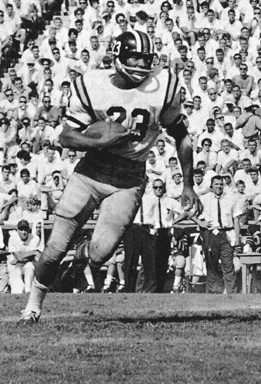
PHOTO: Missouri’s Johnny Roland played on both sides of the ball and returned punts.
Roland burst onto the scene as a 1962 sophomore (the NCAA prohibited freshman eligibility until 1972), earning first-team All-Big Eight and third-team All-American honors. He was seventh in the nation with 860 yards rushing and scored 12 touchdowns. Missouri was ranked No. 12 with an 8-2-1 record and a win over segregated Georgia Tech in the 1962 Blue Bonnet Bowl, 14-10.
But Devine’s promise to Roland’s mother was never more tested than 1963. The school suspended Roland for the fall semester when he was charged with stealing automobile tires and wheels. Roland’s car, which he said he lent to a friend, was found with two new tires and wheels.
In 1963 Missouri, a Black man couldn’t count on the foundational legal doctrine of “innocent until proven guilty.” But Roland said athletic director Don Faurot and Devine listened and accepted his account.
“They were the only two people who believed me,” Roland said. “They wanted to give me a second chance. Dan was living up to that the promise he made to my mom.”
Devine found Roland a construction job in Kansas City. When charges were dropped, Roland returned to the team for the 1964 and 1965 seasons. Roland played on both sides of the ball, although primarily as a 6-foot-2, 198-pound defensive back and punt returner.
“Dan told me, ‘Truthfully, you’re our best running back, but we’re stacked at running back. We can be a better team with you on defense.’ I was a team player.”
Entering 1965, Roland was named Missouri’s first Black team captain with a co-captain’s role. He finished the year earning All-Big Eight for the third time and his second All-American selection – this time as a consensus choice on five of six NCAA-sanctioned teams.
On defense, Roland intercepted six passes. On offense, he scored five touchdowns with Devine using him inside the 20-yard line. On special teams, Roland returned 42 punts for 690 yards, a 16.4 average. The Tigers finished the year ranked No. 6 with an 8-2-1 record and a win over segregated Florida in the Sugar Bowl, 20-18.
Missouri retired Roland’s No. 23 jersey in 1990, and the College Football Hall of Fame enshrined him in 1998.
THE NFL COACHING DOOR
The St. Louis Cardinals drafted Roland in the 1966 fourth round as a running back, and he once again burst upon his new scene. He was named 1966 Rookie of the Year and earned 1966 and 1967 Pro Bowl selections — back when Pro Bowl honors carried prestige.
But after his lone season with the New York Giants in 1973, he contemplated retirement. Devine opened another door.
“Dan and I would get together every year in the offseason for dinner in St. Louis,” Roland said. “I told him I’ve got to decide if I want to play one more season. He said, ‘If you don’t play, let’s talk about a coaching position for you.’”
Roland was uncertain about his future since the Giants changed coaches after the 1973 season and a 1974 strike loomed (it took place, lasting 42 days from July to early August). Roland coaching the Packers’ special teams launched a 26-year NFL career that included a Super Bowl XX title with the 1985 Chicago Bears.
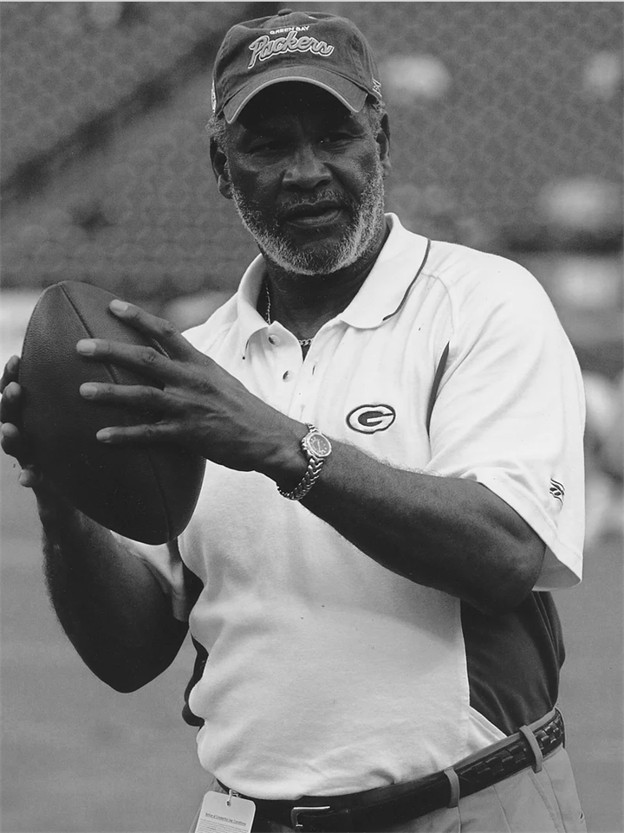
PHOTO: Johnny Roland coaching with the Green Bay Packers.
His Green Bay stint lasted only one year, though, when the Packers struggled and Devine resigned on December 16, 1974. Devine was soon named Notre Dame’s head coach for 1975, and Roland followed him to South Bend.
“I had a meal ticket at Notre Dame,” Roland said. “I was recruiting Southern California and Arizona, and I knew if I could get recruits to cross the Rocky Mountains to campus, I had them.”
But Roland, explaining he had a growing family, stayed only one season after new Philadelphia Eagles coach Dick Vermeil offered him a pay increase to join his 1976 staff.
“Dick was a great guy and great coach,” Roland said, “but he could burn you out as a football coach.”
He said it with a chuckle, and it’s not hard to read between the lines reasons Roland left coaching after three seasons to buy a St. Louis radio station, KIRL. After all, “burnout” was Vermeil’s own explanation when he stepped down from the Eagles following the 1982 season.
Roland returned to the NFL in 1983 when new Chicago head coach Mike Ditka hired him as the Bears’ running backs coach.
“If you did your job, you had no problems working for Mike,” Roland said.
By the mid-1980s, Roland was mentioned as a leading candidate to become the NFL’s first Black head coach along with NFL assistants Jimmy Raye and Tony Dungy.
Raye, who joined the San Francisco 49ers in 1977, was the NFL’s second Black coordinator when the Los Angeles Rams’ John Robinson hired him in 1983 as his offensive coordinator. Dungy, who began coaching in the NFL with the Pittsburgh Steelers in 1981, was hired as a head coach — but not until 1996 by Tampa Bay as the league’s third Black head coach.
Unlike Dungy’s experience, Roland, Raye and other pioneer Black assistants didn’t get a chance to pass through the NFL owners’ vaulted door reserved for White coaches.
After Dungy was the first Black head coach to win a Super Bowl with the 2006 Indianapolis Colts and first enshrined in the Pro Football Hall of Fame in 2016, he paid tribute to Roland and Raye in his HOF induction speech. He named them among the 10 Black assistants in the 28-team league dating to Dungy’s 1977 rookie year as a player with the Steelers.
“It was a small group of men,” Dungy said, “just 10 of them, if you can believe that — 10 African American assistant coaches in the entire NFL. Many of them never got the chance to move up the coaching ladder like I did, but they were so important to the progress of the league.”
Dungy’s point was one man alone doesn’t blaze trails. His comment shouldn’t be overlooked when considering Bear Bryant and the 1970 USC-Alabama myth.
MEDIA COMPLICITY LOCKED HISTORY’S DOOR
The list of pre-1970 trailblazers written out of history is a long one:
In addition to West, Stevenson and Roland, they include Maryland’s Darryl Hill (1963); Wake Forest’s Bob Grant and Butch Henry (1964); Houston’s Warren McVea (1964); Southern Methodist’s Jerry LeVias (1965) and Rufus Cormier (1966); Baylor’s John Westbrook (1966); Kentucky’s Nat Northington and Greg Page (1966) and Wilbur Hackett and Houston Hogg (1967); Tennessee’s Lester McClain (1967) and Jackie Walker (1968); Auburn’s James Owens (1969) and more players benefitting coast to coast from Daugherty’s coaching tree.
Their stories were lost due to sloppy journalism regurgitating one integration story, the 1970 USC-Alabama game. There are no facts to support the claim Bryant was an integration leader.
In fact, Bryant’s track record was he dragged his feet into the 1970s as the seventh of 10 Southeastern Conference schools to include its first Black player. By then, 33 of 37 major southern programs were integrated. These facts are never cited about Bryant in the 1970 USC-Alabama myths.
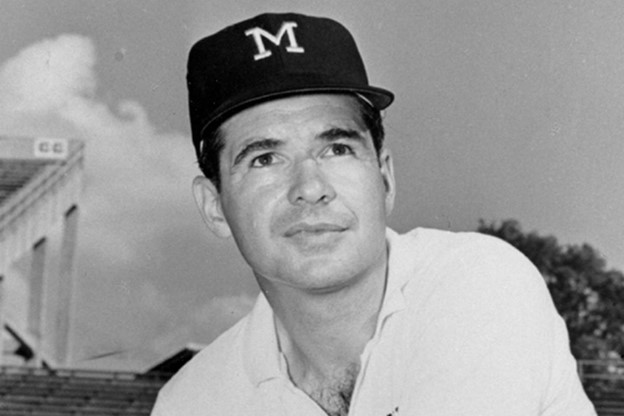
PHOTO: Dan Devine’s track record breaking Jim Crow barriers at Missouri dated to 1958 — far ahead of southern coaches.
The mythmakers were former USC players who tried to sell a movie script. In forming a narrative, they failed to understand 1960s progress. They also failed to recognize by the time the Trojans arrived at Legion Field in Birmingham, Alabama’s fans grew accustomed to integrated opponents running over the Crimson Tide.
— In a 350-day span overlapping the 1968 and 1969 seasons, Missouri beat Alabama in the 1968 Gator Bowl (12-28-68), 35-10; Tennessee overwhelmed Alabama start to finish in the annual “Third Saturday of October” rivalry game (10-18-69), 41-14; and Colorado beat Alabama in the 1969 Liberty Bowl (12-13-69), 47-33.
— Missouri numbered 15 Black players in the Gator Bowl. In the 1969 Tennessee-Alabama game, Walker was the first Black man to score at Legion Field with an interception return for a 21-0 first-quarter lead. Walker was later the SEC’s first Black All-American player in 1970 and 1971. Colorado numbered seven Black players in the 1969 Liberty Bowl.
By 1970, the sight of USC’s Sam Cunningham, a Black fullback, running for 135 yards and two touchdowns to beat Alabama doesn’t fit the narrative Bryant wanted to shock his bigoted fanbase into allowing him to recruit Black players. In fact, nine months prior to USC’s arrival, Bryant signed Wilbur Jackson and Bo Matthews to his 1970 recruiting class, although Matthews attended Colorado.
Dead men tell no tales, but Bryant’s own words – or lack of — dispute claims he worked behind the scenes with a Nixonian secret southern strategy. In Bryant’s 1974 book, “BEAR,” he doesn’t’ mention a word about the 1970 USC-Alabama game in any context. Not as a transformative moment. Not even as a Crimson Tide loss.
— The same is true of a lengthy 1980 Time magazine cover story profile of 5,100 words. How could there be a mention? The myth was made up in USC circles in the late 1980s and didn’t spread into the media until the mid-1990s
— A 1991 Bryant documentary, “The Legacy Lives,” written by Al Browning, a Bryant friend, doesn’t mention a word about the 1970 USC-Alabama game.
— When USC returned to Alabama’s Legion Field in 1978 for a game broadcast by ABC-TV, legendary announcer Keith Jackson didn’t mention the 1970 game as a transformative racial moment. He simply stated USC won.
The missing history pages don’t stop there. On the same day USC beat Alabama, September 12, 1970, sloppy journalism ignored two other games won at southern stadiums by integrated rosters.
— Stanford’s all-minority backfield upset No. 4-ranked Arkansas in ABC-TV’s nationally televised game at War Memorial Stadium in Little Rock. Stanford’s Hillary Shockley, a Black fullback from Los Angeles, finished with 149 total yards and three touchdowns against Arkansas. Stanford’s starting backfield included Heisman Trophy-winning quarterback Jim Plunkett (Native American/Hispanic) and tailback Jackie Brown (Black). How much preseason anticipation for this game existed? Dan Jenkins, the godfather of sportswriters, was in Little Rock, not Birmingham, reporting for Sports Illustrated (back when the magazine was the bible of sports).
— At Grant Field in Atlanta, Georgia Tech’s Eddie McAshan, the Deep South’s first Black starting quarterback, led a 23-20 upset of No. 17 South Carolina. By 1970, South Carolina coach Paul Dietzel’s roster included the Gamecocks’ first Black player. Dietzel previously coached Army West Point’s first football Black letterman in 1966, Gary Steele.
— By time Cunningham died in 2021, he realized the myth used him as a pawn. Former NFL player Reggie Berry, who ran an Los Angeles-area education program with participation from Cunningham and Bob Grant, told Cunningham about Grant as a pioneer in 1964 at Wake Forest and other 1960s trailblazers.
“Sam was a smart guy,” Berry said. “What I told him he acknowledged. He looked at me and he said, ‘You’re probably right.’”
Cunningham’s new perspective was reflected in a quote from him in a 2016 Los Angeles Times article:
“It’s already a historic story without adding sauce to it, you know what I mean?” Cunninghams said. “Everybody wants to make it more than what it is. And what it was, was very, very important anyway.”
Cunningham understood he wasn’t more important on college football integration’s timeline than 1960s pioneers.
So, we have a dominant narrative in college football lore about a coach who died in 1983 never speaking a word about the 1970 USC-Alabama and the game’s protagonist who went to his grave believing he had been used to sell a failed movie script.
But ESPN, Sports Illustrated and The Athletic continue to post dubious stories. The Atlantic, despite a 2013 article debunking the premise of the 1970 USC-Alabama myth, gave the 1970 myth new life in a May article. The story was about the NAACP asking Black athletes to not support college programs in states gerrymandering voting districts.
With the media giving a false narrative unjust credibility, Johnny Roland and so many 1960s pioneers lack their proper place in college football integration history. Without the media admitting its failure, Johnny Roland and the true pioneers will live eternally in the shadow of a Bear Bryant/Sam Cunningham fairytale.
THE TITANIUM TEN
Of the 10 Black assistants mentioned by Tony Dungy who were 1977 coaches in the 28-team NFL, the trio who went onto the l0ongest tenures were Jimmy Raye, 36 years; Johnny Roland, 27; and Elijah Pitts, 23.
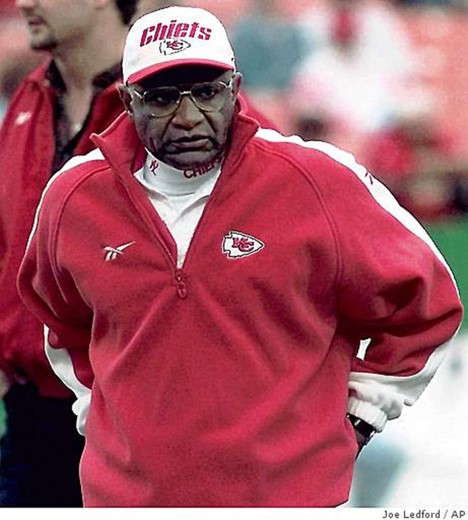
PHOTO: Jimmy Raye with the Kansas City Chiefs, 1992-2000.
— Al Tabor, 1967; 1972-79.
— Lionel Taylor, 1970-81; 1989-90.
— Earnel Durden, 1971-86.
— Bob Ledbetter, 1974-75; 1977-83.
— Elijah Pitts, 1974-83; 1985-97.
— Johnny Roland, 1974; 1976-78; 1983-2005.
— Alan Webb, 1974-78.
— Willie Brown, 1976-78.
— Buck Buchanan, 1976-78.
— Jimmy Raye, 1977-2010; 2012-13.
***
For those struggling to acknowledge facts that the impact of Bear Bryant/1970 USC-Alabama game is a fairytale, here is a quote from Lane Demas, a Ph.D professor at Central Michigan University and an author.
“Alabama football integrated because an organized, sustained movement of Black Americans nationwide forced it to, against its will,” Demas said. “That’s the only answer that makes sense if you study the broader historical context.
“The USC-Alabama story is in a long line of white myths that serve to deny Black people their agency in terms of changing America. Focusing on figures like Branch Rickey and Bear Bryant creates a narratives in which it is ultimately White people who make cautious, thoughtful, calculating decisions to create and integrate their own teams. They become the agents of change, not Martin Luther King, Rosa Parks, or thousands who struggled in the streets.”
-30-
Visit my homepage: TomShanahan.Report
— Watch a three-minute video to learn about our documentary at the fundraising stage, GAME CHANGERS OF THE CENTURY, and the Investment Deck.
I invite you to follow me on Twitter @shanny4055
I’ll put my facts on the true pioneers of college football integration versus Bear Bryant fairytales against anybody, anytime, anywhere. Watch here.
Click here for my story on the 1962 Rose Bowl and Segregation and Alabama that earned first place for Enterprise from the Football Writers Association of American.

— Tom Shanahan is an award-winning sportswriter with two books on college football integration, “RAYE OF LIGHT, Jimmy Raye, Duffy Daugherty, the Integration of College Football and the 1965-66 Michigan State Spartans,” and “THE RIGHT THING TO DO, The True Pioneers of College Football Integration in the 1960s.” They are the most accurate accounts of college football integration in the 1950s and 1960s. They also debunk myths about the 1970 USC-Alabama game. The false narrative co-opted the stories of the true pioneers who stood up to Jim Crow and the KKK.
— Two children’s books also explain Michigan State College Football Hall of Fame coach Duffy Daugherty’s impact on integration through the Underground Railroad and the Hawaiian Pipeline: “DUFFY’S COLLEGE FOOTBALL UNDERGROUND RAILROAD” and “HOW DUFFY PUT HAWAII ON AMERICA’S FOOTBALL MAP.”
***
PURCHASE LINKS, non-fiction books
— RAYE OF LIGHT,
Raye of Light: Jimmy Raye, The Integration of College Football 3rd Ed – August Publications
or on Amazon.
— THE RIGHT THING TO DO, August Publications or on Amazon.
PURCHASE LINKS, children’s books
— DUFFY’S COLLEGE FOOTBALL UNDERGROUND RAILROAD: Order from Barnes and Noble here and Amazon here.
— HOW DUFFY PUT HAWAII ON AMERICA’S FOOTBALL MAP. Order here:
How Duffy Put Hawaii On America’s Football Map by Tom Shanahan, Paperback | Barnes & Noble®
Amazon.com: How Duffy Put Hawaii On America’s Football Map eBook : Shanahan, Tom: Kindle Store

