


Kiffin’s slippery quotes and gerrymandering
PHOTO: Lane Kiffin and Trinidad Chambliss on Mississippi’s sideline last year.
Buy me a coffee to support my research to tell untold college football integration untold stories.
Thomas Shanahan | @Thomas-Shanahan-23
Order link:
Raye of Light: Jimmy Raye, The Integration of College Football 3rd Ed – August Publications
***
By TOM SHANAHAN
Mississippi quarterback Trinidad Chambliss’ transfer saga seemed exhausted as the calendar flipped toward the fall. Until his former coach who bailed on Ole Miss for LSU proffered flailing quotes in a Vanity Fair magazine article.
A year ago, Lane Kiffin brought Chambliss to play for Ole Miss in Oxford as backup insurance. Soon enough, an injury thrust Chambliss into a starting role.
The electric QB led a bastion of Southeastern Conference football into the College Football Playoff semifinals by picking up where he left off in 2024 directing Ferris State of quiet Big Rapids, Michigan, to the NCAA Division II title.
What a talent. What a story. Why would Kiffin leave Ole Miss for LSU?
The slippery coach attempted to explain himself – beyond money and LSU’s three recent national titles, 2019, 2007 and 2003. Kiffin explained in Vanity Fair quotes recruits told him, “Hey, coach, we really like you. But my grandparents aren’t letting me move to Oxford, Mississippi. That doesn’t come up when you say Baton Rouge, Louisiana.”
On its surface, the comments sounds plausible. The grandparents know Jim Crow segregation is recent history, not ancient.
Most Gen Zers need to look up the meaning of Ole Miss. Combine that with the nickname Rebels that honors traitors who fought to preserve slavery. In 1962, White supremacists rioted to block the admission of Mississippi’s first Black student, Air Force veteran James Meredith. President John F. Kennedy ordered the U.S. Army to Oxford to restore order. Folksinger Bob Dylan wrote a song, Oxford Town.
A 1962 riot might seem ancient to today’s athletes, but as author Robert Heinlein has said, “A generation which ignores history has no past and no future.”
As for Kiffin’s quotes, they fit his knack for creating a narrative to fit his purposes. Chambliss response contesting Kiffin’s comments fails to fully grasp the history surrounding him.
“Me, personally, I don’t agree,” he said. “I don’t think that what he said was truthful. … The Oxford community is nothing but love, and they care about their people no matter what they look like: brown, black, purple, yellow — you know what I mean?”
Well, Kiffin and Chambliss are both wrong.
Chambliss doesn’t seem to understand he is welcome as a Black athlete leading Mississippi to football victories, but “Average Joe” Chambliss is steered away from voting polls with Sheriff Jim Clark-like machinations.
Mississippi as well as Louisiana – not to mention Alabama and other southern states – practice a racist voting euphonism called gerrymandering. States’ rights, which translates to Jim Crow bigotry, bubble beneath the surface of southern politics.
Why don’t Generation Zers, Black and White alike, understand trails were blazed for them by brave pioneers? They opened doors to the first Black players to take the field in the 1970s at Oxford, Baton Rouge, Tuscaloosa and Athens.
One reason is the modern media promulgates a 1970 USC-Alabama fairytale as if one game enlightened southern bigots. The myth doesn’t recognize year of trail blazing from pioneers.
They include Missouri’s Mel West and Norris Stevenson (1958), Maryland’s Darryl Hill (1963); Wake Forest’s Bob Grant and Butch Henry (1964); Houston’s Warren McVea (1964); Southern Methodist’s Jerry LeVias (1965) followed by Rufus Cormier (1966); Kentucky’s Nate Northington and Greg Page (1966) followed by Wilbur Hackett and Houston Hogg (1967), Tennessee’s Lester McClain (1967) followed by Jackie Walker (1968); Auburn’s James Owens (1969) and others.
In 1969, Walker, the SEC’s first Black All-American player, led the Volunteers to a 41-14 rout of Alabama’s all-White roster before a full house of 72,443 fans at Legion Field in Birmingham. Walker returned an interception for a first-quarter 21-0 lead. Walker integrated end zone at Legion Field a year before USC and Sam Cunningham arrived at Legion Field in Birmingham to play Alabama.
Hackett’s Kentucky teams didn’t match Tennessee’s SEC title, but he forged his own history in the 1969 season as the SEC’s first Black team captain in any sport.
The 1970 myth ignores Alabama was the seventh of 10 SEC schools to field its first Black player in varsity game in 1971. Bryant’s foot dragging was followed by Mississippi, LSU and Georgia in 1972, but the media quizzically promulgates the Bryant/Cunningham myth. A recent example was a May article in The Atlantic.
I don’t mean to pick on Chambliss – he’s a product of Gen Z, after all, and Big Rapids is my hometown — but I need to point out some there is irony to his transfer saga.
While the quarterback’s current school’s history includes decades of segregation and the 1962 Oxford riot, his former school was a progressive campus for Black students and athletes dating more than a century.
Ferris State founder Woodbridge Ferris, upon reading Booker T. Washington’s book “Up from Slavery,” sponsored 12 students from Hampton, Washington’s alma mater in Virginia (he later founded Tuskegee in Alabama). The Black students were educated to transfer to a four-year school. By happenstance, one of the dozen students was Gideon Smith, who turned out to be a great athlete.
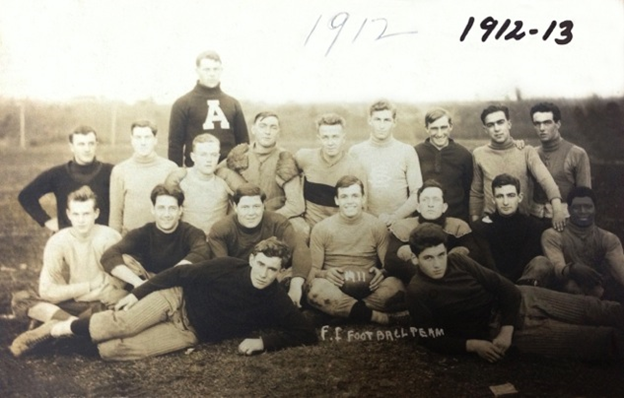
PHOTOS: Gideon Smith (right) at Ferris State in 1912 and Smith honored in 1953 at Michigan State honored with other members of the 1913 team.
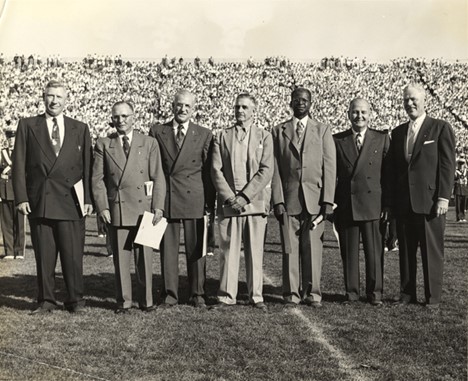
Smith was Ferris State’s first Black athlete in 1912. Upon transferring to Michigan State he was another football program’s first Black player, 1913-15. Smith played like an All-American, leading fledgling Michigan State to its first two wins over national power Michigan in the 1913 and 1915 seasons.
Smith never cashed in on NIL deals or AT&T commercials like Chambliss could do, but Smith used his education to return to Hampton as a professor, coach and administrator. In 1922, he coached Hampton to the Black national title. Smith is a member of the Ferris State, Michigan State and Hampton Halls of Fame. He’s on the ballot for the College Football Hall of Fame as a small-school coach.
How many times on ESPN’s College Game Day was Chambliss’ remarkable tale coupled with the background of Smith’s Ferris State’s story?
When Smith was posthumously inducted into Ferris State’s Hall of Fame in 2023, his grandson, John Belcher, spoke for him. Belcher, expressing pride in his grandfather, likes to point American sports history focuses on Jesse Owens, Joe Louis and Jackie Robinson for opening doors, but his grandfather and the pioneers of the 1960s faced the same bigotry as Owens, Louis and Robinson.
Chambliss was on the Ferris State campus in 2023. He should be proud to be connected to Smith’s history at two Michigan colleges and at a Virginia HBCU.
There’s more that grandparents remember about Mississippi besides Confederate symbols.
They recall Ronald Reagan’s 1980 Presidential campaign stop in Mississippi. Reagan talked about “states’ rights” – George Wallace’s mantra – in a speech delivered in Neshoba County, a location not far from the site where three Civil Rights activists registering voters were murdered, in 1964.
They remember in 2002, Mississippi Senator Trent Lott celebrated racist South Carolina Senator Strom Thurmond’s 100th birthday with tone-deaf comments. Lott said if the country had elected Thurmond in the 1948 Presidential election on the Dixiecrats ticket, “we wouldn’t have had all these problems over these years, either.”
The 1964 and 1965 Civil Rights Acts were thought to extinguish Jim Crow, but Reagan and Lott attitudes continue to pulsate through the South and return like a B-movie horror flick.
The NAACP understands this, proposing Black athletes don’t support colleges in southern states gerrymandering voting districts. But can the NAACP get Gen Z athletes understand it?
-30-
Visit my homepage: TomShanahan.Report
— Watch a three-minute video to learn about our documentary at the fundraising stage, GAME CHANGERS OF THE CENTURY, and the Investment Deck.
I invite you to follow me on Twitter @shanny4055
I’ll put my facts on the true pioneers of college football integration versus Bear Bryant fairytales against anybody, anytime, anywhere. Watch here.
Click here for my story on the 1962 Rose Bowl and Segregation and Alabama that earned first place for Enterprise from the Football Writers Association of American.

— Tom Shanahan is an award-winning sportswriter with two books on college football integration, “RAYE OF LIGHT, Jimmy Raye, Duffy Daugherty, the Integration of College Football and the 1965-66 Michigan State Spartans,” and “THE RIGHT THING TO DO, The True Pioneers of College Football Integration in the 1960s.” They are the most accurate accounts of college football integration in the 1950s and 1960s. They also debunk myths about the 1970 USC-Alabama game. The false narrative co-opted the stories of the true pioneers who stood up to Jim Crow and the KKK.
— Two children’s books also explain Michigan State College Football Hall of Fame coach Duffy Daugherty’s impact on integration through the Underground Railroad and the Hawaiian Pipeline: “DUFFY’S COLLEGE FOOTBALL UNDERGROUND RAILROAD” and “HOW DUFFY PUT HAWAII ON AMERICA’S FOOTBALL MAP.”
***
PURCHASE LINKS, non-fiction books
— RAYE OF LIGHT,
Raye of Light: Jimmy Raye, The Integration of College Football 3rd Ed – August Publications
or on Amazon.
— THE RIGHT THING TO DO, August Publications or on Amazon.
PURCHASE LINKS, children’s books
— DUFFY’S COLLEGE FOOTBALL UNDERGROUND RAILROAD: Order from Barnes and Noble here and Amazon here.
— HOW DUFFY PUT HAWAII ON AMERICA’S FOOTBALL MAP. Order here:
How Duffy Put Hawaii On America’s Football Map by Tom Shanahan, Paperback | Barnes & Noble®
Amazon.com: How Duffy Put Hawaii On America’s Football Map eBook : Shanahan, Tom: Kindle Store
Tags: Chapel Hill, Duffy Daugherty, Durham, Holiday Inn, Michigan State, North Carolina

